

These Tire Wear Patterns Could Reveal What's Wrong With Your Car
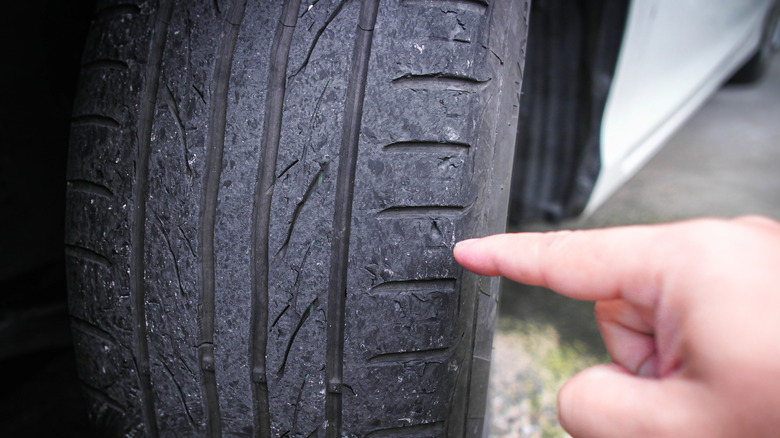
Because the tires connect the vehicle to the road, no matter how powerful, luxurious, or safe a car is, it's only as good as the tires it rides on. Therefore, tires are not just rubber — they can be a window into your car's suspension and steering health. If the car is skidding around, it can indicate worn-out tires. If the steering feels loose or the car pulls to one side, it can reveal issues with alignment, suspension, or even brake performance.
These are also telltale signs that your car tires need replacing ASAP, but even with new tires, if you don't solve the root cause, the issue will remain. This is why tire maintenance and frequent checkups are so important. If you don't catch the problems early on, they are likely to progress further, and you are not only risking the life of your tires, but potentially your own safety. With that in mind, these tire wear patterns could reveal what's wrong with your car.
Tires worn out in the middle

If you take a look at your tires and notice that they are wearing out in the center, it can signal problems with overinflation. This is because air pressure affects the contact patch. If your tires are overinflated, they will bow out in the middle, meaning that the middle of the tire wears out faster because of a smaller overall contact patch. This was also noted in a 2025 study published in Lubricants (MDPI), which stated, "Experimental observations demonstrate that the increased inflation pressure leads to a proportional decrease in contact area."
An overinflated tire can have additional consequences besides just wearing out the middle of the tire. Inflating to the PSI number on your tire is a terrible idea because it can shorten the lifespan of the tire, and also reduce overall safety, stability, as well as ride comfort. To avoid this and save your tires in time, always make sure they are inflated to the correct PSI level according to the manufacturer's recommendations. If you don't know where to find these, take a look at the car's owner's manual, the door jamb sticker, or inside the fuel filler door.
Tires worn out on the edges (shoulders)
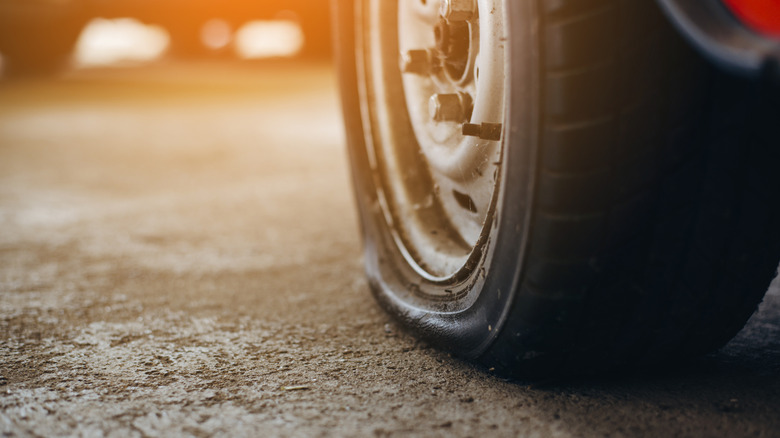
Inflating your tires too much reduces the contact patch, but inflating them too little will increase it. Although that may seem like a trick to increase traction (and it does in certain off-road instances), it can also lead to your tires wearing out on the shoulders more. Underinflated tires can also lower your fuel efficiency because the larger the patch, the higher the rolling resistance — one of the ways tire pressure affects gas mileage.
According to a report from the National Highway Traffic Safety Administration (NHTSA) titled "Tire-Related Factors in the Pre-Crash Phase" (DOT HS 811 617), "when tires are underinflated by 25% or more, they are approximately three times as likely to be cited as critical events in the pre-crash phase compared to properly inflated tires."
It's worth differentiating underinflation from other factors that can also cause or contribute to outer tire wear. These include aggressive cornering where more of the weight is placed on the outer edge. Wheel misalignment issues, or even worn-out suspension components – namely a broken sway bar link or control arm bushing problems — can also cause it.
Tires worn out in a cupped pattern
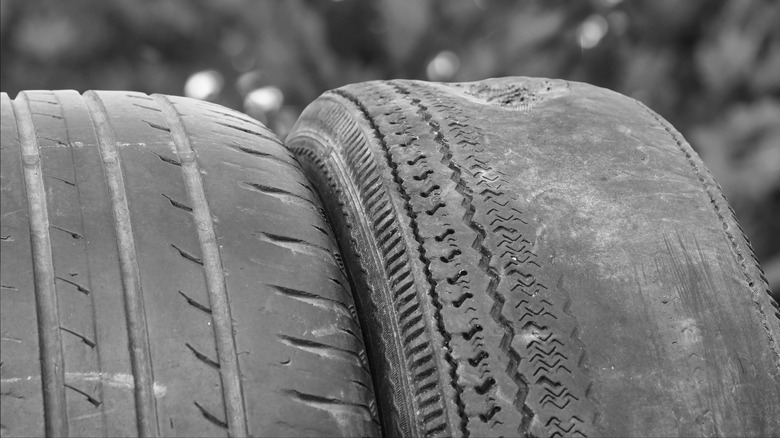
Tires worn out in a cupped or scalloped manner are warning signs that it's time to get your tires balanced. According to Bridgestone, "Tire cupping can appear as if someone took an ice cream scoop and scooped out part of the tread every three to four inches around the circumference." In other words, cupping occurs when certain sections of the tire experience more pressure, causing those areas to wear out faster.
This is typically caused by tire misalignments, worn-out suspension components, or problems with low-quality tires. Specifically, your car's shocks and struts manage how your car goes over bumps. As time goes on, these can wear out and start bouncing over undulations, which causes tire cupping.
Tire misalignments that cause cupping include incorrect toe and camber angles, as well as front-to-rear wheel misalignment, which prevents the wheels from staying parallel to each other and perpendicular to the road. Also, if your tires are of lower quality, they can be more prone to cupping. It's the same story with unbalanced tires. With that in mind, it's important to inspect the vehicle, identify the root cause, and replace the tires.
Tires worn out in a feathered pattern (toe wear)

If your tire block edges develop a sawtooth-like pattern, one where a single side of the tire block is smoother while the other is sharp, it typically means your tires are wearing out in a feathered pattern. The most common cause of feathered tire wear is an incorrect toe alignment, meaning that the two opposite tires scrub against the surface of the road unevenly.
This is what causes the smooth-on-one-side-but-sharp-on-the-other pattern. In general, improper alignment can mess up a car's toe, camber, and caster, and each of these can cause tire wear. Wheel bearing and ball joint issues, unbalanced tires, and pressure can also contribute. If you're lucky enough to notice the pattern early on, a proper alignment is likely to fix it.
If the tires are severely worn on one side, you will likely have to carry out all of the necessary suspension and alignment repairs and replace the tires. Although you can align your car's tires yourself, it is tricky and it requires tools such as jack stands, a string, a ruler, and possibly a helper to measure distances accurately. Because of this, and because proper alignments require precision, it's better to take your car to a professional.
Tires worn out on one side (camber wear)
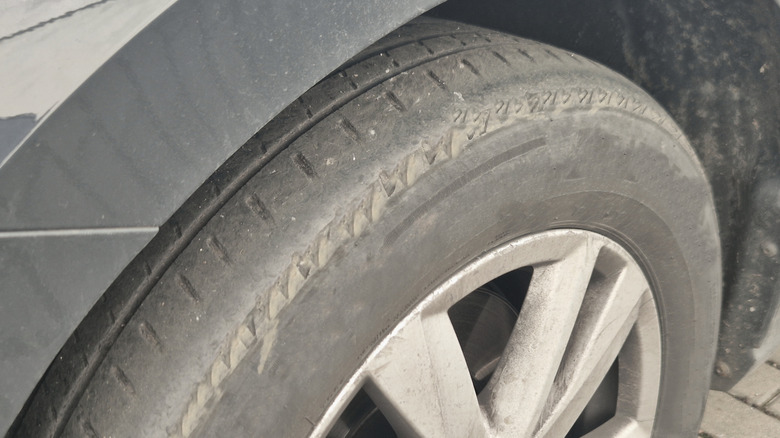
Tires wear on one side is similar to the previously mentioned feathered (toe wear) pattern, but the difference with single-side tire wear is that it is primarily caused by camber issues. To spot the difference between camber and toe wear, look at the tread: camber wear affects only one shoulder, while toe wear creates a feathered pattern across the surface of the tread blocks. These can also be caused by impacts to the wheel assembly, mods, poor installation, or by ball joint, spring, and alignment issues.
Because camber essentially means your tires meet the road at an uneven angle, it can also lead to handling and pulling problems. To fix this, you will have to narrow down the culprit, and perform an alignment. Be sure to do so right away since skipping an alignment is one of the small mistakes that can cause big damage to your wheels. Cars with independent rear suspension systems are prone to inner camber wear, meaning that negative camber can toe-out the rear tire and cause it to wear faster.