

The Harley-Davidson MX250 Was An Honest-To-Goodness Dirt Bike, And It Didn't Last Long
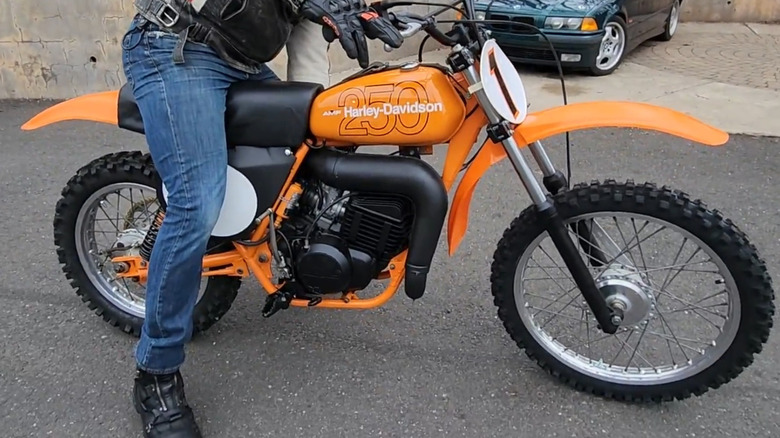
To tell the tale of the failure that was the MX250, we must descend into the recesses of Harley-Davidson's dark AMF years starting in 1969. That's when the most famous and storied American motorcycle brand was bought by a bowling ball manufacturer. To be clear, AMF, or American Machine and Foundry, did save Harley-Davidson from bankruptcy. Well, it saved Harley-Davidson in the same way a drowning person gets saved by a boat that's on fire.
The 1970s were a chaotic time for Harley, as AMF was simultaneously tossing ideas at the wall to see what stuck and cheapening the bikes with lower-quality materials and poor build quality, resulting in reliability somewhat on par with a Triumph Stag that used vegetable oil in place of motor oil. One of the ideas AMF-era Harley tried was a dirt bike.
There was actually some historical merit to the idea, as Harley-Davidson released the scrambler-style S-125 (eventually renamed the Scat) in 1947. Harley also bought 50% of Aermacchi in 1961, then 100% in 1973, and Aermacchi's Baja and Sprint were successful small-displacement motorcycles available in off-road versions. Harley-Davidson rebadged them for the American market, and started by importing the 250-cubic-centimeter version of the Sprint that Harley bafflingly, infuriatingly, briefly renamed the "Wisconsin."
There was also the XR750 flat track racer that was, after ironing out scores of bugs, nearly unstoppable (it was quite stoppable at first). But these bikes weren't true blast-through-the-wilderness motocross bikes, which were gaining popularity in the early '70s. So in 1975, AMF-era Harley-Davidson hand-built 65 prototype MX250s. For more rear suspension travel, they took front suspension forks, shortened them, and attached them to the rear hub. The MX250 was not off to an auspicious start.
If at first you don't succeed, strong-arm your dealer network
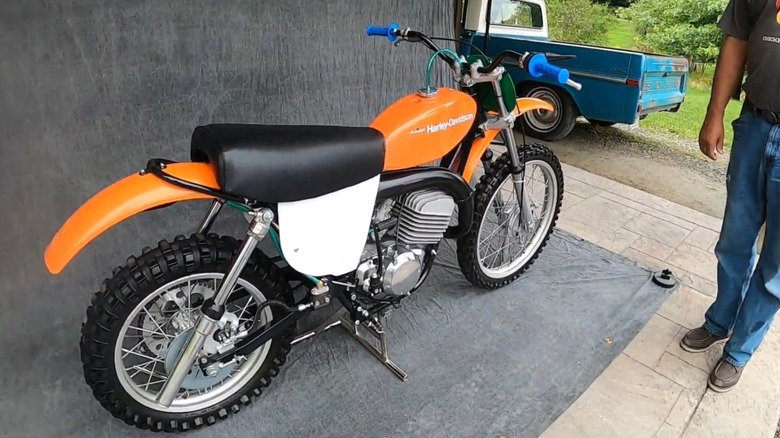
Almost none of Harley-Davidson's dealers wanted the thing. Heading back to the drawing board, Harley and Aermacchi worked in collaboration to build a proper dirt bike. It received a 242cc two-stroke single making 32.4 hp. Well, it made 32.4 horsepower in a wafer-thin rpm range. Apparently, the thing was gutless below 7,000 rpm and breathless over 9,000 rpm. Combine that with a clutch that was grabby when cold and slipped as it heated up, and you were looking at a bike that was actively antagonistic toward the rider.
As soon as the bike was as ready as Harley and Aermacchi were willing to make it, off it went to dealers. This time, Harley pretty much told the dealers that the bike was going to be for sale, and it would be in their showrooms despite their unwillingness, so deal with it. As you can imagine, this was not a popular move for dealers or customers accustomed to Harley's normal fare, the polar opposite of a dirt bike.
Harley-Davidson manufactured around 900 MX250s in 1977 for the 1978 model year, which is around 900 more than people were willing to buy. Once Harley accepted that the bike was as desirable as bread to someone with a gluten allergy, it not only ceased making the MX250, it sold Aermacchi. The buyers were brothers Claudio and Gianfranco Castiglioni, who changed Aermacchi's name to Cagiva. Then in 1981, AMF sold Harley-Davidson to Willie G. Davidson (grandson of Harley's founder) who led a group of enthusiasts and investors to regain control and restore the brand to greatness. Too bad Harley-Davidson seems to be in trouble again.
Naturally, the MX250 is a collector's item now
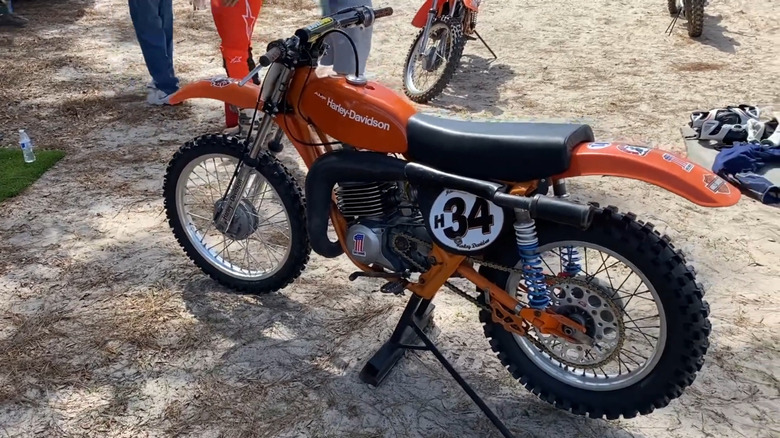
This part of the story may actually make you pity the MX250. It did race a little, both in front-fork-out-back configuration and in its final normal-rear-shock form. Harley enlisted Rocket Rex Staten, Marty Tripes, Mickey Boone, and Rich Eierstedt for its motocross team, and despite the bikes struggling to last through a competition, all the riders managed respectable finishes, especially Staten and Tripes; Staten finished fifth at the Pontiac Silverdome in 1976 and Tripes placed fourth overall at Hangtown in 1977.
Later in 1977, after increasing the displacement to 350cc to enter the American Motorcycle Association's 500cc Motocross Nationals, Harley enjoyed its only podium finish at the Unadilla race where Staten finished third, eventually ending the season in eighth place overall. It's a little bittersweet that just before Harley pulled the plug, Staten said, as recorded by Cycle News, "It's great for the team to finally give them a result like this. They've been working so hard and we've finally got a bike that's competitive."
While the MX250 failed to achieve motocross dominance, what really doomed it was its dismal market reception. It was seen as too heavy and outdated for the hardcore motocross crowd, and to Harley-Davidson's regular clientele, it was a wispy little thing that sounded like it was powered by indignant yellowjackets:
But due to its odd history and current rarity, the MX250 is now collectible. The few survivors are cherished. Brand new in 1978, an MX250 was $1,695, which is $8,426 today. J.D. Power estimates an excellent-condition MX250 is now worth nearly $20,000, and a mint condition example sold on Bring A Trailer for $23,000 in June of 2024. Still, Harley will probably make bicycles again before it tries another dirt bike.