

Marine Vs Automotive Engines: The Main Differences
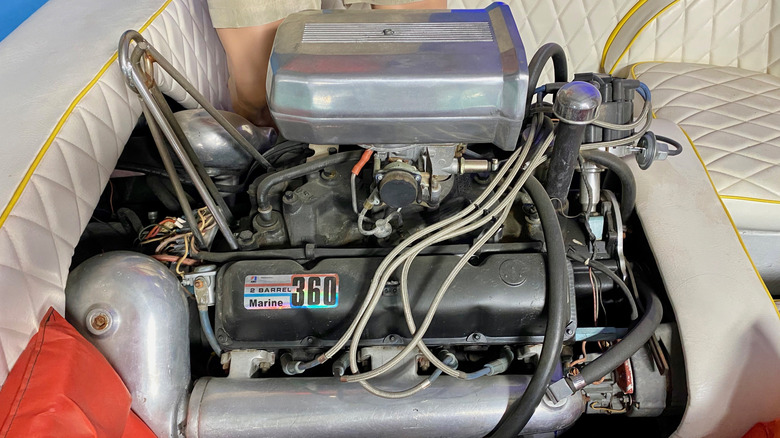
Marine engines and automotive engines are as different as Steinway pianos and comedy keyboards that operate by squeezing loud, well-tuned hamsters. They may look the same on the outside, but there's a bevy of changes under the hood. The first place you may notice those differences is in your wallet, as marine engines are usually more expensive. According to the Blueprint Engines website, a 390-hp deluxe-dressed fuel-injected GM small block 350 will set you back $7,399. But a 350-hp base-dressed carbureted marine 350 will cost you $8,299.
As you might suspect, those price differences reflect each engine's ability to handle continuous use on the high seas. A marine engine will survive life in saltwater if it's designed well and properly maintained, and run at 4,000 to 5,000 rpm for hours at wide open throttle. Meanwhile, a car engine would probably become a smoking, seized wreck if it had to endure the same punishment.
Marine engines are also designed specifically with "not spontaneously combusting" in mind, as the conditions in which they operate mean errant sparks or leaked fuel could result in, well, fire, but also actual detonation. It's terrible and dangerous when a Ferrari F430 goes up in flames, but a boat may decide to get all that damage out of the way with one solid "boom." That's why blowers and ventilation are absolutely crucial in marine engine compartments.
Oh, and marine engines sometimes run backward to keep the propeller spinning the correct way. This quirk was exploited by Rocky Phillips when creating a two-engined dragster called Evil Twin, which uses two Chevy 350s (one with a Chris Craft marine camshaft allowing it to spin counterclockwise) that mesh flywheels like a couple of clock gears.
The sea is a cruel mistress

Marine engines use heavy-duty blocks featuring beefy main bearings. Often these blocks are Schwarzenegger-ian cast iron, but sometimes aluminum (see Volvo's Penta V8) since it's lighter, better at dissipating heat, and less corrosion-prone (mostly). The problem with aluminum is that electrolysis is a major concern, which is why items like cooling heat exchangers are made of metals such as titanium and cupronickel. To fight corrosion, marine engines often have special coatings to prevent saltwater from reaching sensitive metals.
Saltwater is just plain destructive, and the only way to fight it is by putting up fences to keep it out. Gaskets in particular must be made of corrosion-resistant composites and/or metals to keep water from finding its way into the engine's interior. Even the freeze plugs need special attention. Normally, blocks get steel, brass, or aluminum freeze plugs to stop up the holes left over from the casting process. In boat engines, these are usually bronze, which is better at saying "nope" to rust. And, even with sealers, coatings, and hardy materials, galvanic isolators and sacrificial anodes may be necessary to completely ward off electrolysis.
What's worse, without ventilation, boat engine compartments can fill with fumes that, once reaching their magic stoichiometric ratio, make for an excellent bomb. To prevent a salvo, the starter, distributor, and alternator need screens to suppress internal sparks. Plus, boat carburetors feature J-shaped vent tubes that feed fuel back to the carb. If these tubes were straight as in automotive carburetors, the fuel could just run down the side and pool in the engine compartment (and, you know, "kaboom"). Unfortunately, fuel injection doesn't necessarily solve this issue, as injector leaks can also cause a fire/blowing-up risk.
Tuned to perfection for protection
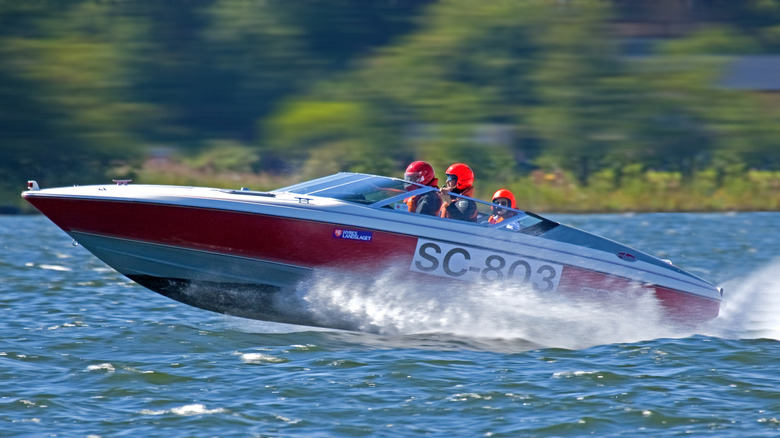
Cam timing in marine engines must accomplish two disparate, yet essential tasks. The first is to generate a torque curve flatter than Wile E. Coyote after falling off a cliff. High peak horsepower isn't the goal (though the most powerful piston engine around is a boat engine), as marine engines must push 6,000-plus pounds of boat through water rather than around 4,000 pounds of car through air. The second job of the camshaft is to help keep water out of the combustion chambers. By reducing valve overlap, or the amount of time that all valves in the chamber are open at once, there's less chance of sucking water in through the exhaust.
Let's not forget cooling! Boats either use closed-loop cooling with heat exchangers (good idea) or "raw water" systems (bad idea). In fresh water, sucking the wet stuff through the engine's water jackets isn't a terrible notion, though it is terrible notion-adjacent. Yes, these systems have a strainer, but that's just one more item to get clogged. Pulling saltwater through engine blocks, though, is a fantastically awful solution. Yanmar tried building corrosion-resistant blocks with porcelain-impregnated cast iron and integral zinc anodes for raw water engines, but that's like making umbrellas out of construction paper instead of tissue paper. It just delays the inevitable.
So, what about those backward-running marine engines? In twin-engine boats, one of the engines runs counterclockwise. That way, the two propellers don't cause prop walk by spinning the same direction. Reverse-operating engines may require specific crankshafts with opposite-drilled oil holes, but absolutely positively need unique camshaft grinds to facilitate mirrored firing orders. To make things more complicated, the distributor and oil pump need to run clockwise, so about-face-engines have to have special gearsets to drive them. Nothing can be simple.