

The Semi Truck Brands Owned By Traton (And How It Acquired Them)
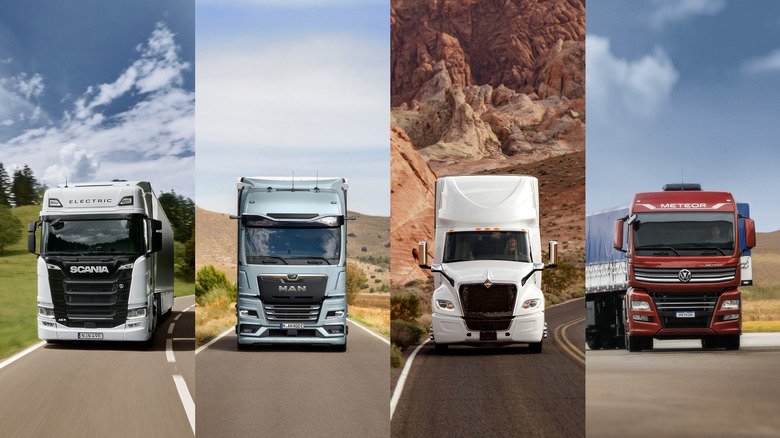
The easy part in discussing the Traton Group's (Traton AG) history is that it currently owns four brands selling semi trucks: Scania, Man, International (formerly Navistar), and Volkswagen Truck & Bus. But the full story of how Traton came to control that foursome is a bit more complicated. The starting point can be found in that final name, though. Basically, the Volkswagen Group owns Traton SE, with the SE meaning "Societas Europaea" and reflecting the company's legal status in the EU. Traton SE, in turn, owns the Traton Group, which covers the four mentioned trucking brands. In other words, those brands are among the long list of car companies that Volkswagen owns right now.
The Traton Group itself traces its roots back to 1995, when the Volkswagen Group launched its Commercial Vehicles brand in a bid to grow its presence in that segment of the industry. The new organization was itself designed to be like a holding company, with control over various other VW subsidiaries. VW Commercial Vehicles became VW Truck & Bus GmBH in 2015, then Traton in 2018, and Traton SE was listed on the Frankfurt stock exchange in 2019. The name isn't German, though. Traton describes its name as being a combination of values such as "transformation," "transportation," "tonnage," "tradition," and being always "on."
VW Truck & Bus
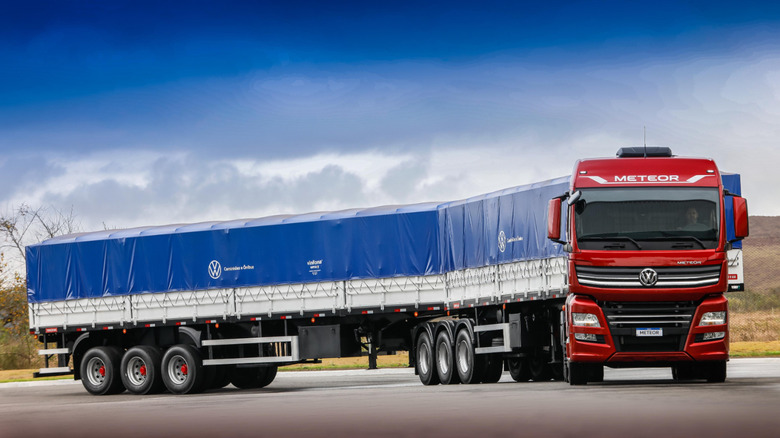
Considering the owners, it shouldn't be surprising to hear that the first brand to join the Traton Group was Volkswagen Truck & Bus — originally known as Volkswagen Caminhões e Ônibus (VWCO). The VW Group bought Chrysler's Brazilian operation in 1981, renamed it VWCO, and helped it to become one of the biggest players in South American trucking. Traton even notes that the subsidiary became "the largest manufacturer of school buses in the southern hemisphere."
On the topic of size, VWCO is responsible for what's currently considered the largest VW vehicle in the world, the Meteor semi truck (which has no relation to the Rolls-Royce Meteor engine). The truck was launched in 2020 with two models: the Meteor 28.460, capable of pulling up to 53 metric tons with a 6x2 drive train, and the Meteor 29.520, with a 6x4 setup rated to tow up to 74 metric tons. Both offer a pair of diesel engines making up to 520 horsepower and around 1,840 pound-feet of torque, with those mills being borrowed from MAN (another member of the Traton Group). In fact, the Meteor trucks are heavily based on MAN's TGX truck family, and they're even built alongside them on the same assembly line.
The Meteor family is itself growing, too. A hybrid version of the truck premiered in 2024, showcasing an innovative axle setup. A diesel engine powers one of the rear axles, and the other can be driven by the hybrid battery as needed.
Scania
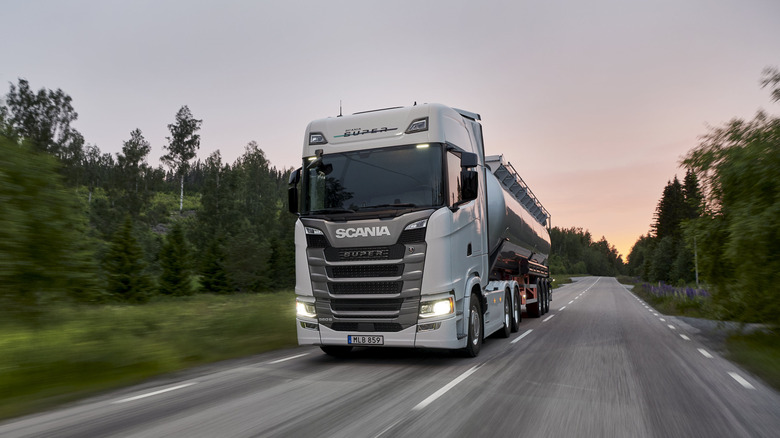
While Traton acquired VWCO essentially through internal corporate reshuffling, Scania had a long previous life as both an independent brand and as a partner with another big name in transportation. Indeed, Scania was born from a partnership between two trucking companies that were founded near the turn of the 20th century. Those two companies — Maskinfabriksaktiebolaget Scania and Vagnfabriks-Aktiebolaget i Södertelge — eventually came together to form Scania-Vabis in 1921.
The company certainly found its share of success, especially after World War II. That was when it finally adopted modern assembly-line-style mass production, allowing it to later launch its first turbo diesels. Yet soon after that, in 1969, it merged with Saab (the automaker behind hot rides like this bargain 2000 9-3 Viggen) to create a partnership that lasted up until 1995. Scania had another five years of independence before Volkswagen took its first ownership stake in the company in 2000. By 2008, after further investment, VW took majority control of Scania and brought it within the Volkswagen Group to Traton. The takeover was completed in 2014 after VW purchased yet more shares. At this stage, Scania is wholly owned by the VW Group.
This wasn't the first time that Volkswagen helped Scania to keep its business rolling forward. Way back in 1948, the former relied on the latter to import vehicles into Sweden, and it was profit from selling VW sedans that helped fund Scania's truck growth in the 1960s.
MAN
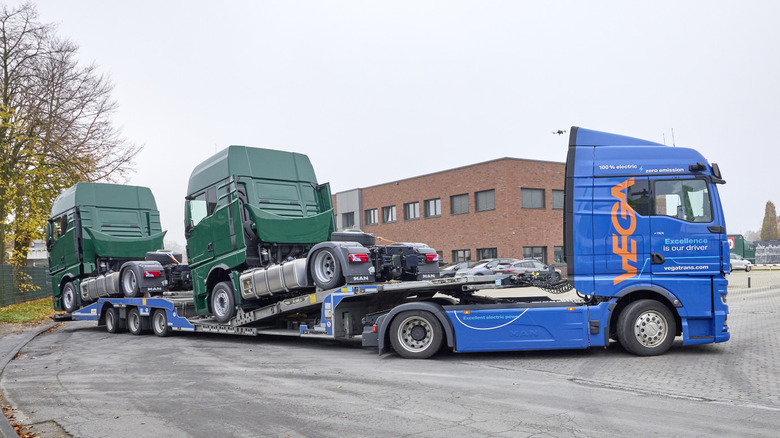
Despite the name, MAN was not born with any relation to gender. Like Scania, it was originally created out of a merger between two separate companies founded previously. The result was the creation of Maschinenfabrik Augsburg-Nürnberg AG in 1898. That brand name would be shortened to M.A.N. for badging on the company's early vehicles.
MAN, as it became known, made a habit of finding new partners to achieve new growth. Its very first trucks didn't come along until after partnering with Adolph Saurer, a Swiss engineer with his own truck brand that remained in operation until the 1980s. Teaming up with the likes of Bosch led to the introduction of MAN's first electric buses in 1970, setting the stage for today's electric school buses that could lower your electricity bill. Through yet another partnership, MAN also stands out as the tip of the spear for Traton Group trucks in China. It has a 25% stake (plus one share) in Sinotruk, whose parent company – China National Heavy Duty Truck Group Co., Ltd. — was China's first-ever homegrown producer of heavy-duty trucks.
The connection with VW dates to 2006, when Volkswagen took a small "strategic" stake of about 15% in MAN. Over the next few years, the two would get closer and closer, and that included seeing MAN purchase Volkswagen Caminhões e Ônibus from Volkswagen in 2008. Ironically, that Brazilian-based business would return to VW in 2013 as part of its acquisition of MAN.
International
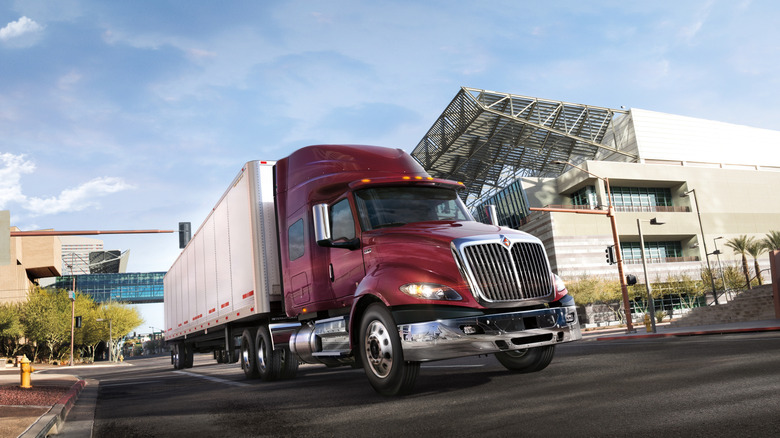
Sure, International Harvester has been out of business since the 1980s, but it lives on with the Volkswagen Group. Thanks to VW's purchase of Navistar, which began in 2016 and was completed in 2021, Traton now owns the successor to IH's commercial and retail vehicle brands.
The truck side of the business, rebranded as Navistar when IH split up, has now reverted to the International name as a Traton Group brand. The result is that the Traton Group has gone a long way toward fulfilling Volkswagen's goal of establishing a global footprint for its commercial vehicles. (On a separate note, International Harvester also had an extensive farm-equipment operation which was merged with Case to become Case IH in 1984.)
International Harvester's more retail-focused rides are being revived under the Volkswagen Group's Scout Motors brand, which came as part of the Navistar purchase. The upcoming Scout Terra pickup and Traveler SUV were revealed as retro EVs late in 2024, although the EV transition isn't happening on schedule, and even those models come with optional gas-powered range extenders. Either way, the Terra and Traveler aren't expected to go into production until 2027, so VW has time to get things right — unlike with the electric ID.Buzz that never lived up to its potential.