

5 Car Window Designs That Dared To Be Different
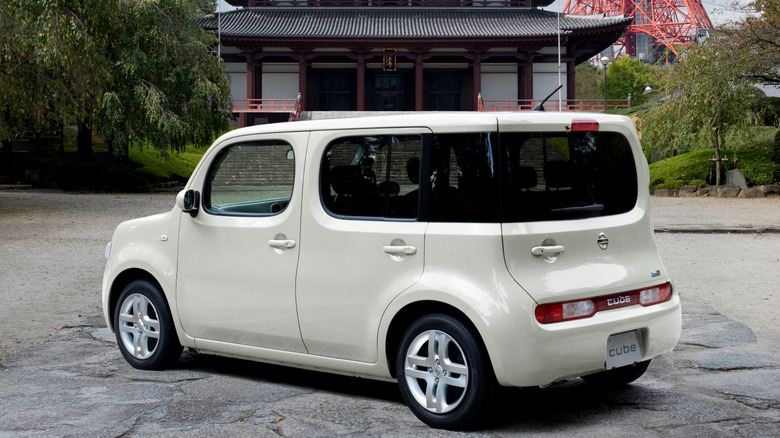
We can appreciate when automakers dare to do something a little different. They might try out an experimental power plant like those in the jet engine cars of the past, or they could explore interesting interior materials like the funky BMW i3 did. Some even toy with unique window designs. At the moment, the mass majority of cars on the road really do look like one another. Everyone seems set on blending in with the crowd, and that's led to a sea of white, silver, gray, and black cookie-cutter SUVs and crossovers flooding our roads. Sure, some might have fancy headlights or a slightly different HUD, but in reality, they look remarkably similar to each other — if not practically identical.
Wind the clock back a few years, though, and automakers didn't mind throwing an oddity into the mix every now and again. While we could explore silhouettes, wheel designs, or crazy cabins, we think it's worth revisiting cars which gave us daring window designs instead. It's not something we focus on all that often, and that's what makes these cars worth highlighting. Here are five of the wildest windows we've ever seen on production cars from around the globe.
Subaru SVX (1991-1996)
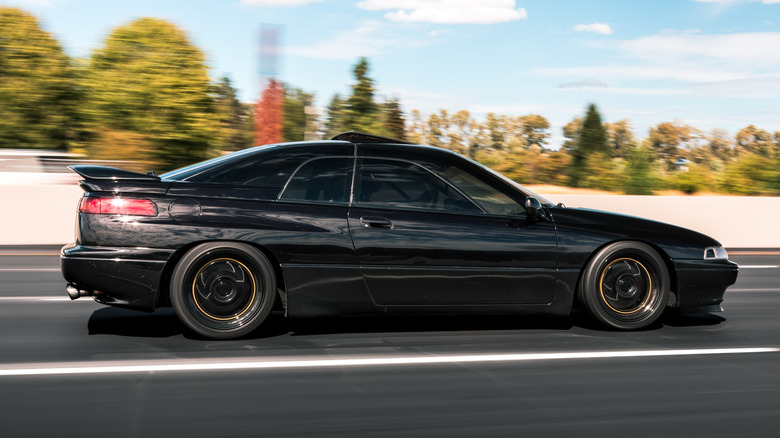
No conversation highlighting cars with wacky window designs is complete without covering the Subaru SVX. When we think of the star-studded Subaru badge, it's not hard to think of Colin McRae hurtling an old Impreza down dirt tracks at almost impossible speeds. While that's always fun to recall, the SVX is another Subaru from the era that truly does deserve more time in the spotlight. It was an all-wheel drive two-door coupe with a flat-six engine. And, as if that wasn't interesting enough, Subaru gave it windows within windows.
The design choice seems almost inexplicable, but there were a few reasons for it. Firstly, the car was aviation inspired, and this window design echoes that inspiration. Secondly, it was actually practical; the windows reduced wind noise, and allowed you to open the window without letting rain in the car. Unfortunately, they just looked too odd, which likely contributed to the SVX's poor sales numbers. We were never graced with a renewed SVX model, but even if one did return today, the chances of it sporting this defining feature would be quite slim considering how safe automakers play things in the modern day. Fortunately, for wacky window lovers, the SVX is still underappreciated enough to not command crazy money, which makes it a great alternative to typical big-money performance cars that steal all the headlines.
Citroen Ami 6 (1961-1969)
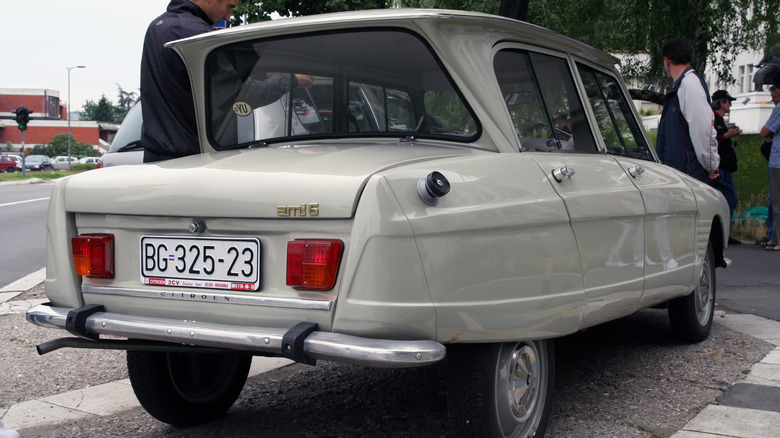
No list of oddities is complete without a curious French classic, and the Citroen Ami 6 is perhaps one of the most curious classics out there — even if it's not one of your favorite French cars ever made. Specifically, it's the sedan that we're focusing on today, rather than the wagon variant. The latter actually outsold the sedan by a factor of three to one. The reason for the sedan's sales failings was simple, too, as it was considered to be really darn ugly.
There's no escaping the bizarre looks of the old Ami 6, but the rear window definitely stands out the most. Sure, it's just a rectangle, it doesn't flap open or swing to the side, and it doesn't have another window within it like the aforementioned Subaru. But thanks to its extremely odd angle, the word "rakish" has never been a more fitting adjective for its appearance.
While it was unpopular upon its arrival in the 1960s – and, admittedly, its striking looks will no doubt still divide opinions today — the Ami 6 is largely recognized as a bright and playful design by admirers today. It also makes for a charming and simplistic weekend classic perfect for navigating tree-lined country roads on sunny Sunday outings. Another '60s classic with a similarly rakish rear window would be the ever-popular Ford Anglia, but it's hard to argue in favor of the Ford when deciding which design is more daring.
Nissan Cube (2009-2014)
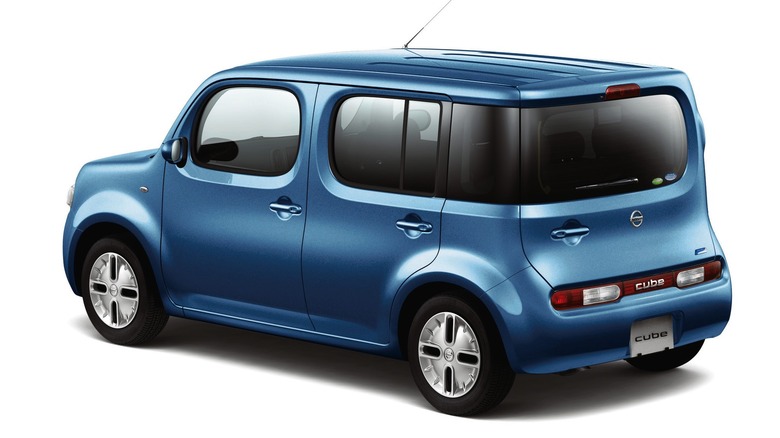
Every car on this list pushed the boundaries of window design and dared to be different, but arguably no automaker went quite so far to disrupt convention as Nissan did when penning the Cube. For some reason, the Japanese automaker decided that cars didn't even need symmetry, instead adorning the cutesy Cube with an asymmetrical window design. The wraparound rear-side window was not only a signature design element, but Nissan also claimed it was practical, too, stating that it "creates enhanced rear diagonal visibility for lane changes and reverse parking." It's hard to say whether this was the intended benefit from the start or more of a happy accident.
Nissan's Cube was always going to challenge traditional car design. It tried to create a cozy, comfortable, lounge-esque vibe inside, which some might argue the asymmetrical window helps to achieve. After five years, the Cube was discontinued from the American market, but fans can easily pick one up for a little over $5,000 today. On top of offering an interesting design choice, it's also practical and cheap, so it's easy to see why stylish and creative types would lean towards Nissan's playful Cube when perusing the classifieds for an inspired daily driver.
First-generation Plymouth Barracuda (1964-1966)
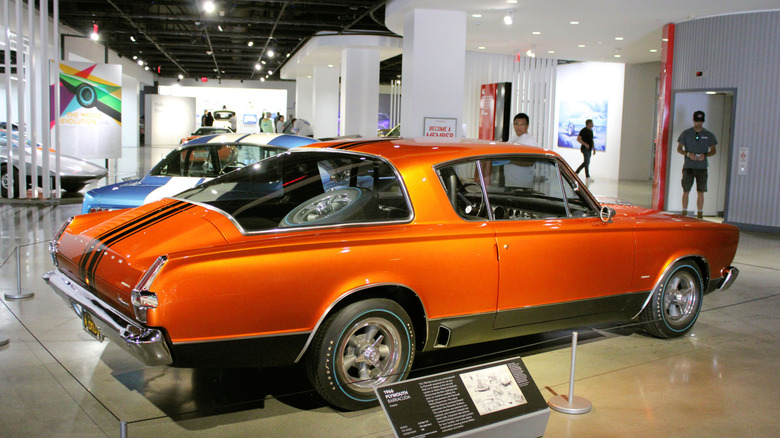
Getting a chip or crack in your window is always frustrating, and it can be costly to repair. But for owners of the first-generation Plymouth Barracuda, a chip or crack in the rear window might just be enough to ruin the entire year. It's the talking point of the car, and at its time of production, it was the largest rear window ever fitted to a production model.
The car itself is nothing too exciting; it's just another muscular coupe from the 1960s. It wasn't one of the all-time greats, but its humongous greenhouse of a rear window has been a reason to remember it for decades. While it makes for a great example, the Barracuda wasn't the only car of the era to sport such a design. Other classic American coupes sported similar curved rear windows, including the C2 Corvette, although Plymouth took things to the next level and sized it up massively. It makes this otherwise-forgettable car into a real classic, and we'll bet that the rearward vision from the driver's seat had some pretty great practical benefits, too.
Peel Trident (1964-1966)
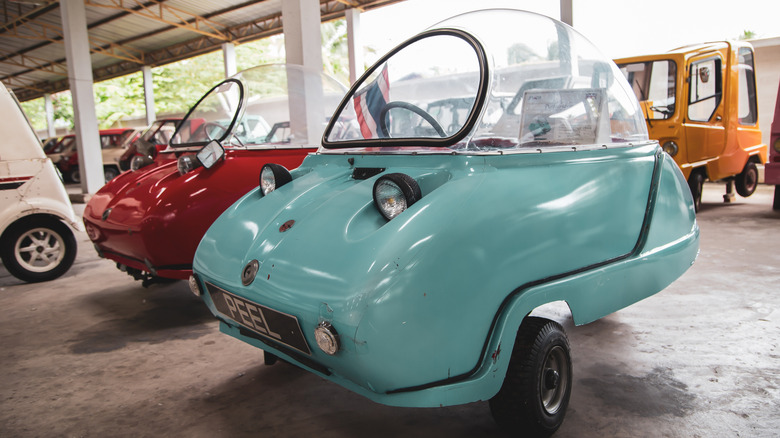
It's not a brand most folks are likely to be familiar with, but if you like a compact that lives up to its name and weird window designs are your thing, then the Peel Trident should be on your radar. It's a microcar from the 1960s produced on the Isle of Man in small numbers, and its motivation is provided by a 50cc engine.
Some would argue its signature feature was its diminutive size, but that was a feature of all microcars of the era. Vehicles such as the BMW Isetta, the Peel P50, and the amusingly-named Goggomobil all shared similar dimensions, but none sported a window quite so outrageous as that of the Trident. In fact, it's more of a complete glass canopy than it is a window, which perhaps didn't make it ideal for those living in hotter climates. This canopy was rounded and would open to the side for egress and ingress. You're unlikely to find any replacements lingering around in your local auto shop, so avoiding chips and cracks is of the utmost importance when at the helm of the Trident.