

Automotive Vs. Motorcycle Oil: The Differences Explained
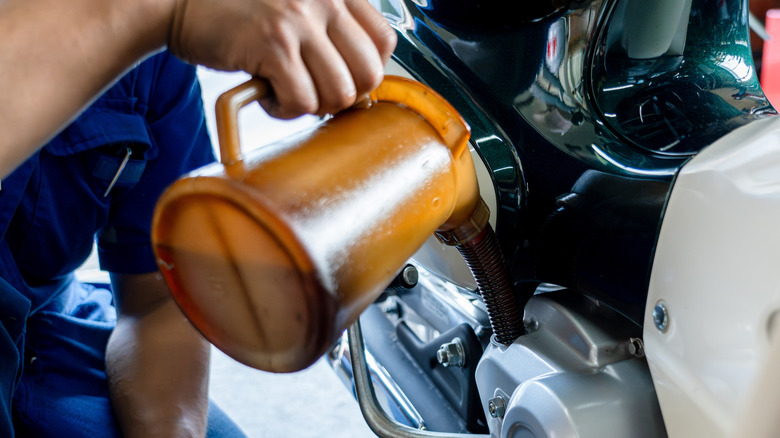
Before you even think about pouring automotive oil into your motorcycle's engine, you need to get your facts straight. Not all oils are the same, and automotive engine oils have advanced to such an extent that some engines require manufacturer-specific oils to run properly without voiding warranties. It wasn't too long ago that motorcycle engines were compatible with engine oils for cars, but oils had to evolve to comply with burgeoning emissions standards.
That meant auto engine oils began incorporating friction modifiers to better protect against cold starts while improving fuel economy. In case you're wondering, friction modifiers are anti-wear additives that help reduce friction and metal-to-metal contact. They have chemical compounds that attach themselves to metal surfaces like the fibers of a carpet, cushioning the metal underneath from light friction.
Friction modifiers are especially beneficial during cold starts, when almost all the oil has drained to the sump, as they add a thin barrier of protection to cams, bearings, and pistons. However, the very same friction modifiers and other additives in automotive oils are incompatible with motorcycle engines and, in some cases, can cause drivetrain and clutch issues, which are systems that rely on a degree of friction to work effectively.
Motorcycle engines can rev higher

We admit that you probably won't blow your motorcycle engine to bits if you use the wrong oil. But doing it habitually may cause premature wear and tear and have the same consequences as using the wrong type of oil in your car.
For starters, many sports bikes can rev to 10,000 rpm, while some performance bikes have screaming engines that rev up to 20,000 rpm. Compare that to your gas or diesel truck, and the numbers don't even come close — most car engines have redlines at 6,000 to 7,000 rpm.
The point is that higher revolutions place enormous strain on the engine and its internal components. Motorcycle engines are subjected to extreme heat, higher loads, and spinning and shearing, which can all degrade lesser engine oils. The extreme spinning and shearing could also cause incompatible oils to foam up, further hindering lubrication and adding more wear. And when the oil degrades or begins to foam, that's when things go wrong — this could make your bike's engine go kaput.
Heat can overwhelm incompatible oils

Not only do motorcycle engines rev higher and work harder, but they also produce more heat in the process. A typical car engine can reach 235°F, and that's with water cooling, fans, and radiators.
On the other hand, a Harley Milwaukee-Eight 107 engine can see rear-cylinder temperatures exceeding 420°F, all while vibrating rhythmically and burping premium gas (for newer models, anyway). The point is, motorcycle engines run hotter than car engines, so why use oils designed for cars? You could argue that the best synthetic auto oils can cope with intense heat, too, but not to the point of 400 degrees and upwards.
At that temperature, lesser oils can easily lose viscosity, and extreme heat can oxidize or degrade them faster, which means you'll need to change them more often to get a consistent level of protection. Motorcycle oils are formulated to withstand higher temperatures than automotive oils. That alone should prevent you from trying your luck with incompatible oils.
High revs and heat mean more power

Motorcycle engines can rev higher and produce more heat because they typically have higher power densities and, in many cases, higher compression ratios than car engines. In other words, sportsbike engines are capable of producing more horsepower per liter than some of the most potent four-cylinder engines available today.
As a result, the engine undergoes more stress, which places a greater load on internal components. These conditions also tax the oil itself, which is where dedicated motorcycle engine oils enter the picture. Available in conventional, synthetic-blend, and full synthetic formulas, motorcycle oils are designed to withstand higher temperatures while maintaining protection of metal parts.
Add to that the fact that motorcycle engines have smaller sumps, meaning there's less oil to circulate. If you use automotive oil instead of motorcycle oil, the extreme heat cycling and low quantity will eventually render the oil ineffective, leaving engine components under-protected.
Some motorcycle oils need to lubricate the transmission, too
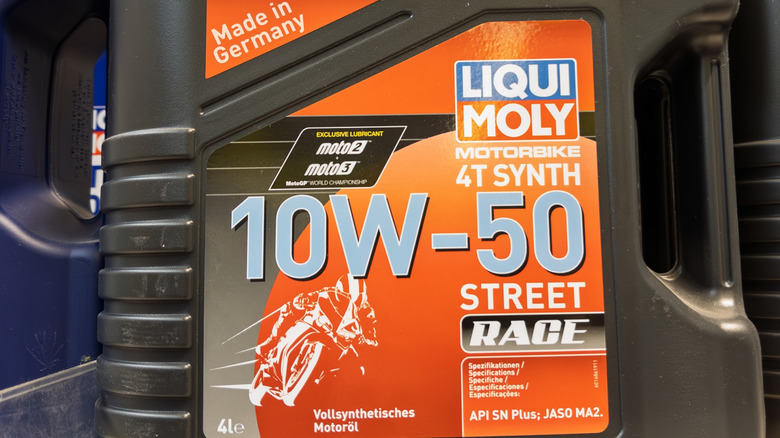
There are motorcycle engines that use different fluids for the engine, driveline, and transmission. However, some bikes have a shared sump for the engine and transmission, and this can be a problem when you use automotive oil in a motorcycle engine.
The friction modifiers in car engine oils won't survive the extreme crushing, shearing, and shredding of the transmission gears, which also means they'll wear out long before the real action begins. Moreover, motorcycle oils need to be compatible with clutches that produce dust, while still providing enough lubrication to reduce wear. To be up to the task, motorcycle oils contain higher levels of chemical dispersants that trap dirt and keep the oil clean.
This is why motorcycle oils need to meet the Japanese Automotive Standards Organization (JASO) quality requirements. JASO standards apply to two-stroke and four-stroke motorcycles, with oils that carry an MA, MA1, or MA2 label on the container. As to what JASO-rated oil is right for your motorcycle, refer to the owner's manual. As a general rule, synthetic oils offer the highest level of protection but also come at a higher cost, and it's always best to stick to the recommended viscosity grade unless you're running a modified engine.