

Small Block Chevy 383 Vs. Big Block Mopar 383: How The V8 Engines Compare
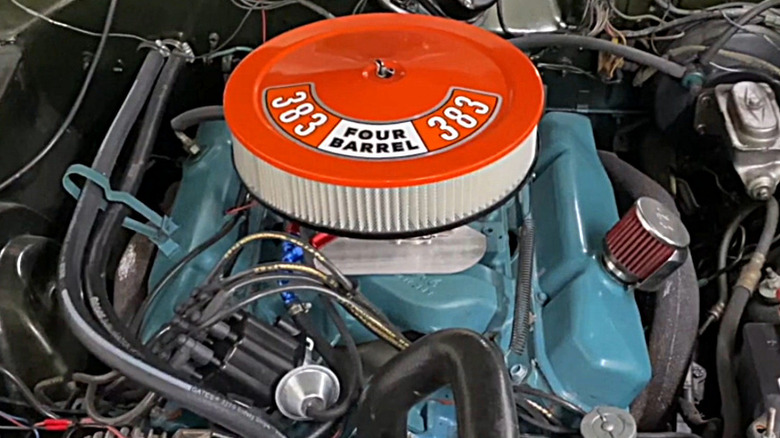
Not to sound like a parody of Jerry Seinfeld here, but what's the deal with all these identical-displacement V8s from different manufacturers? We've talked about the Ford 427 vs. the Chevy 427 before, so let's address another shared displacement: the 383. Chrysler spawned its own 383s, but the Chevrolet 383 is purely a product of the aftermarket (though Chevy makes them now, too). When Joe Sherman (RIP) crammed shaved-journal 400 cranks into overbored 350 blocks in the late '70s, he created a legend and forever made it more complicated to Google the 383 V8.
While the small-block Chevy 383 stroker has long been a muscle car favorite, the B-series big-block Mopar 383 has only become well-regarded relatively recently. For most of its existence, it lived in the shadow of the massive RB-series 440 Magnum and Six Pack/Six Barrel V8s, muttering like Rodney Dangerfield, "I get no respect, no respect at all."
Interestingly, there was a short-lived RB-series 383 with a small 4.03125-inch bore offered in 1959 and 1960. It was meant to satisfy demand for the 383 B-series, which people actually wanted at that point — at least before all those 440 Six Packs and 426 Hemis rolled around. We're ignoring that one today to focus on the B-series, which is the engine most people mean when they talk about the Chrysler 383.
Hot Rod wrote about the 383 in 1967, noting that "no one (including Chrysler) seems to have taken the trouble to make a study of just what can be done to this engine in the way of bolt-on equipment." So, the Hot Rod crew took it upon itself to figure it out. Horsepower ballooned from 278 to 415 with new headers, cams, and carbs, finally reaching 437 horsepower after installing 440 heads and solid lifters.
Chrysler 383: Magnum force
Chrysler's B-series big-block started small at just 350 and 361 cubic inches in 1958. Those are dang tiny displacements for an engine with bore centers 4.8 inches apart and weighing 620 pounds. By comparison, Chevy small-block V8s have a bore center spacing of 4.4 inches and weigh around 535 pounds (with the iron block and heads).
In 1959, Chrysler bored out the B-series block to create the 383. That same year, Chrysler also raised the deck by 0.75 inches and extended the stroke from 3.375 inches to 3.75 for top-of-the-line 413s that eventually became 440s. These are the RB-series engines, with RB standing for "raised block." (Very creative. So, the B in B-series just stands for "block?")
In 1959, 383s made up to 350 hp with two four-barrels in DeSoto Adventurers. But, when they were stuffed into the relatively teensy A-body Dodge Dart and Plymouth Barracuda in 1967, concessions were made. A 525-cfm Carter four-barrel (575 in the '67 325-hp Dodge Charger 383) and smaller exhaust valves joined a mild cam, resulting in just 280 hp and 400 pound-feet. The cramped exhaust manifold was more restrictive, too, since a 383 in an A-body is like an elephant in a gym bag.
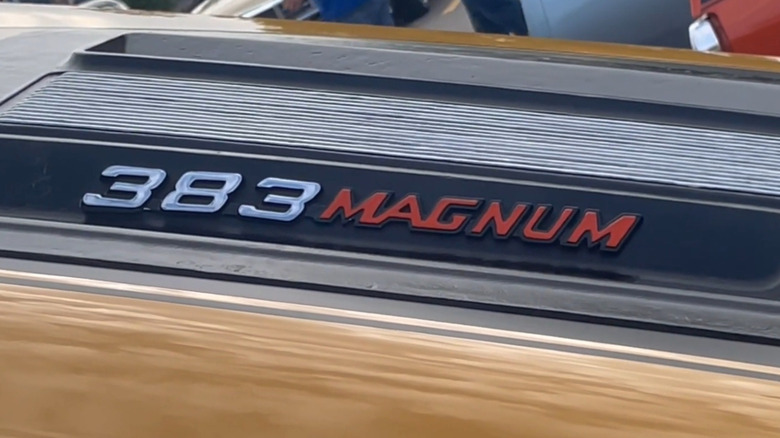
In 1968, Chrysler designed a baby version of the 375-hp 440 Magnum/Super Commando by pilfering its parts, including the heads and cam. The resulting 383 Magnum/Super Commando made 335 hp and 425 pound-feet of torque. Sadly, the 383 couldn't escape tightening emissions regulations. In 1971, its last year, 383s only made 275-300 gross hp. Depressingly, this translates to 190-250 net hp. For 1972, it was bored out to 400 cubic inches and limped along until 1978, when it was given a pink slip and escorted from the building.
Chevrolet 383: A torquing good time
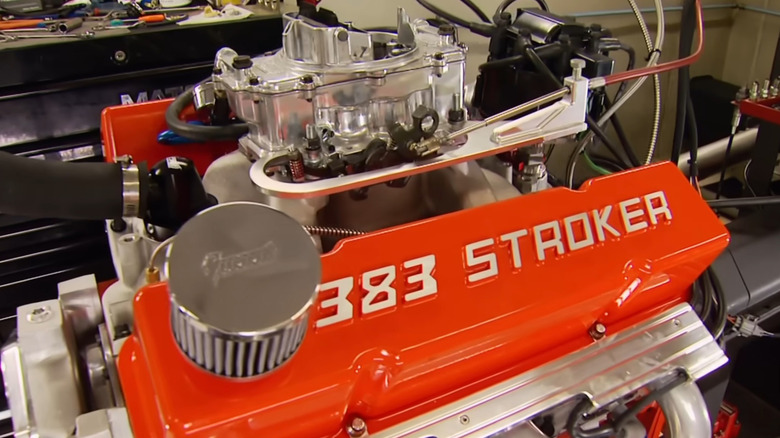
If you wanted performance in the late 1970s, you had a few options: buy an expensive and temperamental exotic (assuming you could legally import it), buy a really expensive tuner car (with fun, goofy names like "Macho Trans Am"), or build something yourself. Joe Sherman chose the last option. At the time, the Chevy 400 small-blocks were utterly unloved thanks to cooling issues, crack-prone heads, and their inability to swap key parts with other Chevy small-blocks. But 400 cranks have a lengthy 3.75-inch stroke, giving them more leverage than the 3.48-inch basic 350 stroke. So, after shaving the journals to fit a 350 block and boring said block 0.030 inches, Joe's 383 was born. It's no wonder Joe Sherman went on to work for Edelbrock.
At first, Chevy 383s used the 400's 5.565-inch rods and the 350's pistons. However, those relatively short rods put extra sideways pressure on the cylinder walls. Even though high revs weren't (and aren't) really the point of a 383, being restricted to about 6,000 rpm and constantly battering the block like that won't cut it in the long term. By switching to the 350's 5.7-inch rods and custom, shorter pistons, the side-to-side pressure was effectively relieved. The result is addictive big-block-style power.
After over 40 years since its inception, the Chevy 383 has proven spectacularly successful because of its phenomenal parts availability and fantastic torque. And now, Chrysler's 383 is getting its own renaissance, no longer being perceived as the "also ran," but instead winning over enthusiasts with its free-revving nature and willing response to modification. Collectors are scooping up comparatively low-cost 383 B-series Chargers, 'Cudas, and Challengers — because 413/426 Max Wedges and 426 Hemis aren't as cheap.