

These Are Ford's 5 Biggest Sales Flops
Ford is one of the very few automotive brands that have been fortunate enough to find success pretty much throughout the entire existence of the automobile. In fact, many people even think that Ford invented the car itself. Ford didn't actually invent the car, but it did manage to popularize it in a way no one had before with the Model T — more than 15 million Ford Model Ts were made, cementing the Blue Oval brand into the history books as a clear pioneer of the automobile.
Given stats like that, it's clear to see that the automaker knows a thing or two about shifting metal, but with a history that dates back over a century, it's obvious that not every effort of Ford's will have been a home run. Rather than celebrating the big successes, this article takes a look into the less-frequented chapters of Ford's history books, and highlights some of the models Ford would likely wish we'd all forget. These are still Fords, at the end of the day, so they are unlikely to rank among the worst-selling production cars of all time, but they certainly sit as ugly outliers in Ford's otherwise glowing back-catalog.
It's important to note, however, that low sales figures don't necessarily equate to a car being a sales flop — if that were the case, this would be a list of Ford GT and limited-run Mustang models. Rather, we've qualified sales flops as cars which were supposed to reel in huge sales numbers but instead failed to captivate large audiences and were scrapped after rather short and un-Ford-like production runs — whether due to awkward styling, poor safety records, or a poorly-timed launch.
Edsel
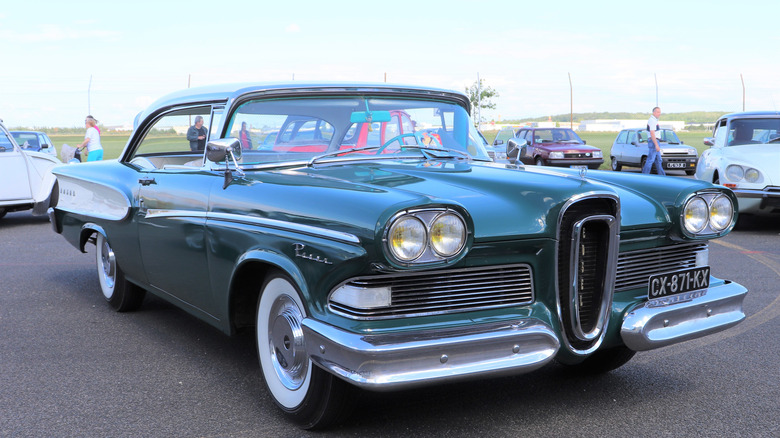
It's a real shame to have to include the Edsel models on this list. They are beautiful and treasured classics, some of which command serious money in today's world. However, there is no escaping it — the Edsel brand was a complete flop for Ford.
Ford introduced Edsel for customers who wanted an option between mainstream cars and Lincoln's luxury models, with the first models debuting for the 1958 model year. They were available in a variety of different body styles, such as sedan, coupe, convertible, and station wagon – fully dressed up with wood paneling, as per trends of the time. We might miss the woody wagons of old now, but clearly, the demand for such a vehicle from Ford at the time was pretty low, as Edsel models didn't provide the success that Blue Oval bosses would have wanted.
It's estimated that Ford was selling around one third of what they should have been with the Edsel brand, and sales dropped a staggering 29% for the 1959 model year. There were valid reasons for the disappointing performance, such as the difficult-to-love styling, and poor build quality. Plus, an economic recession was looming. As such, higher-priced nameplates like Edsel struggled to be justified by many. Names like DeSoto, Packard, and Studebaker also fell by the wayside as a result.
By 1960, the writing was already on the wall for the Edsel, and so the sub-brand was cancelled altogether. It survived as a brand for just three short years, cementing it into the Ford history books in a rather unfortunate fashion.
Aspire
Even the wisest of marketing moves couldn't actually convince the buying public that there was anything vaguely aspirational about the Ford Aspire. It was introduced for the 1994 model year, and set about replacing the equally lackluster Festiva, which — credit given where it's due — did a solid job of providing cheap motoring for budget-minded buyers for some years.
The Aspire did not quite achieve the same levels of success. While actual sales figures are tough to come by, the Aspire lasted only until the 1997 model year, when it was axed for good. Under its hood sat a small and frugal 1.3-liter inline-four, which managed to return 63 hp and 74 lb-ft of torque through a five-speed manual, or optional three-speed automatic. There was little going for it, and it wasn't all that much cheaper than the more capable Escort, especially once options like air-conditioning and the automatic transmission had been selected.
It was an admirable effort from Ford to provide a cheap and cheerful option for the masses with the Aspire, but ultimately it wasn't very cheerful, and it certainly wasn't cheap enough either for people to overlook its innate dullness. Not many survive to this day, but if you can find one, it should be about as inexpensive as motoring gets. Kelley Blue Book pegs an Aspire's current resale price at $1,521, which is actually less than the dealer and destination charges on most new Ford models.
Five Hundred
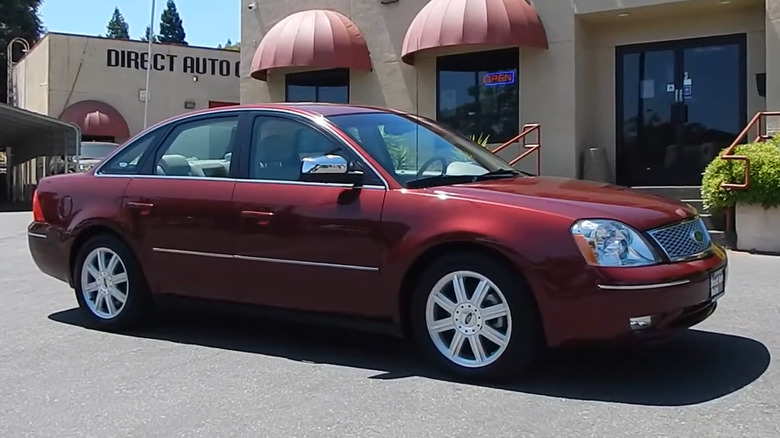
Not to be confused with the Galaxie and Fairlane 500 models of old, which were awesome and not flops at all, the Ford Five Hundred is a very different beast. It was a full-size, four-door sedan which was offered by Ford from 2005 to 2007. That's right, just three years of production, which is probably why you don't remember it at all.
Everything about the Five Hundred was largely uninspiring. It was powered by a 3.0-liter Duratec V6 engine, capable of mustering up an adequate but not exciting 203 horsepower, directed toward the front or all four wheels via either a six-speed automatic or CVT transmission. The styling was safe — in other words, bland — and that's pretty much all there is to say about the model.
It captured just as much interest when new as it does now, as evidenced by the lackluster sales numbers. Sales figures peaked in its first full year of production, at 107,932, but dropped by roughly 23,500 the following year, before declining a further 50,000 in its final model year. In comparison, the Taurus and Crown Victoria found hundreds of thousands of buyers in key years, and these were the models the Five Hundred was meant to be replacing.
Evidently, not many folk cared about the Five Hundred when it was new, and judging by residual values — good examples change hands for less than $5,000 — nobody cares about it now either. A textbook flop.
Ka+
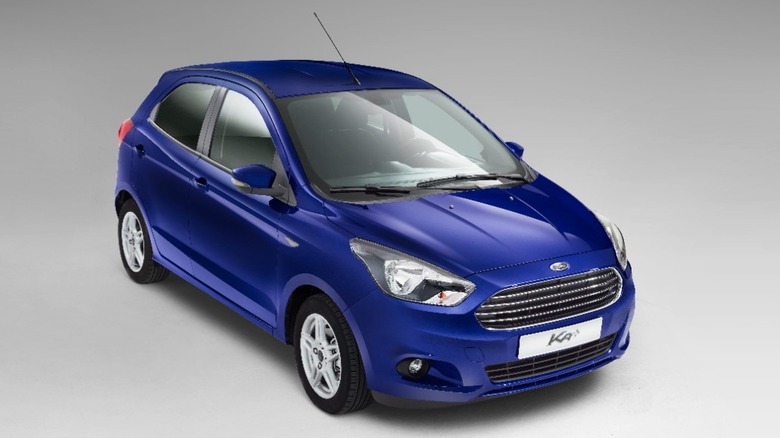
Unlike the other entries from this list, the Ford Ka+ was never sold on American shores. Now, when it comes to forbidden fruit Blue Ovals, America usually looks as if it's missing out. Models like the original and second-generation Focus RS, Escort and Sierra RS Cosworth, and indeed the Group B legend RS 200 are all icons which U.S. Ford fans are right to cry out for. The Ka+, however, is one model we can be quite sure no one is crying over.
It's worth stating that the standard Ka was a hugely successful model for Ford in Europe, particularly in the U.K. The first-gen model remained in production for over a decade, sold in impressive numbers, and was one of the staple first car choices for young drivers in Britain. The Ka+ replaced the second-generation Ka, as a sort of bigger little car. It sported an extra pair of doors and a little more room inside, making it a spacious option in the supermini sector.
We can see the idea behind it, but the model flopped quite hard. After just a few years on sale, the Ka+ was discontinued. Other competitors such as the Renault Twingo and Dacia Sandero clawed in much more sales, and changing emissions regulations were the straw that broke the camel's back. Despite being discontinued fairly recently, a Ka+ is now a rare sight on the roads, and serves as a reminder that even the biggest of automakers get it wrong from time to time.
EcoSport
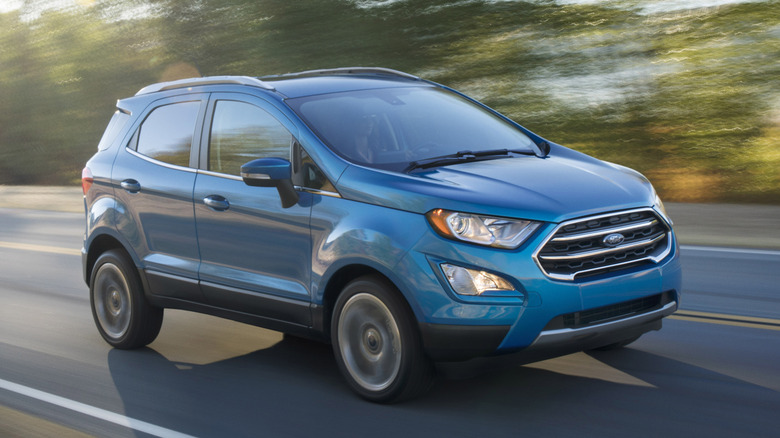
The Ford EcoSport is another recent Ford flop, having been offered in the U.S. between 2018 and 2022. For a Ford product, that's a suspiciously short production run, and the first sign that things didn't pan out all that great.
The EcoSport itself is a subcompact SUV, so it's quite surprising to see it feature as a failure here, given the huge success of SUVs in general in recent years. The subcompact SUV space is a segment that had not seen the same level of exposure as other larger SUV classes in the U.S., which is perhaps the leading reason why it didn't impress customers all too much. Most buy an SUV because they want space and practicality, and the diminutive EcoSport doesn't have all too much of that to offer.
Initially, sales for the little Ford were quite strong, with 54,348 shifting in 2018, and just over 60,500 selling in both 2019 and 2020. From here, though, sales dropped quite sharply, to 40,659 and 29,193 in the following years. In contrast, the next smallest Ford SUV – the Ford Escape that's still around but soon won't be sold in six states – was selling well in excess of 100,000 units a year reliably, and in some instances, exceeding even 2- or 300,000. Ultimately, there were a few reasons why Ford had to discontinue the EcoSport, such as its tiny 1.0-liter engine, low-rent interior, and general inadequateness for American roads. As such, it rounds up our list of Fords that flopped.