

This One-Off Pontiac Supercar Had A Ferrari Engine Under The Hood
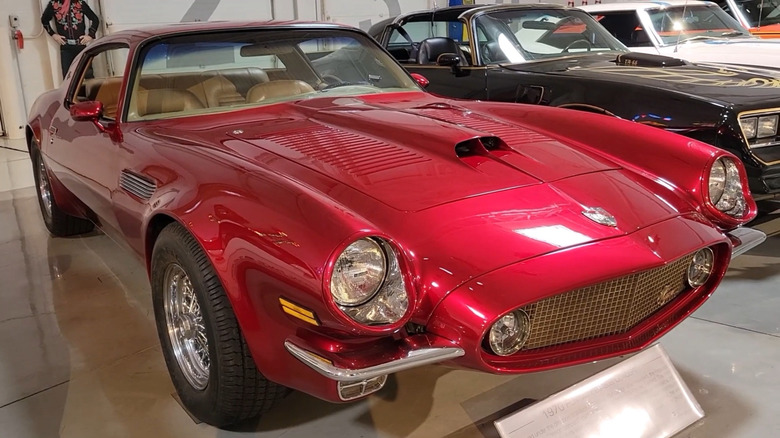
You may have seen this one-off Firebird before. Or should it be Uccello Di Fuoco (Italian for "Firebird")? Perhaps Ferraribird? This car is so cool, every last automotive writer on the planet wants to take a turn writing about it. And why not? It's General Motors legend Bill Mitchell's ultimate early '70s automotive casserole: An American muscle car with Ferrari V12 power and the styling of both. Behold, the Pontiac Firebird Pegasus!
Pontiac (RIP) was GM's excitement division, aka the one that focused on performance and kept muscle cars alive long past their expiration date. Those most responsible for Pontiac's hot-rod image are Semon "Bunkie" Knudsen, Pontiac's general manager from 1956 to 1962, and John Z. DeLorean, assistant to Knudsen and chief engineer Pete Estes before becoming chief engineer himself in 1961, then head of Pontiac from 1965 to 1969. But the Pegasus gestated after they left, and this fever dream was born under Mitchell, GM's vice president for design from 1958 until 1977.
In 1970, Chevrolet stylist Jerry Palmer sketched a mashup of a Camaro and a Ferrari 250 Testa Rossa, and Mitchell became smitten with the concept. Rather than let Chevrolet use it, Mitchell sprinted to Pontiac to craft this stunner. As explained to Motor Trend by retired GM design VP Chuck Jordan, Mitchell wanted a "high-revving low-torque Trans Am." Was Mitchell saying that Pontiac screwed up the overhead-cam-6 in the Firebird Sprint? Was its 6,500-plus-rpm capability not good enough? Did it have half the cylinders it should have?
Whatever Mitchell's logic was, he'd get his wish when Enzo Ferrari himself offered up a 352-hp V12 from one of his 365 GTB/4 "Daytonas." As for why, maybe Ferrari was still angry with Ford and wanted to help create a Mustang killer?
This work of art almost got a slushbox (the horror)
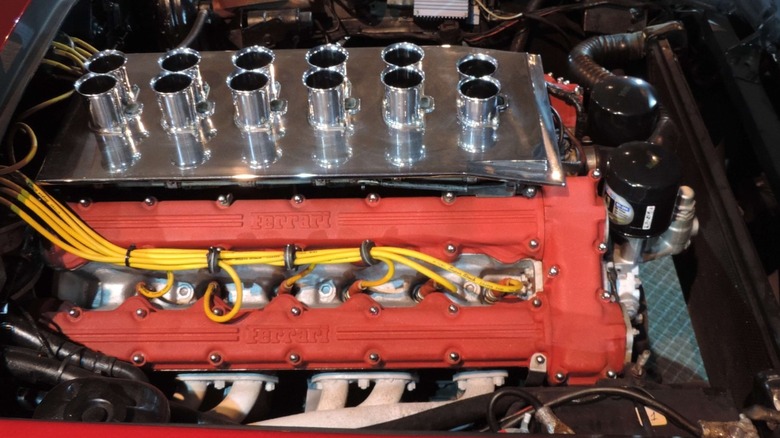
Now, you won't believe that automotive engineers in the '70s could commit such heresy, and please don't hold this against Bill Mitchell, but unbelievably, this car almost got a three-speed automatic, which would have been less desirable than passing a kidney stone. Apparently Mitchell loved low-effort cruising enough to try putting Maranello's best in front of a transmission that still needed whale oil.
Thankfully, the spin-happy V12 didn't much care for the automatic, proving engines can have souls, and the engineers went and found a five-speed shift-for-yourself gearbox from a Ferrari 365 GTC/4. While the Pegasus didn't get the Ferrari's shiny shifter gate, at least the gear lever was surrounded by some lovely tan leather.
(You'd think this power-train lesson would have percolated through the car industry, but no. Both Lamborghini and Ferrari both slapped automatics behind their V12s right from the factory. Lamborghini offered Chrysler's Torqueflite as an option for the four-seat Espada [the highest-selling and longest-produced Lamborghini for many years] and Ferrari let buyers infest its 400i, a car so angular you can cut yourself by staring at it, with a GM-sourced TH400.)
Apparently Bill Mitchell himself forgot his love of not shifting and pretty much made the five-speed V12 Pegasus his personsl car. Who can blame him? Sure, it's not as sharp as a GTB/4 Daytona due to Pontiac giving the Pegasus a solid axle held in place by leaf springs and a relatively portly 3,834-pound weight. At least it has a 4.10:1 differential to get it moving and Corvette disc brakes stop it from moving. Mitchell loved taking Pegasus to events, blasting around tracks as a demonstration, then popping the hood so people could ogle the 12-cylinder sculpture.
The sharp sheet metal on the Pontiac Pegasus oozes with style
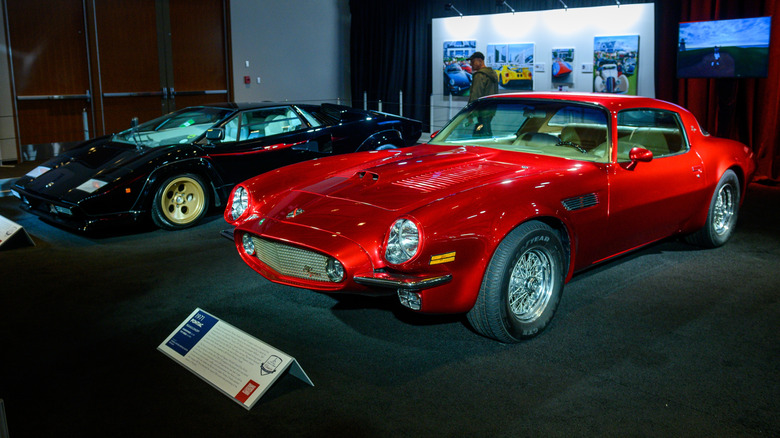
Thankfully, to make the engine fit, the underlying Firebird's frame didn't need extending. However, the firewall did have to move back about 9 inches. Squeezing the engine under the hood also necessitated bespoke headers, which were no longer equal length, changing the exhaust note.
Compare that to an actual Ferrari 365 GTB/4 Daytona.
All this work helped preserve the underlying Firebird's perfect proportions, and the Ferrari-esque finishing touches elevated it to "sumptuous" territory. In addition to its elongated-scoop-eye headlights and pointed, oval grill, there are hood and fender vents, wraparound rear glass that subtly foreshadow the then-upcoming 1975 Firebird redesign, and a boattail rear with no spoiler. Capping off the Italian American looks are genuine Borrani wire wheels and Ferrari exhaust tips.
The beauty is more than skin deep, too, as the interior received an instrument panel and gauge cluster from Ferrari. Everything is wrapped in leather, including the dashboard and the custom headrestless seats. A shame it's rarer than the rarest of the rare Firebirds and spends most of its time just resting in the GM Heritage Collection.
Pegasus' appearance has changed somewhat over the years, most noticably after its refresh in 2012. Originally, the exterior paint shared space with what seemed like miles of gold pinstripes, but Ed Wellburn, then head of GM Design, thought those pinstripes should disappear in favor of a straight deep-red finish. What's less noticeable is the subtle reshaping of the nose after Bill Mitchell smacked it into a bridge. In a lovely bit of irony, that accident happened at Road America in Wisconsin, and the bridge where Pegasus had its impromptu rhinoplasty was Bill Mitchell Bridge.