

Beware Of Invisible Cows: Hawaii's Weirdest Road Signs Just Want You To Be Careful, OK?
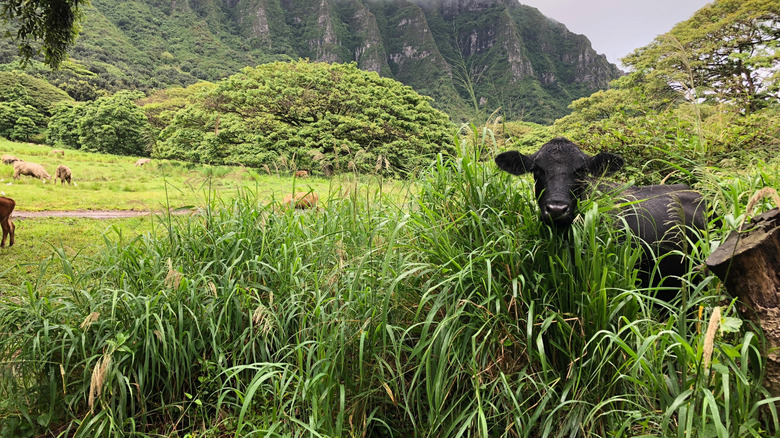
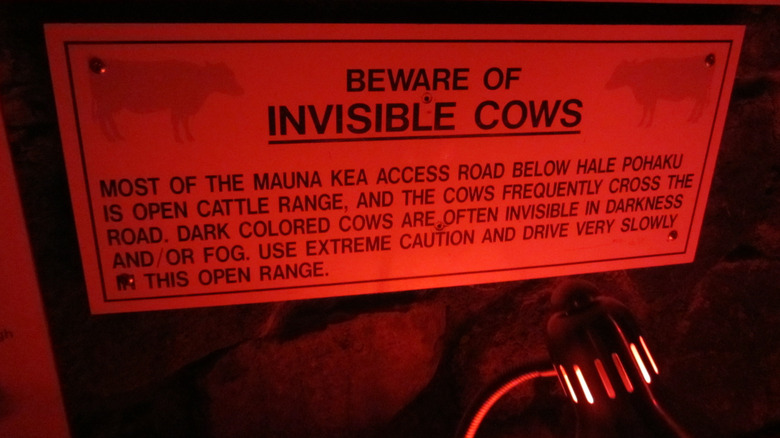
Just about every U.S. state (and heck, most countries) can lay claim to road signage that leaves drivers confused, befuddled, and dazed. On the outskirts of Paris, you might come across signs warning against driving explosives into tunnels. Hitting the pavement in Pennsylvania? Watch out for the inscrutable "Stop Except Right Turn" notices. But some of the most common caution notices you'll see pertain to the animal friends with which we cohabitate. Many Americans have come across those yellow diamonds on the roadside telling us to make way for deer, but Hawaii might take the cake for boasting the spookiest signs of caution: "BEWARE OF INVISIBLE COWS."
As far as we know, there's no secret government program afoot in the Aloha State to cloak bovines for some nefarious purpose. Rather, these signs simply let motorists know that the foggy, dimly lit mountain access road on Mauna Kea might prevent you from seeing the roving bands of dark-colored cows that roam the mountainside and surrounding areas. Silly as the sign may be, if you don't heed the warning, you might have an unpleasant run-in with a wayward herd of these tough-to-spot cattle.
The real question is how these goth-flavored cows, which are very much not native to Hawaii, got here in the first place. Who brought them to the island? Furthermore, why, centuries after the arrival of these cows, are they still causing potentially serious problems for intrepid drivers traveling up the small, hairy mountain road?
Don't have a cow (crash), man
We can attribute Hawaii's cow crisis to good ol' fashioned colonialism. Back in the late 18th century, a handful of cows were gifted to King Kamehameha by a visiting Brit by the name of Captain George Vancouver. The king, realizing the potential economic windfall of a beef cattle industry on the Hawaiian islands, placed a firm ban on hunting these newly arrived animal ex-pats. This policy led to a population explosion, and by 1848, an estimated 35,000 cows were running rampant around the Big Island – and wreaking havoc on local flora and fauna as an invasive species.
To help curb the out-of-control cow population, Spanish-Mexican cowboys, or vaqueros, were hired to teach Hawaiians the art of cattle wrangling. The newly minted Hawaiian cowboys, called paniolos, began their attempts at controlling the roving bands of cows and eventually established ranches.
While this strategy worked to an extent, the rise of automobiles (and a thriving car culture) in Hawaii led to a new problem: car accidents involving errant cows crossing the foggy, often-poorly lit Mauna Kea Access Road. According to eyewitness accounts, thick fog at higher elevations on the Big Island made these cows especially hard to spot – especially during afternoons and evenings. Thus, the now-famous "invisible cows" signs were introduced.
Today, state-sanctioned hunts and fences help manage the problem. Still, those "invisible cow" signs — while admittedly pretty hilarious — are posted for good reason. So, the next time you're traversing the treacherous high-elevation road sections on Mauna Kea, heed the warnings. Your 4x4 and the cows will thank you.