

Consumer Reports' Best Compact SUVs Ranked By Interior Space (And What That Will Fit)
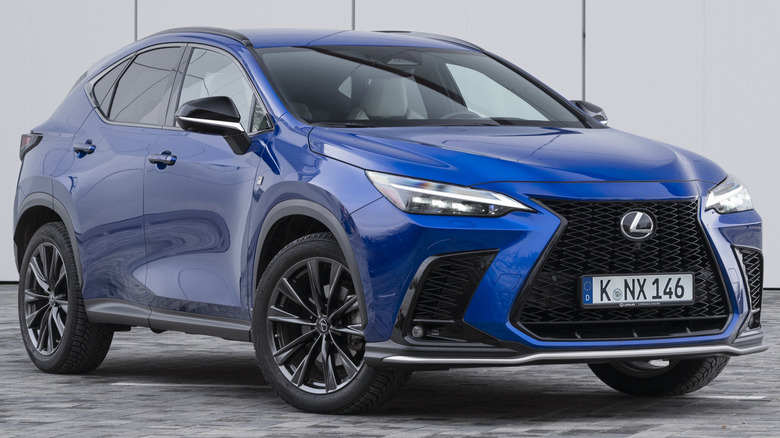
The compact crossover market is absolutely stacked with options these days, with practically every manufacturer pushing one of these lifted hatchbacks into production. Some are better than others, though, which is where Consumer Reports comes in. Our pals at CR have gathered their impressions of every compact SUV and ranked them by road test data, comfort, safety, predicted reliability, and predicted customer satisfaction. Since they've already done the hard work, we thought it would be fun to pick out the six top-rated machines and see how they compare on just one metric: cargo capacity. And we're going to do it with a twist.
It's nice to know which vehicles in the class come highly rated, but maybe you have some practicality questions a ranking just can't answer. Consumer Reports will tell you that a Lexus NX Hybrid (photo above) is a better car than a Ford Escape, but you already knew that. So we're going to give you some weird real-world cargo space applications.
What kinds of things do you really want to carry in your compact crossover? Maybe you have a trio of Belgian Malinois that hate each other and need to be crated and separated. Could you haul a minibike? Do you need to deliver cases of beer across state lines because the boys are thirsty in Atlanta and there's beer in Texarcana? Maybe you're a tennis instructor, or you're hauling pizzas for a birthday party. Here are the facts on which of these cars is best for you, and why.
What are the best compact SUVs?
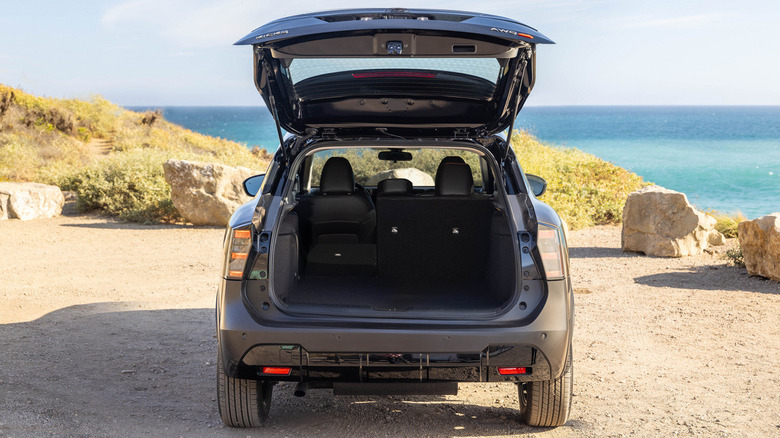
Based solely on Consumer Reports' scoring metrics, the best compact SUV on the market today is the powerful, efficient Subaru Forester Hybrid. It scored better than the standard Forester, because the hybrid is quieter and more pleasant taking off from a stop. And it had a higher score than the much more expensive Lexus NX Hybrid or Porsche's popular Macan. By the time you get to its own tax bracket, the Forester Hybrid trounces the better-than-its-gas-version Toyota Corolla Cross Hybrid, the Nissan Kicks, and the tariff-hampered Mazda CX-30. There are over a dozen other players in the class, but we're going to keep to these six for our comparison.
Because we want to know the maximum amount of something each of these vehicles can carry, we're going to only concern ourselves with the cargo volume with the rear passenger seats folded. Standard EPA cargo volume is typically measured from the front sliding seat in its rearmost position, and vertical measurement taken from a horizontal tangent to the top of the seatback.
How do these six machines compare if you're rating them only on the size of their cargo areas? The Corolla Cross is the smallest of the six at just 44 cubic feet, just shy of the Mazda's 45.2 cubic feet, and the Lexus NX Hybrid's 46.9 cubic feet. From there it's a pretty big jump to the other three, with the Macan coming in at 53.1 cubic feet, the Nissan Kicks jumping up to 60 cubic feet, and the Subaru Forester Hybrid winning again at 70.7 cubic feet.
What can you carry in a compact SUV?
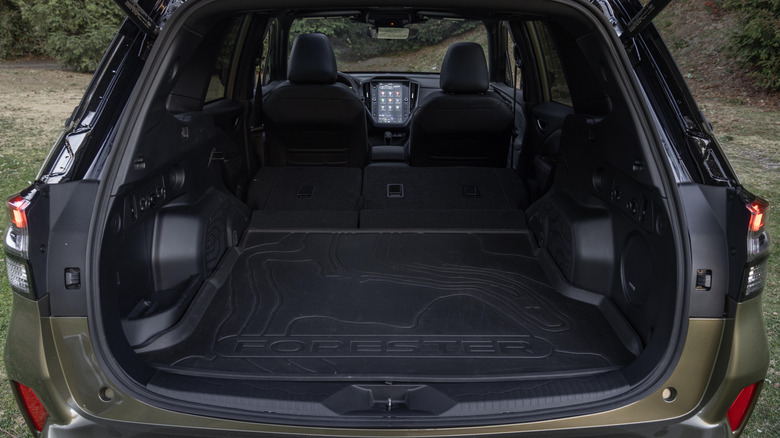
To provide some context as to the sizes of the cargo areas in these vehicles, we'll start with some normal everyday items you might want to haul with your small crossover. Because of the varying shapes of these cars, we're going to work with large quantities of small items that can conform to the specified box.
Let's begin with tennis balls. Everyone carries around a car full of unpackaged tennis balls at least once a year, right? It's good to know just which car will carry the quantity of tennis balls you need to haul. Obviously spheres can't fill 100% of the space, so we have to assume a 74% efficiency rate when dense packing equal spheres. The volume of a tennis ball is about 9.15 cubic inches, and a cubic foot is 1,728 cubic inches, meaning we can fit 139.75 tennis balls in each cubic foot. The Corolla Cross, with its cargo area filled to the brim, could carry 6,149 tennis balls, while the Forester Hybrid could haul 9,880 of them.
Or let's say you're hosting a birthday party and you need to carry a bunch of Costco pizzas. These pizzas come in boxes measuring 18.5 x 18.5 x 2 inches. The Nissan Kicks measures 55.7 inches from the back of the front seats to the hatch, meaning you should just barely be able to get three Costco pizzas deep in the back. According to Edmunds' cargo capacity test, the Kicks is at least 38 inches wide, so you could go two pizzas wide. Let's not get too hectic here and say we're stacking pizzas about 2½ feet high, meaning we can get stacks up to 15 pizzas tall. That's 90 pizzas!
What else?
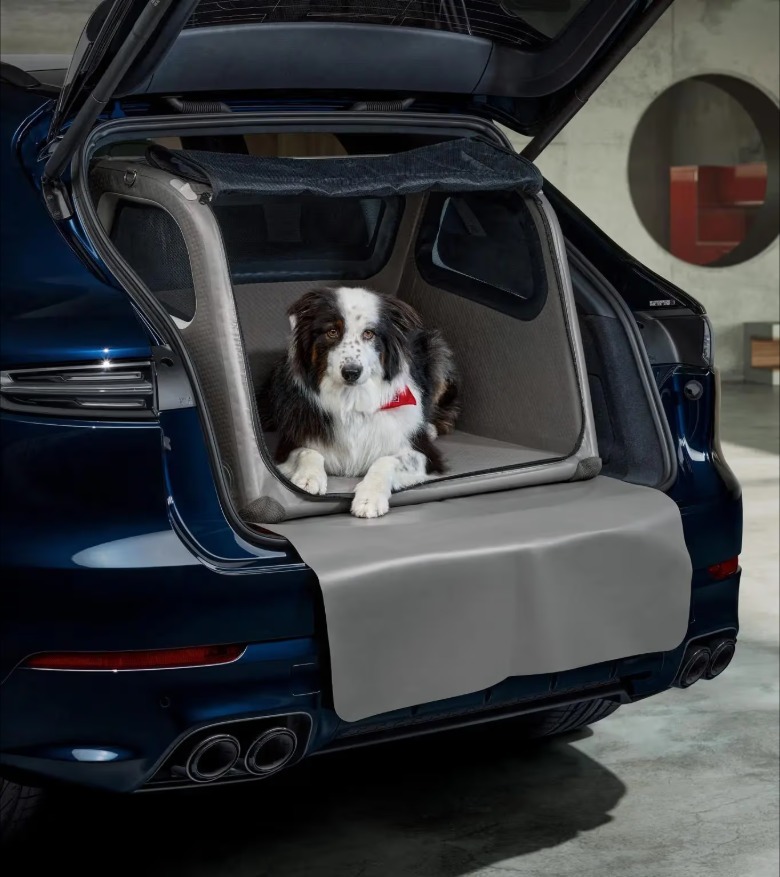
Porsche touts the standard gasoline-powered Macan as "easily accomodating" two full-size golf bags or four roller suitcases, even with the rear seats up. Due to the car's sloping roofline, it might be difficult to get three large dogs in the back, but Porsche does sell three different-sized zip-up inflatable dog transport boxes for the Macan's back hatch.
The largest of these is made for dogs sized up to about 90 pounds, while you could fit two of the smallest ones side-by-side if you had a pair of Pekinese or something. All of them allow for the dog to be crated behind the rearmost seat, so you could still have rear-seat passengers. If you're picking a smaller SUV like this, you'll have to be wise about what kind of dog fits your car.
Here's a nice theoretical for you. You're out traveling the neighborhoods at yard sales next summer and you come across a small minibike and exchange a crisp $20 bill for it. It'll make a nice little project for you and your kid to bond over, and they'll have some fun ripping around the neighborhood, annoying Carol from the homeowners' association down the street, which you see as an added bonus. Can you get it home in your Lexus NX?
Something like the Rascal 212 Off-Road mini bike measures about 45 inches long, and 37 inches tall at the handlebars. Obviously you'll want the fuel tank to be empty so as not to spill, but as Autoblog's test shows the NX cargo area is at least 44 inches wide and NX owners on lexusnsforum indicate the height of the opening is just a smidge over 37 inches, it should fit without issue, assuming you fold at least one chunk of the 60/40 rear seats.
Bee double-e double-r you enn, beer run
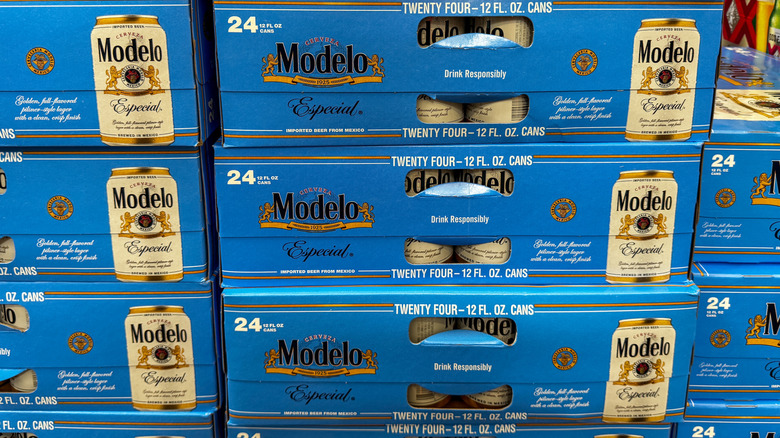
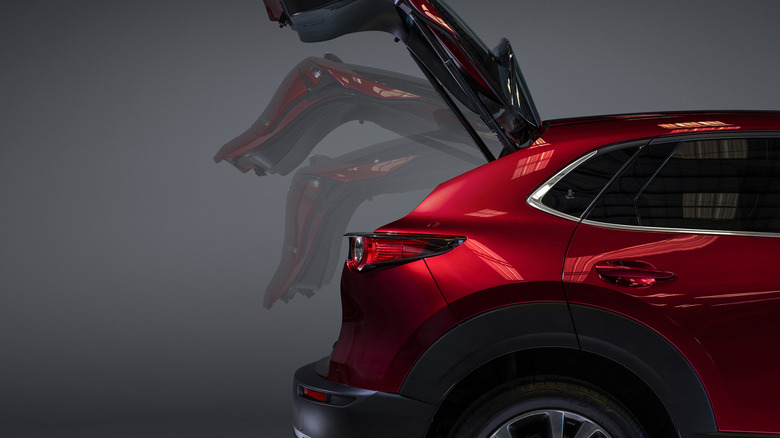
Now we've reached the answer to the question everyone wants to know: Just how much beer can you fit in the back of a Mazda CX-30? According to a CX-30 owner's measurements at cx30talk, with the seats folded the rear cargo area measures about 59 inches deep, 39.5 inches wide at the narrowest, and 29.5 inches in height at the rear opening. A standard 24-pack of 12-fluid-ounce cans of beer is 5.4 inches long, 10.15 inches high, and 15.07 inches wide. As with the pizzas in our earlier example, we'll just math it out.
The CX-30 should fit 10 packs laying down flat, which can theoretically be stacked five cases high. That alone is 50 full cases of beer, or 1,200 cans. There's still room for a few to be added handle-side up around the perimeter, two high. By my estimation, there's space for 12 more cases around the edge, for a grand total of 62 cases, or 1,488 cans. If you get creative you might be able to Tetris in another case or two, but we'll call it there for now.
There's just one problem here. The Mazda CX-30's maximum payload capacity, including the combined weight of all passengers and cargo, is just 850 pounds. With a case of beer weighing in at 18 pounds, those 62 cases add up to 1,116 pounds! The U.S. Centers for Disease Control and Prevention says the average American man weighs 199 pounds, leaving you just 651 pounds of beer to work with if you're a guy driving to pick them up alone. You can reasonably only haul 36 cases of beer, so you'll either have to make a second trip, or cut some people from the guest list for this weekend's rager.