

Laid-Off Textile Workers Ran Their Bosses' Hidden Exotics As A Museum For Two Years
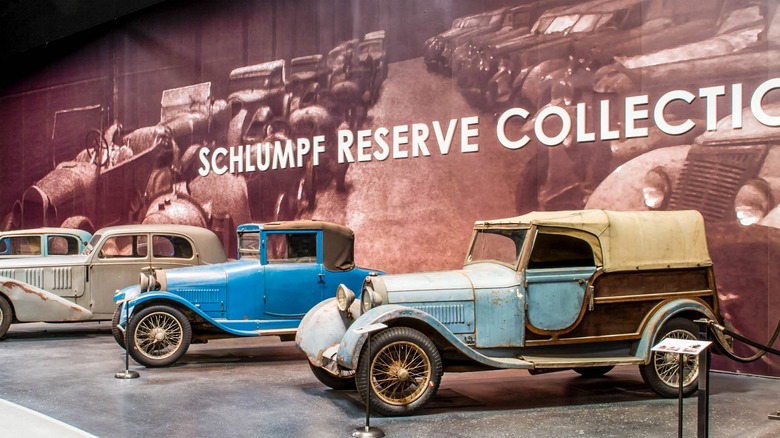
What's the coolest automotive museum you've ever seen? What about the most mind-blowing piece of automotive history you've ever beheld with your own eyes? I live right down the street from the National Automotive Museum in Reno, NV, which is a great time, but it doesn't quite take the cake. There are some real gems out there, like the Gilmore Car Museum, which lets you drive a Model T, or the Studebaker National Museum, where you can watch footage from 1932 of grown men throwing cars down a hill for safety testing. But if I had a time machine and could visit any car museum anywhere in time and space, there's one in particular that I'd just love to see.
That would be the Schlumpf collection in Mulhouse, France, specifically during the two-year period in the mid-to-late-70s when it was run by laid-off textile workers after their bosses shut their factories down and fled the country. Yes, the story is as wild as it sounds.
Now housed in the Musée National de l'Automobile in Mulhouse, the Schlumpf collection is an astounding piece of both car collecting and labor history. It began as the personal (and, sure, slightly obsessive) collection of Fritz Schlumpf, a long-time Bugatti driver who, along with his brother Hans, ran a textile business with factories in Mulhouse. Born around 1906, Fritz Schlumpf began collecting Bugattis intentionally in the 1960s. He hunted them down with the help of the British Bugatti Owners Club, who helped him locate around 50 individual cars, plus a stash of 30 vintage Bugattis owned by John W. Shakespeare of Hoffman, Illinois. Over two years, Schlumpf and Shakespeare negotiated a purchase price, bringing Schlumpf's personal Bugatti collection up to 80. Then he bought 18 more off Ettore Bugatti himself. Schlumpf was only getting started.
The obsession inevitably went too far
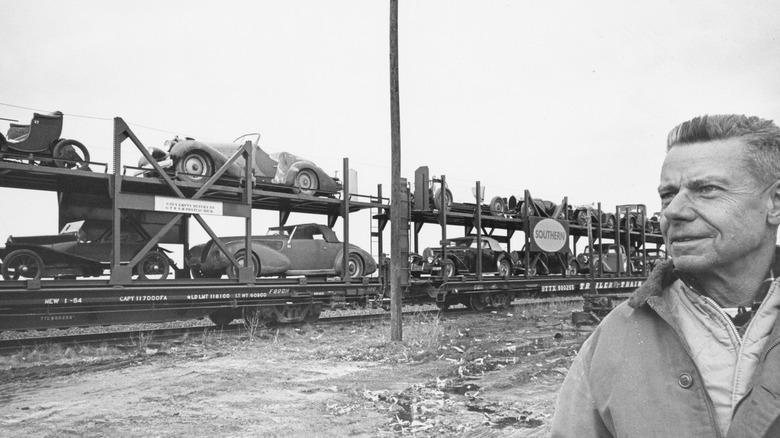
Eventually, Fritz Schlumpf owned an estimated 105 Bugattis, which might've comprised as much as 20% of the Bugattis in existence at the time. Who can blame Schlumpf for apparently wanting them all? After all, Bugattis do drive like a dream, even the old ones. But Schlumpf hadn't just been buying up cars of his favorite French brand. He'd actually been amassing a mind-bogglingly large stable of rare cars, both vintage and contemporary.
By the 1970s, Schlumpf had over 400 cars stashed in an unused factory in Mulhouse that was being fitted into a museum. But in order to acquire them all during a worsening economy, he'd spent money from a government grant intended to keep his factories in operation. When his transgression was discovered, he promptly shut down all his businesses and fled to Switzerland, putting about 1,800 workers out of business.
In response, the workers decided they didn't need a boss and could keep things running without Schlumpf's oversight, so they formed a workers' co-op to keep themselves employed. When members of the co-op traveled to the supposedly unused factory in Mulhouse, what they discovered was a building packed to the gills with exotic cars. A collection the likes of which had never been seen. The workers collectively decided to run the museum while using it to spread the message of their cooperative to the wider world.
The museum was open for two years, with public access to the vehicles for a few hours a day, and it contained some real stunners, including gems like two Bugatti Type 52s, which were electric race cars sized for children. You can still see the collection today, though not exactly as Schlumpf originally had it. The collection was seized by officials and eventually reopened in 1982.