

Watching Grown Men Throwing Cars Down A Hill For Studebaker's Arduous 1932 Vehicle Testing Is A Special Kind Of Delight
There's something mesmerizing about watching a car succumb to extreme physics. It's why rubber-necking a crash is such a thing. It's just disgustingly thrilling to watch chaos happen in person (and of course one hopes no one gets seriously hurt). So this safety video shared by the Studebaker National Museum is natural catnip to fervent watchers of such carnal metal demise.
"Studebaker Safety," a video produced by Chicago Daily News in 1932, provides at least 10 minutes of vehicle testing fun at its Indiana proving grounds with what appeared to be a brand new Studebaker 6, or "Model 55" right off of the assembly line. The "Six" was one of the most popular Studebaker models of the early Depression era, starting at $890 for its base sedan (approximately $21,900 today).
Following a short preamble from Studebaker suits, the video kicked off testing with a simple rolling of the Studebaker 6 down the hill. Simple may be a nice way of putting it because the group of men used ropes and two-by-fours to properly prop up this heavy metal vehicle to its side and simply send it rolling over 300 feet down a steep hill, a couple of times.
There's no problem putting a camera man right in front of the crash
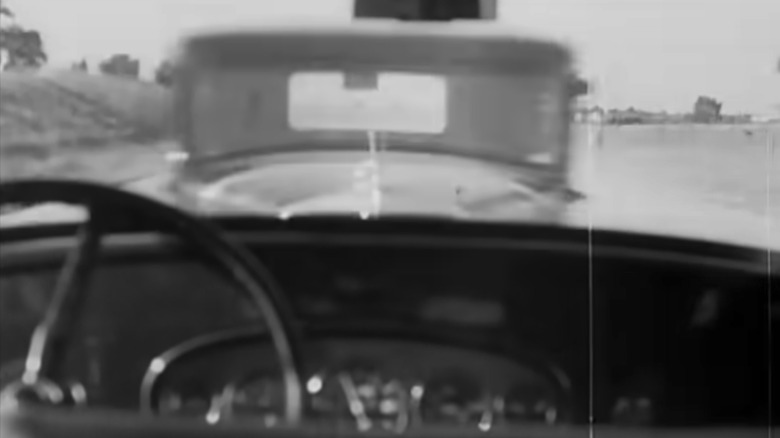
This particular demonstration of vehicle testing is of course extremely rudimentary compared to tests we're used to seeing performed on vehicles today, which usually takes place in more laboratory-specific environments. But for this test in 1932, and you can have a group of spectators somewhere in the vicinity of the test who are then allowed to swarm the car after it completes its initial drop. There's also a camera man stuffed in a hole of a straight road way, whom I like to think is really hoping the car performing the brake test stops when its supposed to.
Studebaker's engineers remain thorough as they perform tests and repeat them as necessary. The suspension and underbody componentry is put through a rigorous whoops-like course that in slow motion reveals all four wheels in the air at times. In another trial, an installed mechanism blows out the tires at 60 mph to see how the car skids after a sudden loss of tire pressure. The climax of the film is a head-on collision with both cars reaching 55 mph. The cars were set up to accelerate after the engineers promptly exit the vehicle, and take off. For 1932, the resulting carnage isn't quite as devastating as you'd expect. In most cases, outside of the final crash, the Six can drive away under its own power. Only the head-on crash appears to have completely disabled it.
8,000 trees mark the spot where Studebaker's proving grounds lived
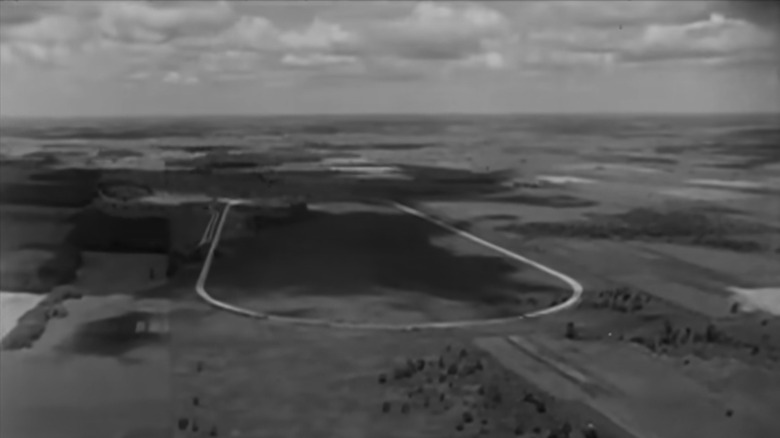
The proving grounds where the Six was put through its paces is no longer around, or rather isn't a crumbling derelict series of structures you can visit. It would become a park shortly after the Midwest car company closed up shop in 1966, and you can visit many of the automaker's important landmarks as noted by South Bend, Indiana's visitor guide. Included on the tour is Bendix Woods County Park, which still has the 8,000 pine trees planted to spell out "Studebaker," visible from the air, as well as the company's former clubhouse which now stands at the county parks office and nature center today. Just don't get any ideas on throwing a car down the hill while you're there. What was cool to do almost a century ago would be rather frowned upon, especially in a park today.
Join me weekly as I introduce a new(er), sometimes nostalgic video worth adding to your Watch Later lists. Leave a note in the comments if you find an older or interesting film you'd like to see featured.