

Why Some Traffic Lights Have A Yellow Border
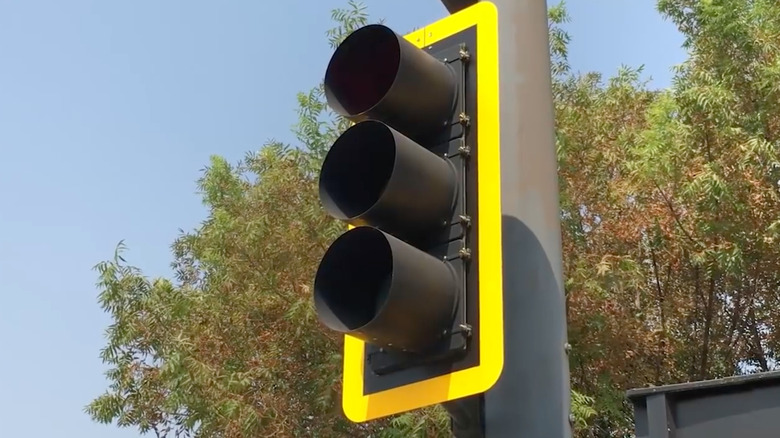
If you're anything like me, in addition to scanning the road for distracted drivers and pedestrians, you also scan signs and roadsides for anything that could potentially be a red-light or speed camera. It feels like Big Brother is always watching and waiting for you to pass the 11 mph over-the-speed-limit threshold or to miss the "no right on red" sign nowadays, so there are a lot of things fighting for your attention when you're behind the wheel. If you've noticed that some traffic signals have a reflective yellow border while scanning your surroundings, you may wonder what they're for, but the simple fact that you've noticed them means they've served their purpose.
Those reflective yellow borders that surround some traffic signals have several intended purposes, including boosting signal visibility at night time, getting the attention of drivers with color vision deficiencies, and ensuring motorists are aware of an upcoming intersection, even when the lights are inoperative — in a power outage, for instance. The border is a simple and low-cost feature that has been proven to increase road safety.
A study showed these borders decrease crashes by 15%
A 2005 study titled "Safety Impact of Increased Traffic Signal Backboards Conspicuity" found that adding a three-inch yellow micro-prismatic retroreflective sheeting around the outer edge of a traffic signal backboard could reduce collisions by about 15%. The reflective material not only makes spotting traffic signals easier at night, but also in the daytime, particularly when signals are backlit at sunrise and sunset, as well as signals that are surrounded by reflective buildings and other visual distractions. The implementation of reflective yellow borders is not federally required at every intersection, so state and local transportation agencies usually decide where to install them.
The U.S. Department of Transportation's Federal Highway Administration considers adding a one-to-three-inch yellow retroreflective border to traffic signal backplates a "human factors enhancement of traffic signal visibility, conspicuity, and orientation." It cites the modification as a very low-cost, proven safety treatment, with the only potential concern being the integrity of the signal support structure in severe winds, which should be considered if adding a backplate to a signal in a wind-prone area.