

Why School Zone Signs Use That Specific Loud, Glowing, Fluorescent Yellow-Green Hue
You're a driver. That means you subscribe to — and hopefully follow — the rules and regulations of the road. That is, unless you want to risk paying out the nose in fees, losing your license, and going to jail. But you know the screw-it-and-go-to-jail option sucks, so you mind the speed limit, avoid deliberately crashing into other motorists, and look out for school buses, their blinking lights, retractable stop signs, and, of course, their precious cargo.
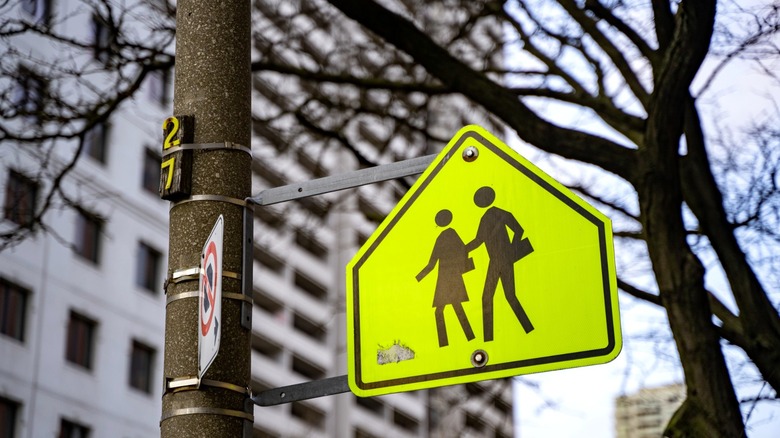
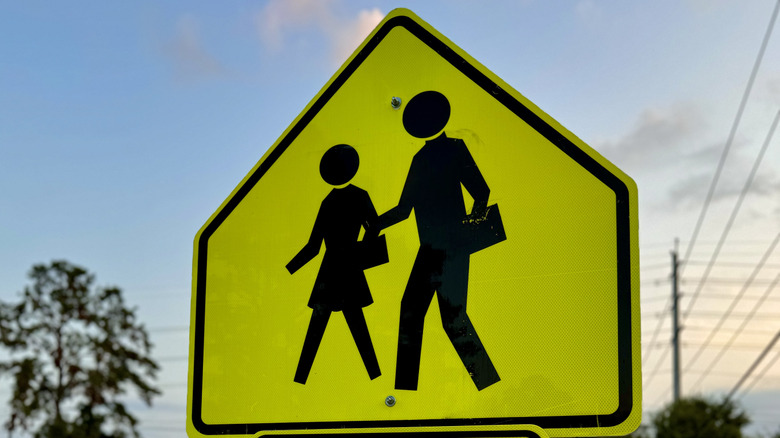
It's not just school buses, though — it's school zones warning you to slow it down and pay attention. And what accompanies damn near every one of those school zones? A set of bright yellow-green school zone signs that might prompt you to question whether or not you're colorblind. Now, you might think, "duh, they're that shade of alien spaceship-signaling color because it's more visible." And, in part, you'd be right. But here's the thing, smart guy, there's more to it than just brightness and visibility.
There's a deeper reason for that crazy bright hue
Believe it or not, the standardized school zone signage you likely see all the time hasn't always been a fixture on American streets. The regulations for traffic control signage, set forth in the Manual on Uniform Traffic Control Devices, weren't published until 1935. That was 27 years after the paradigm-shifting Ford Model T and its simple looks started rolling off the line and mobilized the country. Even still, a standard for school zone signage wasn't included in the MUTCD until its third edition in 1948. And those guidelines essentially implored school zones to mark the streets with a sign that read "School" in black lettering on a yellow background. Hardly groundbreaking. Worse yet, those signs didn't have to be reflective and weren't required to be up after the school year.
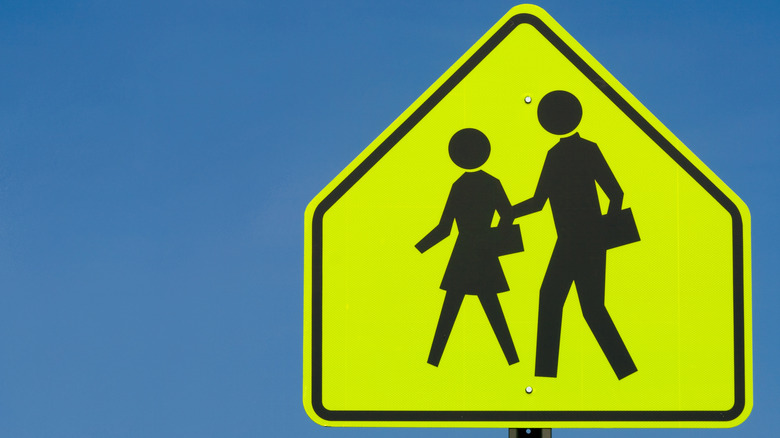
So, what about that specific color? Well, the shade we're referring to here is fluorescent yellow-green (FYG), and it didn't pop up in large numbers until the 1990s. During the final decade of the millennium, injuries and fatalities among pedestrians were on the rise. To combat the trend, the Federal Highway Administration (FHWA) reached into its bag of tricks and pulled out its reserved-yet-unassigned FYG. In 1993, the FHWA conducted a study to determine just how effective the fluorescent color was at reducing incidents. Two years later, the organization concluded that signage in FYG had significantly reduced incidents involving vehicles striking pedestrians.
So, why are school zone signs not a different color?
Okay, so why FYG specifically? There are plenty of bright, noticeable colors out there, right? Why not a red or a pink? Red is the shade of choice for stop signs and stop lights alike, after all. Or orange? Orange is one of the chosen colors for those high-visibility marker balls on power lines, along with bright shades of aviation yellow and white intended to contrast against terrain and background and warn pilots. Regarding red stop signs, early iterations simply weren't noticeable enough in low-light conditions like night. Some regions of the U.S. used add-on lights and glass buttons to reflect oncoming headlamps and promote visibility. Frankly, a glass-beaded stop sign sounds like some pretty sweet garage art. But, by 1954, stop sign producers could rely on fade-resistant porcelain enamel.
FYG, on the other hand, got its chance to prove itself against other colors in the 1990s. And after 57 jurisdictions put it through testing, the highlighter-esque yellow-green color was found to reduce vehicle-versus-pedestrian incidents. In the 1990s, the FHWA conducted a study with the National Park Service testing the effectiveness of the fluorescent yellow-green hue. It proved to make signage more visible from greater distances than yellow signs.
As of the 2009 version of the MUTCD, the eye-drawing FYG is the required color for school warning signs, including school zone speed limit signs and supplemental signs like bus offloading signage. It makes sense, too. Despite little deviations, U.S. road signs tend to use the same font, shape, and style wherever possible to make things easier for the oncoming driver.