

This Fast Prototype Army Off-Roader Owes Its Existence To The Paris-Dakar Rally
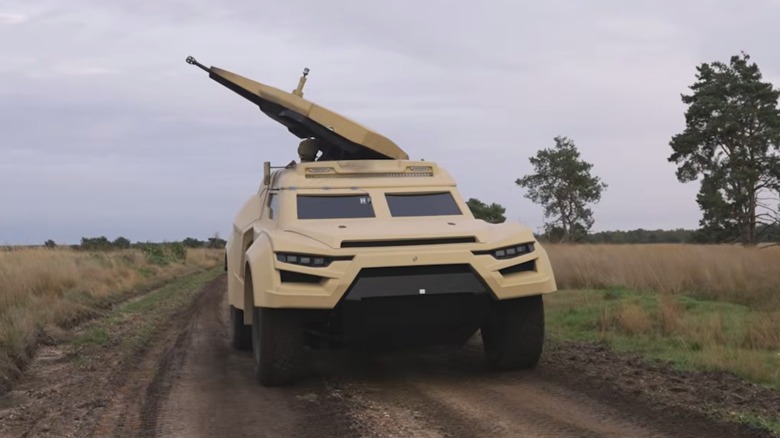
While Donald Trump's been busy threatening our country's European allies and cozying up to Vladimir Putin instead, those allies have been making some military moves of their own. France and Belgium, for example, have been teaming up with John Cockerill Defense to support an innovative new approach to land vehicles — including the Cockerill i-X.
The two countries each have separate 10% ownership stakes in John Cockerill Defense, which touts the i-X as the world's first "ground interceptor." In fact, that is what the "i" in the vehicle's name stands for. The "X," in turn, refers to the vehicle's modular multi-weapons system. Plus, along with the ability to use machine guns and assorted rockets/missiles, the i-X features advanced technology such as onboard AI, various cameras/sensors, "Smart Helmet" integration, acoustic gunshot detection/location, and more.
The i-X also has to provide a military-grade driving experience to fill its role, and the Cockerill crew seems to have taken a slightly different approach from, say, GM. The General's infantry squad vehicle cost nearly $1 billion in taxpayer money, yet, at its core, it uses the same platform underpinning the Chevrolet Colorado production truck. Meanwhile, multiple sources — but not Cockerill itself – say the i-X is built on the foundation of a Paris-Dakar rally vehicle. The actual company behind that rally vehicle remains a mystery, but here's an interesting coincidence that hasn't been mentioned much by the media: France owns 15.01% of Renault, which owns Dacia, which supports the Dacia Sandrider — a purpose-built racer that won the 2026 Paris-Dakar rally. Whether that connection is anything more than a coincidence is anyone's guess, but it is fascinating.
How fast is the Cockerill i-X?
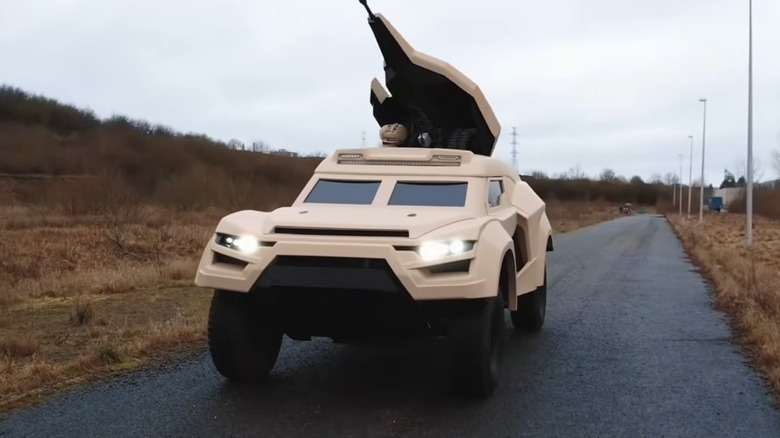
Now, to be clear, the Cockerill i-X is still in testing, so its capabilities could change some before it goes into military production. That said, the company has released some preliminary specs based on the i-X prototypes. Cockerill is a bit vague on powertrains, but it looks like the company is currently touting two packages. One is based on a 750-horsepower V8,and the second is an 800-hp serial hybrid setup with an all-electric mode for about 18.6 miles of EV-style travel. Further incorporating a high-performance suspension, the i-X has a top speed of about 124 mph on the road and nearly 100 mph off-road.
For some context, the Paris-Dakar Sandriders top out at 106 mph, which is the limit for their class — and the maximum allowed speed for any modern Paris-Dakar entry. GM's ISV we mentioned above? Yes, it has a different use case, and that's a good thing. The ISV isn't going to do too much ground intercepting with a top speed of 60 mph. After all, a fast tank, like the Rheinmetall KF51 Panther, can get up to 65 mph on the road. All of those numbers mean you can accurately describe the i-X as fast, at least for a military vehicle.
The i-X is probably pretty fast off-road compared to production vehicles, too. True, automakers don't often let this kind of data out, but one source says first-gen Ford Raptor prototypes were able to exceed 100 mph off-road during testing. Of course, the Cockerill can't keep up with production vehicles on the road, where even the Hellcat-powered 2027 Ram 1500 Rumble Bee full-size pickup is expected to hit 170 mph.
What's the big deal about the Paris-Dakar rally?
The Paris-Dakar rally — now known simply as Dakar – puts vehicles through some of the most extreme conditions on the planet, making the event a fantastic proving ground for military vehicles. And it's not only a test of peak performance. Covering thousands of miles, over all types of surfaces and through all sorts of weather, the rally also can be a showcase for extreme vehicular stamina. Consider: In the race's very first running, in 1978, only 74 of the 170 vehicles in the event were able to finish it. The numbers had improved to 247 finishers out of 317 entries in 2026, but that's still a lot of DNFs.
As for the rally's name change, that's related to its route changes — it hasn't gone from Paris to Dakar, Senegal, since 2001. Ironically enough, given its connection to the Cockerill i-X, the race itself has had to travel around the world to avoid military conflicts. Much like F1's decision to cancel races earlier this year due to the U.S.-Israeli war with Iran, the folks behind the Paris-Dakar rally have had to adjust their calendar based on who was fighting. Sometimes, this meant changing the route or the stopping and starting points, but organizers had to cancel the event entirely in 2008.
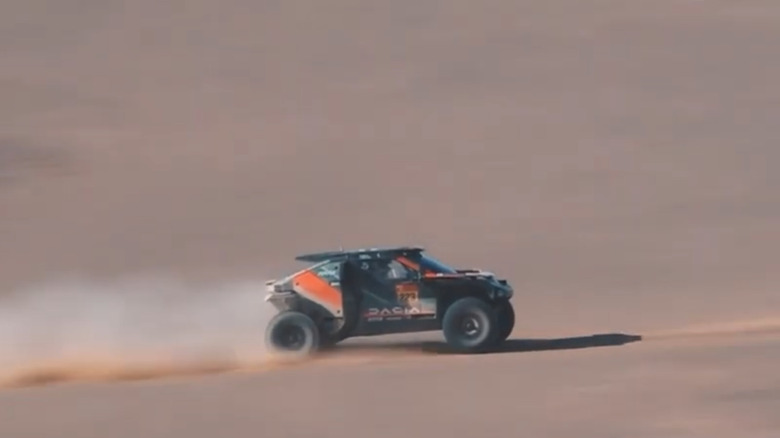
The situation got bad enough that the whole circus relocated to South America from 2009 to 2019, then moved to the Middle East — Saudi Arabia, to be exact — for the years since. The photo above shows a Dacia Sandrider flying through the Saudi desert in 2026. The rally will take a one-year hiatus from that country next, running in Portugal and Morocco for 2027, before returning to Saudi Arabia in 2028.