

7 Luxury Vehicles From Throughout History That Used 4-Cylinder Engines
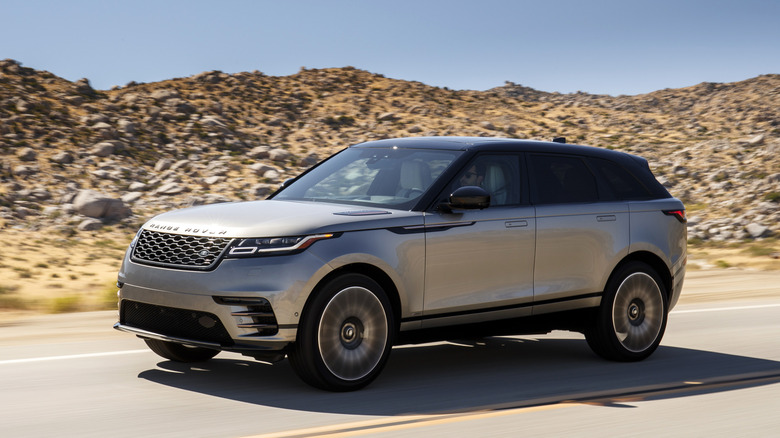
Luxury cars can differ massively from one another, but most of us make similar assumptions when describing the term "luxury car." We picture leather seats, 20-plus-inch chrome wheels, full-size silhouettes, and big displacement engines with a lot of cylinders. However, every once in a while, automakers mix things up a little and throw in an ingredient you might not expect. Four-cylinder engines are one such ingredient, and they found themselves in luxury cars from an assortment of automakers, spanning across what is almost the entire history of the automobile so far.
We're talking Fiats from the turn of the 20th century, British executive sedans produced by Rover in the late '60s and early '70s, hybridized BMW 5 Series sedans, Range Rover SUVs, and more. What's interesting here is that, for the most part, all of these cars were and are considered successes, with rare exceptions (Facel Vega Facellia, we're looking at you), which suggests luxury car buyers aren't actually all that hung up on the engine under the hood. Without further ado, here are our seven four-cylinder luxury cars, in chronological order.
Fiat 60 HP
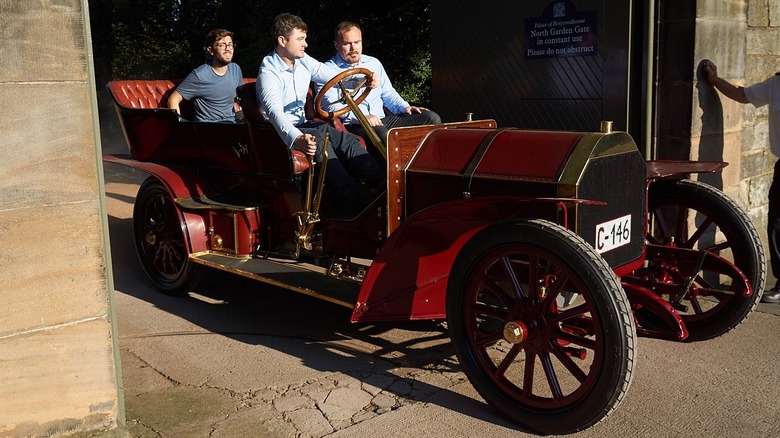
Today, Fiat busies itself with budget-oriented and retro-themed compacts mainly, such as the seemingly evergreen 500, plus its new and immensely cute Panda Grande. Wind the clock back just over 120 years to 1905, though, and Fiat was a very different automaker. It was at this point that it debuted its 60 HP model to rival equivalent models from Mercedes. This thunderously powerful car was powered by a 647-cubic-inch inline-4 with dual-chain drive and a four-speed manual transmission. A 60-horsepower inline-4 might not sound like much at all by today's standards, but in vintage car circles, this Fiat is sometimes considered to be the original supercar.
The Fiat 60 HP had a split personality, designed to be capable both as a road-going vehicle and indeed as a racer, with removable wings and advanced cooling systems. It was also mightily expensive, commanding a $13,500 price tag in 1905, while the sole surviving example also wears a $4,000 coachbuilt touring body.
The craftsmen responsible for the body used only the finest materials available, including aluminum panels, silver solder to cover and hide fastening points, and brass mouldings to disguise the seams of the wooden framework. As for the interior, it was about as luxurious as one could expect for a car of this era, with leather seats and mohair floor mats. Remember, just owning a car in the early 20th century was a mind-boggling luxury, let alone one of this caliber.
Facel Vega Facellia
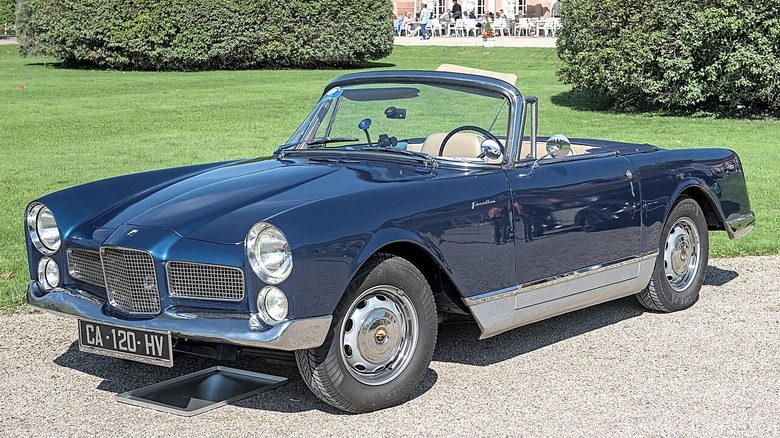
There is much that could be said about the Facel Vega Facellia that is wholly negative, but for a car so imposing and bold in design, that seems unfair, so we shall begin with its stronger points. Facel Vega knew how to do style and opulence quite well, and although the Facellia was its entry-level model, this experience is still luxurious. It was poised as an excellent alternative to Mercedes' SL series, or indeed an equally charming Alfa Romeo of the same era. Inside, the expected amenities are all there in the form of leather seats and numerous gauges set into a hand-painted woodgrain-effect dashboard. On the outside, there is plenty of brightwork to enjoy, and the Facellia shares much in common stylistically with its bigger brother, the HK500.
However, what it sadly doesn't share with the HK500 is its hulking great Chrysler V8. Instead, the Facellia sported a notoriously unreliable French unit – a 115-hp 1.6-liter inline-4. It suffered from overheating issues, fragile internals, and troublesome chromed cylinder liners, which resulted in the majority of cars experiencing engine failure within the first six months of ownership. Facel Vega had no choice but to replace these engines free of charge, but those second engines didn't prove much better either. A final resolution came in the form of a genuinely bulletproof Volvo lump, but by this point, the firm's reputation was in the gutter, and the Facellia would ultimately prove a hurdle too high for the automaker.
Rover P6 2000
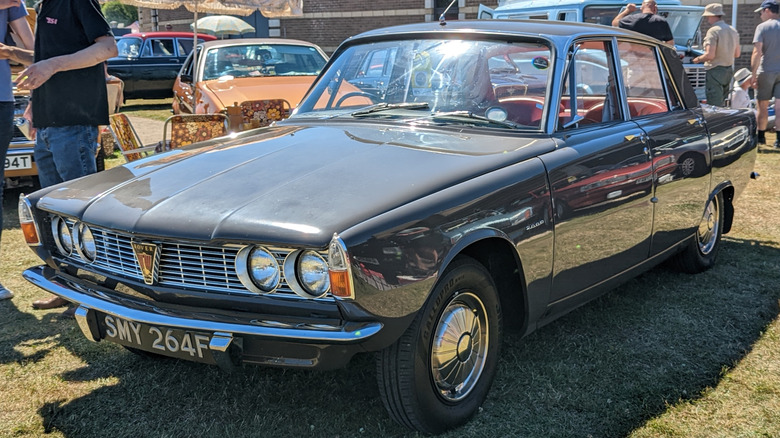
This is a far more conventional offering than the other two covered so far. It replaced the aging P4 model in 1963, and production continued until 1977, so it was clearly a popular choice. With it, Rover successfully filled a notable gap in the UK's car market, where simple commuter cars generally sat at or below 1.5 liters in displacement, while large luxury models sported 3.0 liters or more. With its 2.0-liter inline-4, the P6 could jump between the two segments, offering a premium executive model that cost less than the larger luxury products.
Numerous engine options were offered throughout the model's life, including a twin-carb variant of the 2000, a 3.5-liter V8, and a 2.2-liter version of the 2000, which never made it onto U.S. shores as it arrived after Rover had withdrawn from the U.S. market in '71.
It might not have taken off well in the U.S., but with 322,302 examples sold throughout its life, the P6 was certainly anything but a failure in other markets. One key to its success was sublime handling, which was on par with sports cars of the era and at its best in the four-pot models, alongside a well-equipped cabin. Inside, plush leather seats provide impressive comfort, the steering wheel is adjustable, and faux-wood trim completes the look.
BMW 5 Series
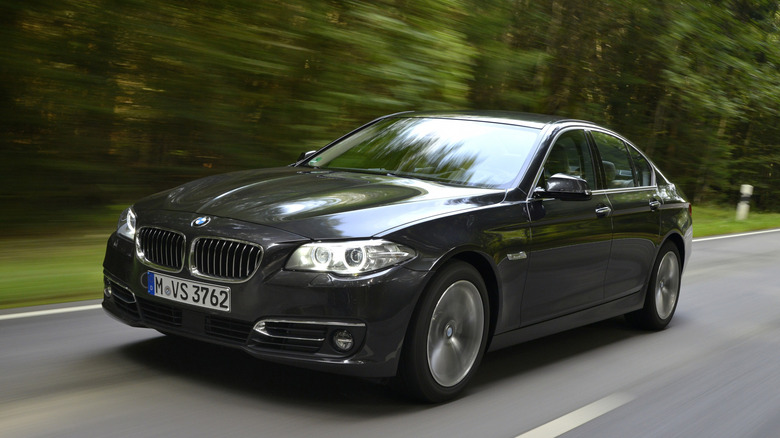
The 5 Series might not be the most opulent sedan BMW makes -– that accolade goes to the 7 Series, which also sported an inline-4 in certain global markets — but it's absolutely still a luxury car from a premium brand. Historically, the 5 Series usually sported a mix of six- and eight-cylinder engines, although a smattering of four-pots have also made their way under its hood. In fact, the first 5 Series (E12) debuted with an inline-4 way back in 1972, offering 115 and 130 hp. The U.S. never received the four-cylinder E12, though, and it would take several generations before a so-powered 5 Series found its way onto American shores.
For the 2012 model year, the F10 5 Series' naturally aspirated 3.0-liter inline-6 was replaced with a turbocharged 2.0-liter inline-4, which delivered 240 hp – identical to that of the inline-6 it replaced. However, real-world performance highlights that the smaller lump is the better performer thanks to additional turbocharged torque, earning it both a 0 to 60 mph and quarter-mile time roughly half a second quicker than the six-cylinder-powered variant.
Since then, four-cylinder engines have been a staple member of the 5 Series lineup, with such engines appearing in subsequent G30 and G60 generations, albeit alongside the usual smattering of larger mills. Those latter two generations use the B48 engine, a fuel-sipping four-cylinder that yields solid mpg, and options like these are only becoming more common in modern luxury cars.
Range Rover Velar
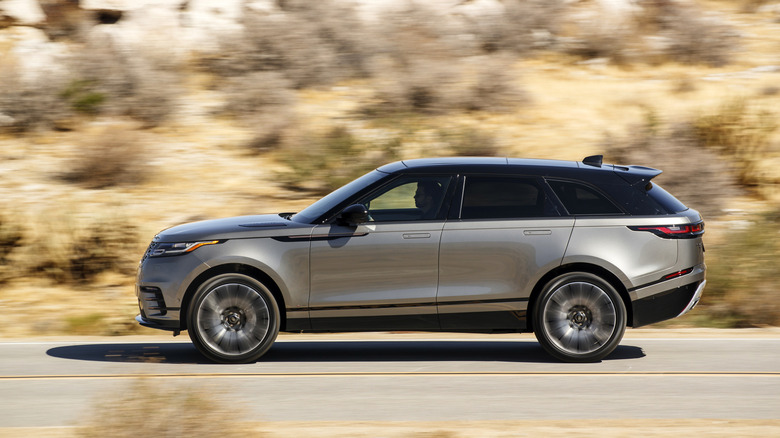
The Velar arrived for the 2018 model year as a compact luxury crossover with a sleeker silhouette than the firm's usual offerings. Right from the get-go, it was offered with a fairly gutless 247-hp turbocharged 2.0-liter inline-4, and that option stayed, following on from a mild makeover for the 2024 model year Velar. It was also offered with a 180-hp turbodiesel inline-4, although that choice had fizzled out by 2020.
Regardless of the somewhat lackluster base engine options, the Velar is still every bit a luxury vehicle. Ever since a 2021 update, the model has boasted clever tech, such as active noise-cancellation technology and an enhanced air filtration system, plus all the typical goodies one might expect to find within a premium SUV. Even on the base models, heated and perforated leather seats are standard, as is a panoramic sunroof, while higher trim levels introduce larger 21-inch wheels, a Meridian sound system, plus cooled seats.
While opting for a 247-hp Range Rover might seem a little uninspiring, not every buyer is going to be chasing a higher-output engine in such a vehicle. Some will be happy to take the very nearly $10,000 discount in choosing a P250 instead of a six-cylinder P400, perhaps if it's to be predominantly used in cities or on school and grocery runs rather than highway commutes.
Mercedes-AMG C63 S E Performance
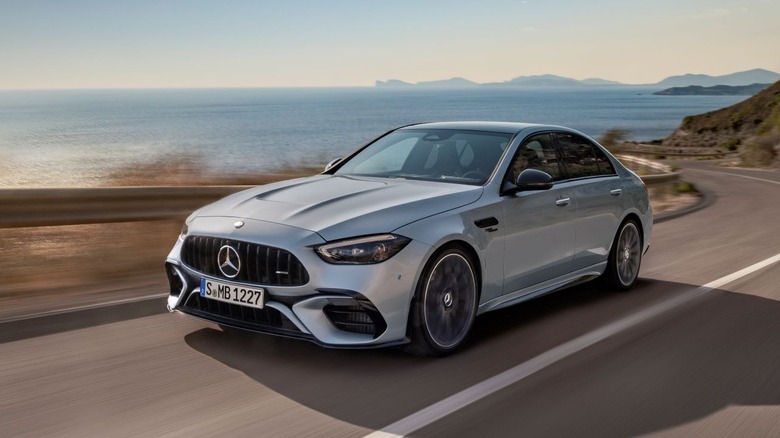
The four-cylinder C63 wasn't exactly a monumental excess, proving that downsizing can go too far, and upsetting purists and AMG enthusiasts by swapping out the thunderous V8s on which Mercedes' tuning arm built its reputation. As such, Mercedes-AMG is now killing the four-cylinder C63 in favor of an inline-6 C53, but on paper, the old four-cylinder car still got so much right.
Taking care of motivation is a boosted 2.0-liter inline-4, which works alongside an electric motor to produce a combined 671 hp — enough grunt to see it take the claim as the quickest production C-Class ever built. According to Car and Driver's testing, it can reach 60 mph in 2.9 seconds, 100 mph in 7.1 seconds, and cover the quarter-mile in just 11.2 seconds on its way to a 174-mph top speed. It does all this while still not ignoring the usual smattering of luxurious extras and options the tri-pointed-star brand is famed for.
Heated and optionally ventilated nappa leather seats accompany carbon-fiber trim, while a 15-speaker Burmester sound system is the standard affair. Buyers enjoy a panoramic sunroof as standard, along with wireless Apple CarPlay and Android Auto connectivity options. There's very little the C63 doesn't boast, in honesty, but that's surely what any buyer of a near-$90,000 C-Class should expect.
Lexus NX 350h
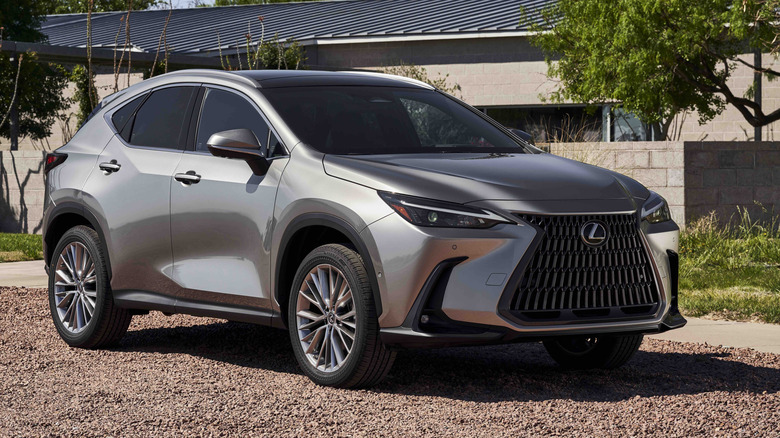
Lexus is the luxury arm of Toyota, and its models all boast plenty of premium features while also packing famous Toyota reliability — a trait often misplaced by its German competitors. The two brands share much with one another, including platforms and powertrains, and the 2027 NX 350h is no exception. The crossover shares its platform with the Toyota RAV4, and is offered in both front- and all-wheel drive. The former sports a naturally aspirated 2.5-liter inline-4 in addition to a pair of electric motors, while the latter boasts a trio of motors. In both instances, the combined output is a healthy 244 horsepower, and that oomph is channeled toward the wheels via a CVT.
It's no performance car, nor is it trying to be one, but with 0 to 60 mph times below seven seconds and a top speed of 124 mph, it's certainly peppy enough for most applications. Those with a hankering for more could always opt for the plug-in hybrid variant, which too boasts an inline-4 and a number of electric motors, but with a combined output of 324 hp. Details such as perforated leather seating, open-pore wood trim, 20-inch alloy wheels, and ambient lighting ensure the NX delivers a premium experience and help to differentiate it from its humbler Toyota roots. The NX Hybrid says the quiet luxury part out loud, but in our testing, it proved to be a genuinely enjoyable and comfortable luxury companion — inline-4 included.