

Airplanes Got ABS Brakes In The '40s — Production Cars Didn't Get Them Until The 1960s
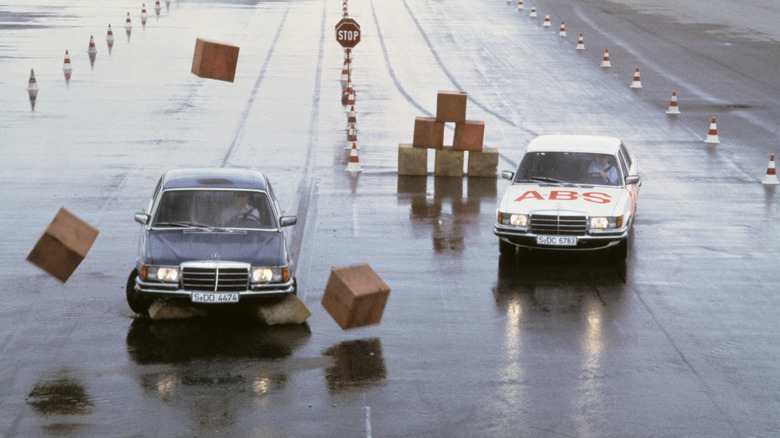
Anti-lock braking systems are one of the most important safety innovations in modern cars. They play a huge roll in the reduction of stopping distances, and they have been legally required as standard equipment on all new cars sold in the United States since Federal Motor Vehicle Safety Standard 126 became law in 2013. The massively beneficial technology has been on cars since 1966, but the idea of anti-skid brakes was already around for about two decades prior to its first automotive implementation.
As airplanes became jet-powered and grew faster and more powerful during the aviation boom of World War II, the tasks of safely landing and stopping those planes became more challenging. The Boeing B-47 Stratojet was the first mass-produced aircraft to ever employ an ABS system in 1947 using a system called Hydro-Aire Hytrol ABS, and Dunlop introduced its Maxaret ABS system in 1952.
Mercedes-Benz, known for its various safety innovations, is widely credited with producing the first mass production car with anti-lock brakes, but according to Hagerty, the first car to ever come fitted with such a system was actually the ultra-low production Jensen FF that was built from 1966 to 1971. It used an adaptation of Dunlop's Maxaret ABS system, but only 320 Jensen FFs were ever built, and none were officially exported to the U.S. The first application of ABS in a mass-production car eventually came from a U.S. manufacturer.
The 1971 Chrysler Imperial was the first mass production car with ABS
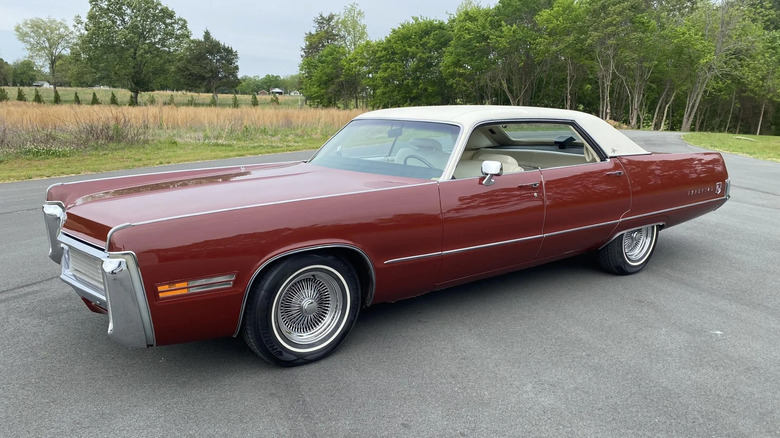
For the most part, credit goes to the 1971 Chrysler Imperial and its optional Sure-Brake system as being the first production car to offer an anti-lock braking system, since it prevented all four of the Imperial's wheels from locking up under panic braking. It was, however, what's called a three-channel anti-lock braking system, which means it used one brake-pressure modulator for each front wheel, and a single modulator to control brake pressure for both rear brakes.
Popular Science put a Sure-Brake-equipped Imperial to the test in 1970, and found the system to reliably prevent wheel lockup, even on ice. Road Test magazine tested a Sure-Brake-equipped Imperial in 1971, and noted how alarming the rapid clunking sound caused by the system's pressure actuation was, and complained about how it may further startle a panicked driver in an emergency situation, but again, the system prevented lockup. Sadly, Chrysler offered the system as an extra-cost option on 1971-to-1973 model year Imperials, but less than 5% of buyers opted for the system, so Chrysler canned it for 1974.
Where does Mercedes fit into all this?
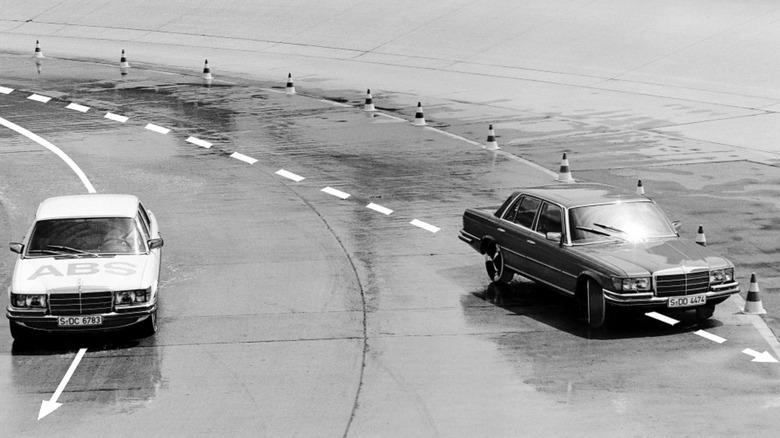
Though Chrysler's Sure-Brake was a computerized system, Mercedes and Bosch were the first to introduce a digital controller and implement the use of digital microelectronics in the 1978 S-Class, which paved the way for modern ABS. There are claims that the 1978 Mercedes-Benz S-Class was the first car to implement ABS, but to phrase it most accurately, it was the first four-wheel multi-channel anti-lock brake system to use digital microelectronics.
From their early roots stopping jets in short order, to safely stopping Jensen FFs, Chrysler Imperials, Mercedes-Benz S-Classes, and now every new car sold in the U.S., anti-lock braking systems have left a mark on transportation safety history. The technology has also paved the way for other pivotal safety innovations like electronic stability control (ESC), as well as performance and off-road features like torque vectoring and brake-based LSDs.