

Mercedes Set A New Safety Benchmark In 1959, And Now It's Everywhere
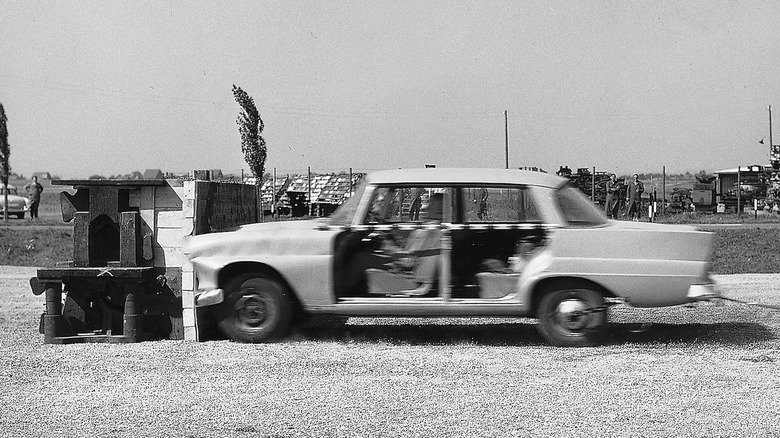
If you read any automotive safety reports, you'll see the words "crumple zone" a lot. Crumple zones are pretty simple in concept: areas of a car's body that intentionally crush, so as to let impact energy deflect away from the passenger cell in the direction engineers intend. However, despite the simple concept, crumple zones are among the most important aspects of automotive safety. And yet, the technology been around since 1959, when Mercedes-Benz first introduced it. The crumple zone set a benchmark for automotive safety, and it's a system still used by basically every single automaker today. It's no surprise that it came from Mercedes, the company that's still going to extreme lengths to invent new safety technology, like heated seatbelts.
Mercedes focused heavily on safety, following its reintroduction into mass-market auto manufacturing after WWII. It had been researching various safety tech in the 1930s and resumed that research when the war was over. But it wasn't until 1959 that Mercedes introduced several new safety features on the W111 (220SE) and W112 (300SE) chassis vehicles, one of them being crumple zones, or what Mercedes called "deformation zones."
The Father of Passive Safety
In 1939, Mercedes hired Bèla Barènyi, a Hungarian engineer who'd later earn the nickname "the Father of Passive Safety." Barènyi suffered permanent body stiffness after an inflammation of his hip as a child. So, in his free time as a kid, he read technical literature, sparking his passion for mechanical and electrical engineering, which he would later study at college. After college, he made a couple of stops at both Steyr and Fiat before landing at Mercedes. It was there that he came up with crumple zones, as well as many other safety features.
The "safety body," as Mercedes called it, was comprised of three sections: a front crumple zone, a rigid passenger cell, and a rear crumple zone. The idea was for the soft crumple zones to absorb much of the impact energy of a crash, before it reached the passenger cell. According to Mercedes, Barènyi came up with the idea in 1951, but it wasn't put into production until 1959.
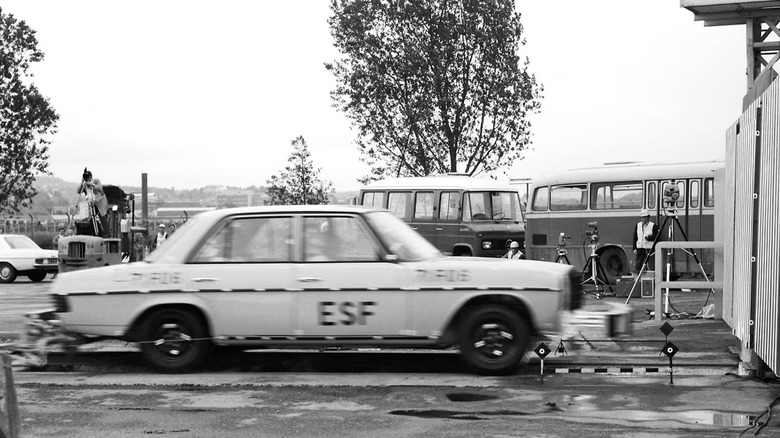
That was far from the only safety innovation to come from Mercedes at the time. In 1949, the conical door pin lock debuted to keep doors closed during a crash. Also, around the same time as the W111 was debuting, Mercedes introduced systemic crash testing at its Sindelfingen, Germany plant. In 1973, Mercedes would go on to develop the offset-frontal crash test to replicate more accurate real world crash results, further improving safety. While it's unclear how many of these inventions Barènyi had his hands in, his influence was so impactful that, according to the Automotive Hall of Fame, Mercedes ran an ad with him in 1993 saying, "No one in the world has given more thought to car safety than this man".
Crumple zones are still among the most important safety features
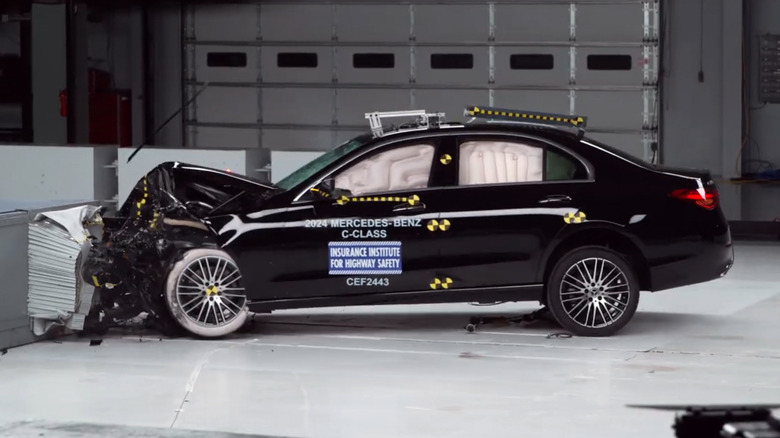
Modern crumple zones work similarly to how Barènyi designed them back in the day. Car structures are still pretty much broken down into three sections, front and rear crumple zones with a passenger cell sandwiched in between. Obviously, technology has advanced dramatically since Barènyi's days at Mercedes, but the idea is the same.
There are two main purposes to crumple zones. The first is to absorb impact energy. By being made of thinner and softer metals, or even various composites, they quite literally crumple upon impact, taking the brunt of the force before it reaches the passenger cell. The second purpose is to begin slowing the vehicle down, so by the time the passenger cell is impacted, it's already moving at a slightly slower speed, reducing the sudden deceleration felt by passengers. The most famous proof of the effectiveness of crumple zones, among other safety features, is the Insurance Institute for Highway Safety (IIHS) crash test between a 1959 Chevy Belair and a 2009 Chevy Malibu. They hit each other head on in the front offset test, and it's frighteningly clear which car is the safer of the two.
This technology has become such a staple that if a modern car is built without crumple zones, like the Tesla Cybertruck, most experts would say that it's an unsafe design. Despite safety regulations getting tougher and tougher to meet, cars are safer than ever, and a technology from more than half a century ago is a big reason why. So, Barènyi's design and Mercedes' engineering prowess created a technology all the way back in 1959 that's still saving lives today.