

9 Classic Plymouth Models And What They're Worth Today
Hopefully you haven't been in a coma for the last 25 years, because you'd be shocked to know that the once-great Plymouth has been dead since the turn of the century. Even more depressing is that the end of this storied brand was pretty ugly. In the 1990s, the vast majority of Plymouth's lineup consisted of badge-engineered versions of various Japanese cars or leftover Dodge products, and it was still only able to muster up about half of Dodge's sales. At the very end, the retro-modern-styled Prowler was the brand's only true Plymouth-designed model.
When it was finally put on the chopping block in 1999, Plymouth was simply not a part of Chrysler's future plans. Done and dusted. But nobody really cares that Plymouth went out at a low point — it's not like we judge Michael Jordan's career based on his final seasons with the Washington Wizards, right? Right.
Plymouth, despite its quiet and underwhelming demise, was a pillar of the American auto industry and delivered some of the most timeless Mopars of the 20th century, some of which you may be interested in for yourself. If that's the case (or if you're simply curious about values), we've conjured up a mix of desirable and important Plymouths, each with an up-to-date estimated value from Hagerty for you to compare against your bank account... and your better judgment.
1959 Plymouth Sport Fury
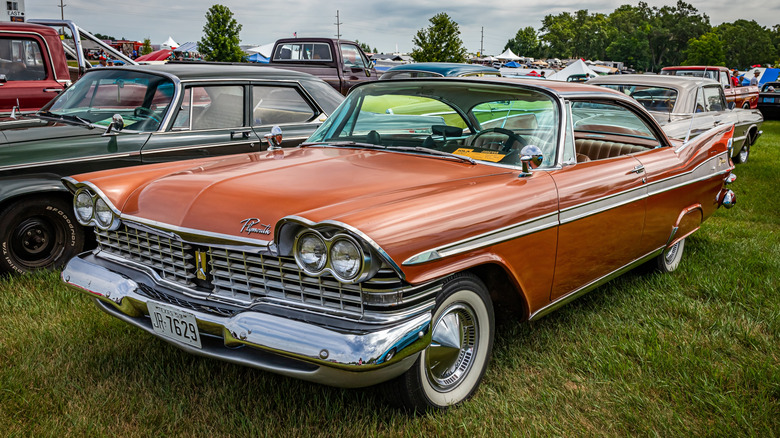
In contrast to the bleak 1990s version of Plymouth, mid-1950s Plymouth was convincingly in the fight for industry-leading sales figures. It was one of the top three brands in the U.S. by sales in the early part of this decade, but its hold was slipping, and the Plymouth Fury nameplate was one small part of the plan to get this train back on track. The Fury first arrived in 1956 as the high-performance trim of Plymouth's full-size Belvedere. For three model years, the Fury name continued as a mere option (these "sub-series" Belvedere Fury models are actually quite rare), but in 1959, the Fury was spun off as a standalone model.
But now, the Fury itself needed a high-performance trim; hence, the Sport Fury. It only came in two-door configurations, with a hardtop and a slightly more expensive convertible option for those in sunny climates. And because it was the king-of-the-hill version of the Fury, the Sport Fury ditched the typical 230-horsepower two-barrel-carbureted 318 V8 and opted for the four-barrel, 260-horsepower version of the 318 V8 as the standard engine option. There was even an optional 361-cubic-inch "Golden Commando" V8, which boosted the Sport Fury's output to 305 horsepower.
Aside from the motors, the 1959 Sport Fury was a slick piece of machinery at the time, featuring an air-powered leveling system for the rear suspension, swiveling seats (safety first, of course), and an automatically dimming rear-view mirror, among others. In 1959, a Sport Fury cost just under $3,000 (around $30,000 in today's money). Coincidentally, for a good-condition Sport Fury equipped with its standard 318 V8, the estimated value today comes out to around $30,000.
1967 Plymouth GTX (440)
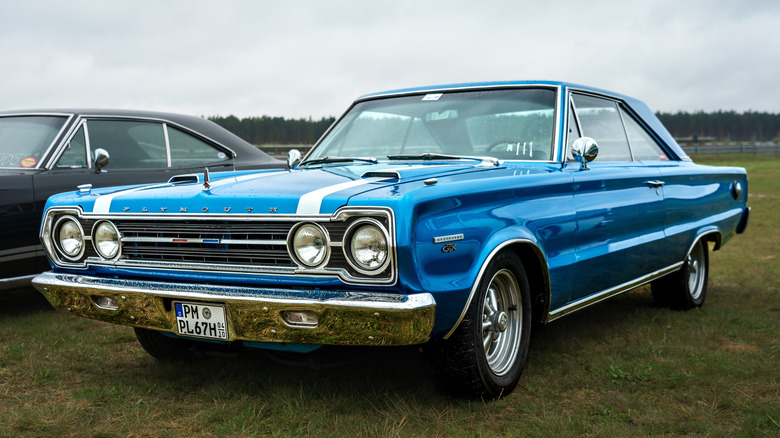
The Plymouth GTX, also known as "the gentleman's muscle car," appeared right in the midst of the whirlwind of Mopar muscle competition in the mid-to-late 1960s. There was the Satellite, Barracuda, Charger, and eventually the Road Runner, Duster, and Challenger, all vying for the hearts and wallets of those partial to a bit of straight-line speed. And because this came before the Road Runner, the GTX was Plymouth's first real attempt at making a hot Belvedere-based muscle car.
But the GTX isn't just special because it was one of Plymouth's very first attempts at a high-performance automobile. Rather, it's because the GTX never settled for dipping a mere toe into the horsepower wars — it dove straight in. Like LeBron James going directly from high school to the NBA, the GTX's standard engine was the 375-horsepower "Super Commando" 440-cubic-inch V8. Additionally, the only optional engine aside from the standard 440 was the venerable 426 Hemi — quite a brochure, no?
However, the 440-powered car is our featured spec for this piece, as the GTX's classic status is truly defined by the fact that its standard powerplant was usually a pricey box to check on the options list. This wasn't just a marketing ploy either. The '67 GTX was an extremely quick automobile in the grand scheme of low-tech American cars at the time. Its 6-second 0-to-60 time was extremely impressive in the mid-1960s, when the vast majority of even performance cars couldn't break the 7-second mark. In fact, the V8-powered Maserati Ghibli from the same year managed only 6.4 seconds and cost about six times as much. Speaking of money, the GTX is now a fairly reasonable purchase in the muscle car sphere, with average valuations of around $44,000 for good-condition examples.
1968 Plymouth Valiant
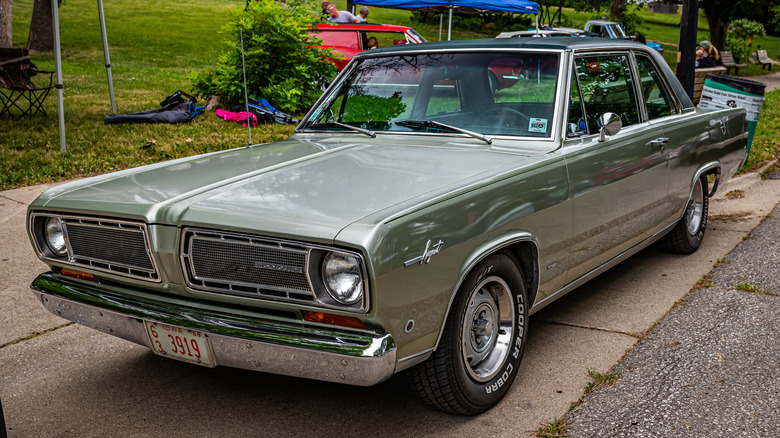
The redesigned Plymouth Valiant arrived on showroom floors for the 1967 model year and was a true people's car. A base model cost just a smidge over $2,000 (approximately $20,000 today); it could seat five people, came in two body styles, and housed dependable engines — all the average family would need for the daily drive to work, school, or a night out.
Our featured spec, however, is the 1968 Valiant. In its '67 debut, the engine options consisted of cost-conscious straight-six engines, or "slant-sixes" as Chrysler called them at the time, with one measly 180-horsepower 273-cubic-inch V8 to top off the range. But in 1968, Plymouth added the now-tried-and-true 318 V8 as an option. This promised 230 horsepower under your right foot, which could convincingly keep up with your average pony car of the time. Today, one might say a well-kept 318-powered Valiant is a unique and classic cruiser with plenty of comfort and potential for speed parts thanks to that small-block Mopar.
But is it really a classic? By definition, its age alone qualifies it, but as a collector's item, it's understandable that the average enthusiast might pass on one of these. But then again, a classic is a classic, and not everyone can afford a six-figure muscle car. Some of us feel more comfortable in the low five figures, which is why this serves as the perfect counterweight to some of the heavy hitters you'll see soon. In good condition, a 318 Valiant can be had for around $11,500.
1968 Plymouth Sport Satellite
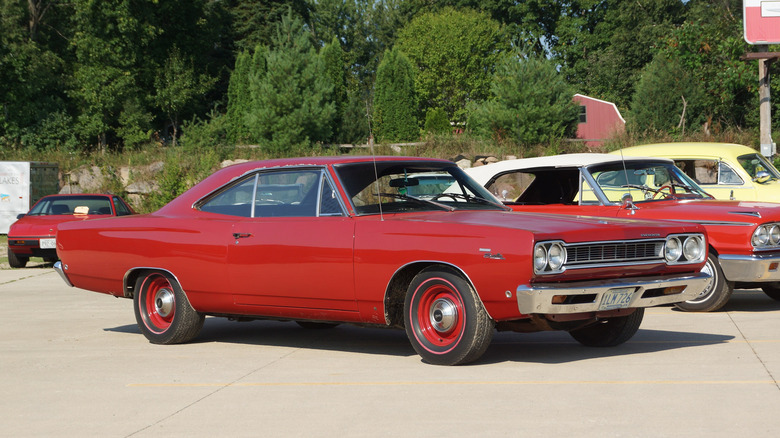
The Satellite was yet another close relative of the Belvedere B-body platform. Introduced in 1965, the Satellite served the role of a slightly more upscale and sporty version of the Belvedere, reflected by the fact that it was a two-door hardtop or convertible originally. However, by 1968, the Road Runner came along and quenched the thirst for a sporty, two-door-only model, so the Satellite was given some more liberties, including a swath of new body styles, such as a four-door sedan and a wagon that could seat six or nine passengers, as well as our featured spec, the Sport Satellite trim.
But this pivot towards the mass market didn't mean it had to give up the good V8s. For 1968, the Sport Satellite could be equipped with either the two-barrel carbureted 318, or one of two versions of the big-block 383 — one with a two-barrel carburetor good for 290 horsepower, and another with the high-performance four-barrel, which was rated at 330 horsepower. The 440 was reserved for the GTX, and the Hemi for the GTX and Road Runner, of course, but the 383-powered Satellites provide more than enough grunt to satisfy muscle car enthusiasts.
Not to mention, these share a nearly identical body style to the Road Runners of the same era, but the Road Runner name typically holds far more weight in the eyes of a collector, meaning a well-equipped Satellite is a good alternative. In 2026, values for a four-barrel 383-powered Sport Satellite coupe hover around $38,000 for examples in good condition.
1969 Plymouth Hemi Road Runner
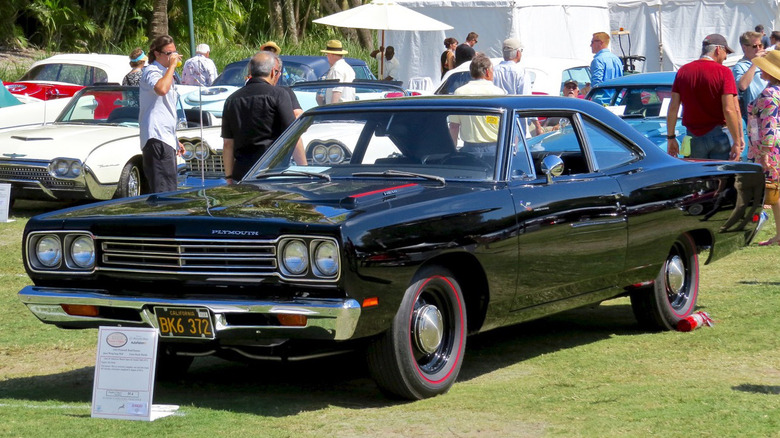
If you want to talk about nameplates that are synonymous with their brand, then the Road Runner is a prime example. Whereas many other iconic muscle cars were originally conceptualized as regular automobiles before leaning into a horsepower-dominant aesthetic, the Road Runner spawned from Plymouth's need for an affordable muscle car that could utilize the B-body platform.
After Plymouth paid Warner Bros. $50,000 (about $500,000 in 2026) for the rights to use its Road Runner name and character from the Looney Tunes universe, the Coke-bottle-shaped car first arrived for the 1968 model year, offering nothing smaller than Chrysler's 383-cubic-inch V8, capable of 335 horsepower out of the box. Of course, a 440 Six Barrel was eventually available, but who wants a 440 when you can have a Hemi? The Hemi Road Runner produced an advertised 425 horsepower and 490 pound-feet of torque and was available with slightly modified versions of the standard four-speed or TorqueFlite three-speed automatic transmissions.
The Road Runner was a popular car, outselling the GTX by around 25,000 units in its first year, but as one could imagine, factory Hemi-powered Road Runners are not an easy find these days. Not only were they expensive at the time — about $4,300 in 1969, or $40,000 in today's money — but fewer than 800 were ever fitted with the top-dog motor for 1969, and even fewer are still in operating condition nearly 60 years later. As a result, a good-condition Hemi Road Runner coupe is estimated at around $92,000, with rarer color combinations and low-mileage cars fetching far above that.
1971 Plymouth Hemi 'Cuda
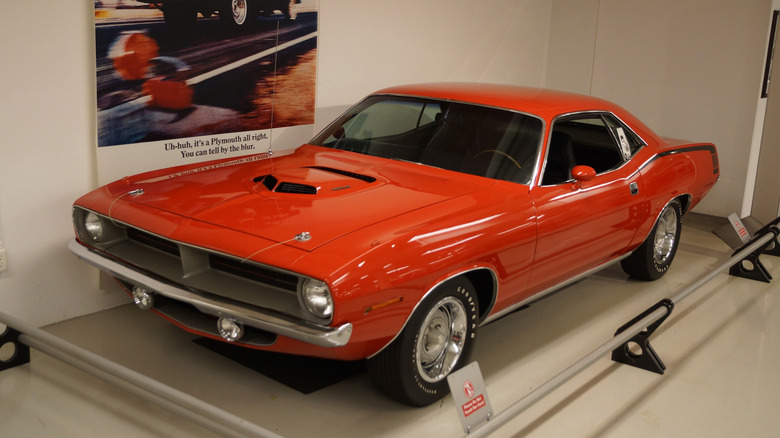
We said that Plymouth shouldn't be judged solely on its unfortunate end, but, damn, does it hurt even more, considering this automaker put together the definitive holy grail of muscle cars and the most collectible and desirable of its kind. And let's address the elephant in the room — the Hemi 'Cuda is easily the most expensive car on this list of classics. Valuations put a good-condition 1971 Hemi 'Cuda hardtop at around $278,000, a price comparable to what you'd pay for a brand-new Porsche 911 GT3 S/C.
At first glance, the 'Cuda looks like a purpose-built performance machine, and it was... at least, the third-gen cars with the 426 Hemis were. The original A-body "Barracuda" debuted in 1964 and was targeted directly at a little pony car called the Mustang. And it's safe to say that it didn't make the impact Plymouth was hoping for when compared to the Blue Oval's pony. But by the third generation, the 'Cuda seemed like it was less concerned with sales and more about horsepower. It got larger, wider, and a whole lot angrier.
The regular third-gen Barracuda kept its original name and could be had with one of two straight-six engines as well as V8s as large as 383 cubic inches. The official 'Cuda name was reserved for higher-trim variants, like the Hemi examples we're focusing on today. Engine options included a 383 V8, a 340 V8, two 440 V8s (one with a four-barrel carburetor and the other with a Six Barrel configuration), and of course, the 426-cubic-inch Hemi. After 1971, the Hemi option was discontinued, and the Barracuda as a whole wouldn't see a model year beyond 1974.
1971 Plymouth Duster 340
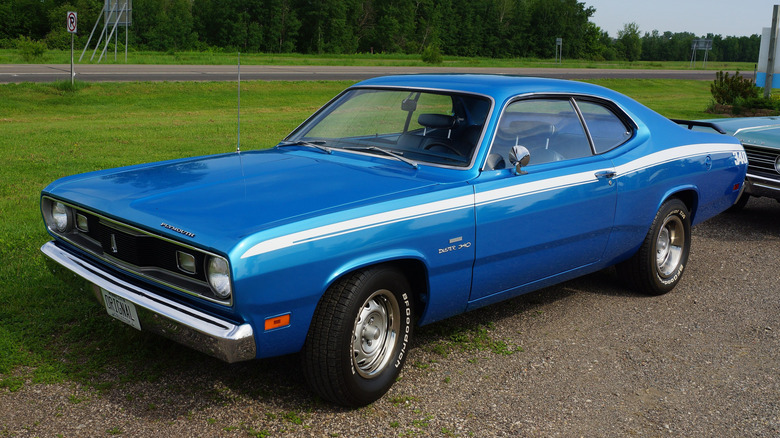
Much is said about the lost concept of the dirt-cheap, "ratty" muscle car from past decades, and even more is said about which one defines that idea the best. But digging into the history behind these machines reveals that the Duster, which debuted in 1970, is the one true choice. According to MotorTrend, when designers Milt Antonick and Gene Weiss were crafting the Duster's original appearance, they literally referred to its design philosophy as "junkyard styling" and utilized designs from several other existing Chrysler products.
The Duster's purpose was to take the A-body platform and create a small, affordable car that could play into both the mass-market segment and the hot, performance-oriented market, meaning it would feature a fairly well-spread range of engines and trim packages. Available engines included 198- and 225-cubic-inch slant sixes, a 318 V8, and the topic of our discussion today, the 340. This top-dog engine was the centerpiece of its own special trim level, predictably named the "Duster 340." This engine featured upgraded cylinder heads, a forged crank, and a four-barrel carburetor, which combined for a solid total output of 275 horsepower and 340 pound-feet of torque.
This package also included larger tires, as well as upgraded sway bars, torsion bars, and springs. Sadly, the Duster 340, in its best form, only existed for the 1970 and 1971 model years, as looming regulations would dampen its potency starting in 1972. Fewer than 13,000 examples of the Duster 340 were built in 1971, but because it was a slightly milder performance muscle car compared to other contemporary choices, average values are palatable at around $34,000 for a good-condition Duster 340.
1992 Plymouth Laser RS Turbo
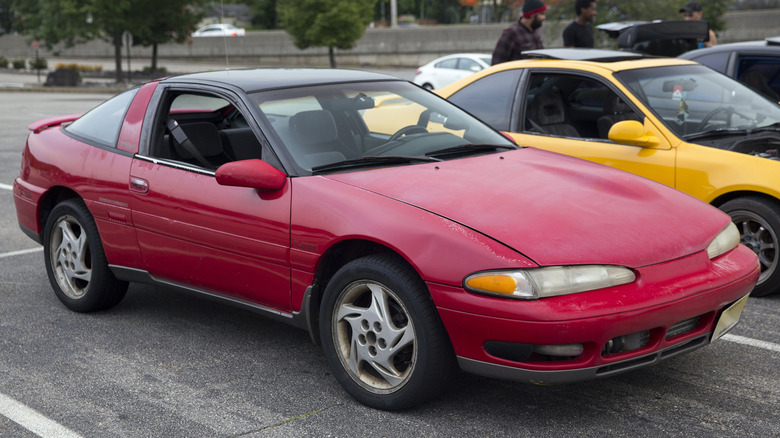
Mitsubishi and Chrysler's relationship ended up being a great help when Chrysler was recovering from nearly going out of business in the 1980s. Later on, both companies needed each other even more to meet a growing demand for affordable and efficient Japanese cars in the U.S. amid Japan's export limits. This is when the two came together to create Diamond-Star Motors — a joint venture in which Chrysler helped pay for a shared factory in Illinois and Mitsubishi ran it, building cars that each company could badge as its own.
The Plymouth Laser is a direct product of this DSM partnership, and our featured "classic" pick is the 1992 RS Turbo. The word "classic" is in quotations, because after those like the GTX and Hemi 'Cuda, a Mitsubishi-based squirt like the Laser feels a bit out of character. However, in recent times, these sometimes turbocharged and all-wheel-drive variants of the DSM triplets (Plymouth Laser, Eagle Talon, Mitsubishi Eclipse) have experienced a resurgence in enthusiast appreciation. And it's no surprise why.
The 1992 Plymouth Laser RS Turbo utilized a turbocharged 2.0-liter Mitsubishi four-cylinder engine that produced a hearty 195 horsepower. Additionally, every Turbo model could be had with all-wheel drive if the customer desired. If they did, then a five-speed manual transmission was required. All in all, these cars were solid packages at the time, and while they weren't built to the highest standard of quality and featured goofy giant hood bumps that weren't even for the turbos, current values for '92 model-year examples are only around $9,000 for units in good condition — a price so low that you can overlook squeaky interior items and cheap plastics. Oh, and don't forget that Tina Turner was a Plymouth Laser spokesperson, may she rest in peace.
1997 Plymouth Prowler
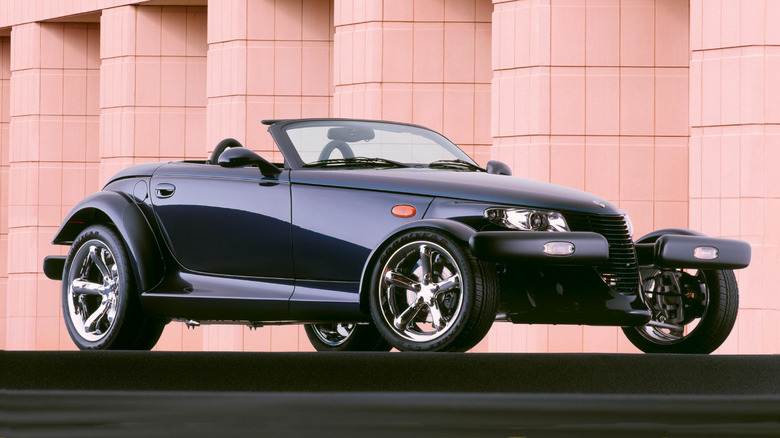
The Plymouth Prowler debuted in 1997 and was the true impetus of the retro-modern styling movement that would follow over the coming decade... or just a rolling midlife crisis, depending on who you ask. It was many things — bold, flashy, old-school, and completely insane, of course. But one thing it wasn't was fast. If there were a single car that didn't come with a V8 but desperately needed one, it was this 1930s-esque roadster hot rod. Instead, it was available only with a 214- to 253-horsepower 3.5-liter V6 and an automatic transmission — one of several reasons why it didn't end up a major success.
But we've included the Prowler here because, despite its failures, it was a quintessential product of its time. Chrysler had already done crazy things like the Viper earlier in the decade, which garnered attention and excitement for the brand. Not only was the Prowler created to serve a similar purpose, but it was to be a case study in aluminum car building — something that was slowly becoming the industry standard at the time. At the end of the day, how can you not include the Prowler when discussing notable Plymouths?
It was never meant to be a mass-production vehicle; in fact, fewer than 12,000 were ever built, including when it was badged as a Chrysler following the gutting of Plymouth in 2001. But it served its purpose, setting Chrysler up with newfound knowledge that would come in handy in the new century. Since its discontinuation around 25 years ago, the Prowler has, of course, acquired cult status for its outlandish yet familiar presence, putting a good-condition 1997 at around $24,000 — a small price to pay to be the envy of boomers everywhere.