

Peugeot RCZ Vision Is A Fabulous Follow-Up To One Of This Century's Most Beautiful Cars
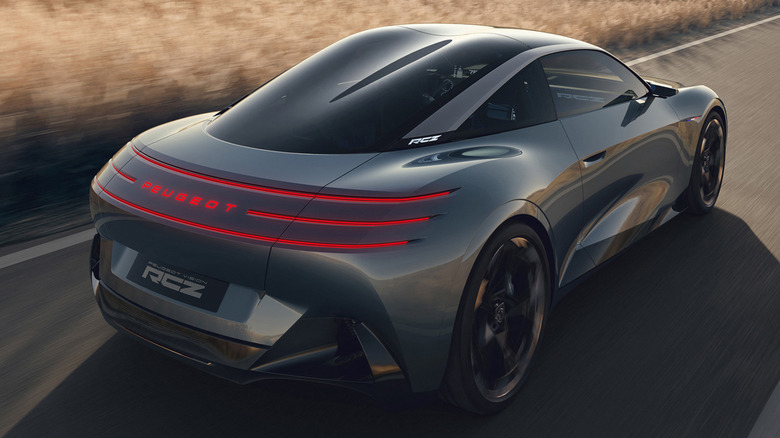
I'm of the strong mind that the French have produced by far the most beautiful and fascinating car designs in history (that includes both French automakers as a whole and individual designers who are themselves French), and that has pretty much always been the case. In our modern era French cars are cooler and more exciting than ever — just take one look at everything that's come out of the Paris Motor Show. My personal favorite reveals of the show is the Peugeot RCZ Vision, which imagines a new generation of one of this century's most beautiful cars.
Front-wheel-drive coupes aren't often sensational lookers, but when Peugeot first showed off the original RCZ in concept form in 2007, it dropped jaws around the world, prompting the automaker to put it into production two years later. The RCZ's standout feature was its double-bubble roof and rear window, but even putting that aside, the coupe's proportions, recognizable face, prominent rear fenders and pert rear end made it unlike anything else on the road.
 Peugeot
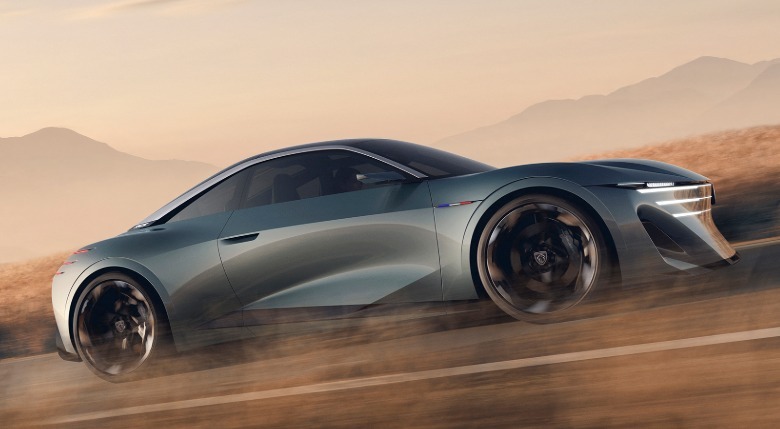
The automaker says the new RCZ Vision is just a show car, "the ultimate expression" of Peugeot's upcoming Feline Future design language, but there's a strong chance it could make it to production. Speaking to Autocar, chief designer Matthias Hossann said practicality and usability were a priority to make it as realistic as possible, thus why it has four seats, and that Peugeot sees room in the market for a car like this. It'll all depend on customer demands, so if you're lucky enough to live in a country where Peugeot sells cars, please, start calling your dealers and demanding a new production RCZ.
The steering wheel will reach production, at least
Peugeot says the RCZ Vision uses a next-generation version of the modular STLA One platform, with a solid-state battery developed with Factorial Energy that has a 1000-volt architecture and can be charged from 10% to 80% in 10 minutes. The company doesn't say how many electric motors the concept has, but I imagine it would get a dual-motor all-wheel-drive setup, and Peugeot does quote 500 horsepower, a range of 373 miles on the WLTP cycle, and efficiency of over 5.4 mi/kWh, which would be very impressive.
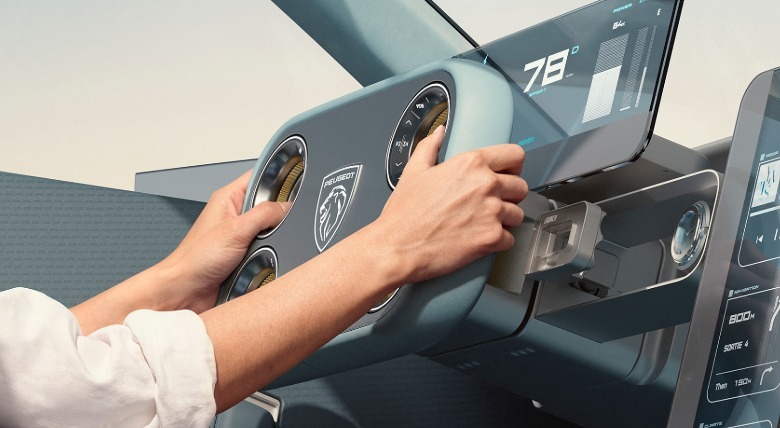
This is the first Peugeot, concept or production, to feature a brake-by-wire system, which offers "more precise braking modulation and seamless integration of regenerative braking." A bigger deal that's already confirmed to be coming to production Peugeots is a steer-by-wire system that uses the brand's Hypersquare steering wheel. This is going to be offered on the new e-208 that goes on sale next year, and what you see in this concept is what the production Hypersquare will look like. No, for real. You hold the wheel at the circles on top, with your thumbs able to hit the buttons and control rings that create the "spokes."
 Peugeot
Maximum rotation requires slightly less than one full turn of the Hypersquare wheel, instead of three turns with a regular mechanical steering setup. The steering ratio changes depending on the speed and situation; at low speeds Peugeot says it "makes every maneuver quick and easy," particularly when parking and navigating around tight city streets, while at high speeds it's set up for smoothness and composure. The company says this system also negates vibrations from bad road surfaces.
I'm ready for the Feline Future
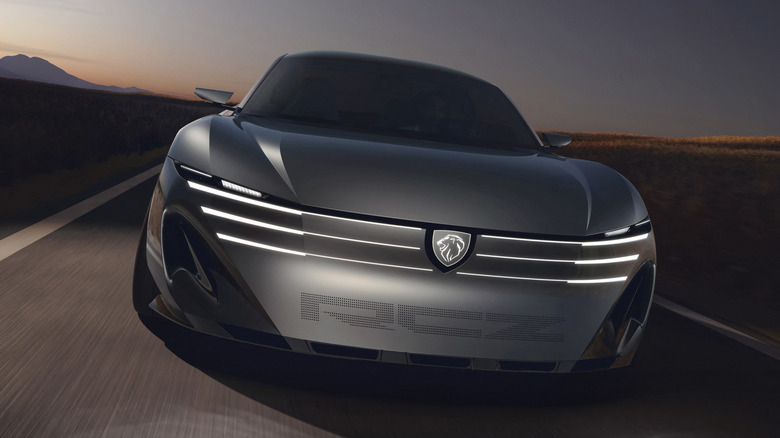
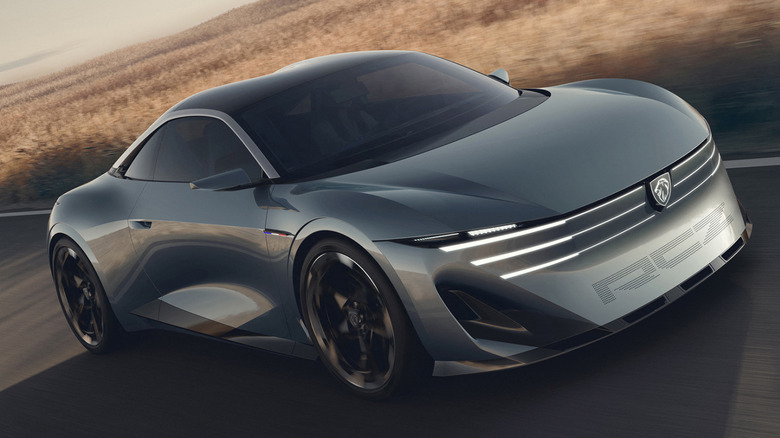
Yes, I did say that Peugeot's new design language is called Feline Future at the top of this story. Doesn't that rule? The company says it's driven by five words: "Freedom, courage, elegance, inner force, and instinct." The feline theme didn't just come from the car design trope of using an animal ready to pounce as inspiration, though Peugeot does mention that specifically when talking about the RCZ Vision's profile. No, the front end straight up looks like a cat. Peugeot has been doing three claw mark lines as its headlight signature for a while new, but new models will have three whisker-like light lines running all the way across the front end, pairing with slim headlights and a prominent badge to create a real face that Peugeot calls "the lion's gaze."
There are triangular intakes in the corners of the front bumper, which juts out like a jaw and has RCZ written in perforations. Though it does still have front-wheel-drive proportions, the Vision concept has a much more dynamic silhouette and stance than the old RCZ, and the more angular lines and surfacing suit its shape. It's still got chunky, boxy fenders, with 21-inch wheels up front and 22s in the rear. Peugeot says the battery pack is just 4.3 inches thick, helping keep the body looking lithe.
Double the bubbles
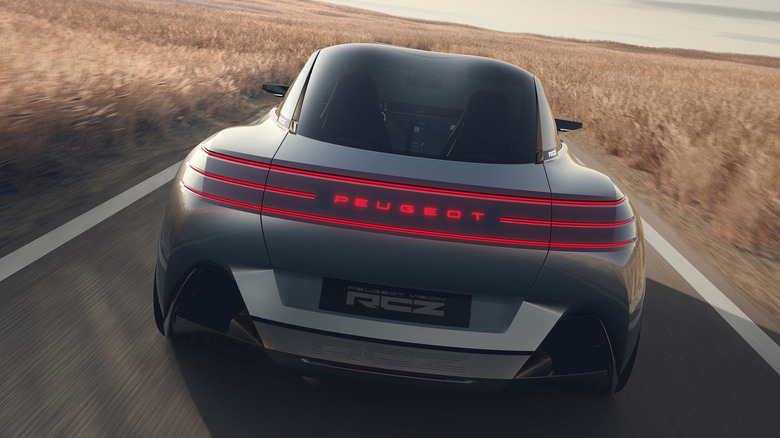
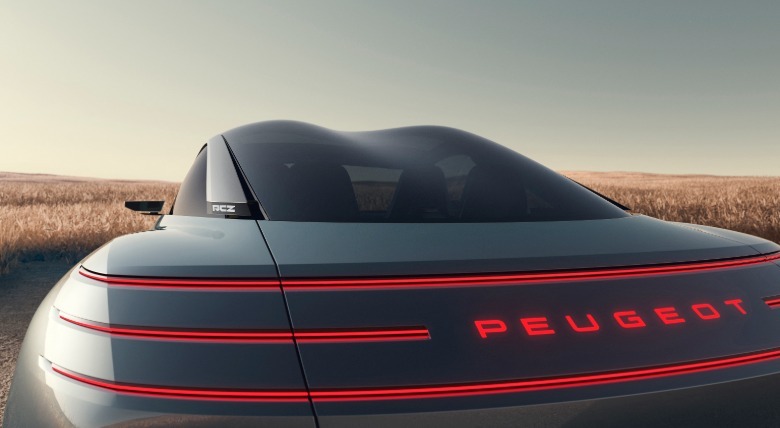
The roof was the star of the show on the original RCZ, and the same is true with the Vision. Its silver trim along the sides of the roof is sharper, kinking downward to form the C-pillar that has an illuminated RCZ logo at the base of it. The double-bubble roof is two panels with a structural beam under the seam between them, another hint that Peugeot's designers took production pretty seriously when designing the car. The roof panel itself is transparent, with the pair of bubbles starting there before really intensifying as the long back window begins. It looks absolutely fabulous, and doesn't feel out of place with the hard-lined exterior.
It's still got a nice round booty, too. Three taillight lines stretch across, set into little three-dimensional ridges with an illuminated Peugeot script in the center. The rear bumper isn't too fussy, echoing the intakes of the front end with RCZ perforated into the center of the diffuser, and an active spoiler sits at the base of the rear window. Calm down the bumper designs a bit and give it more regular glass glazing, and I think the RCZ Vision could easily translate to a production design.
Designed for minimal distractions
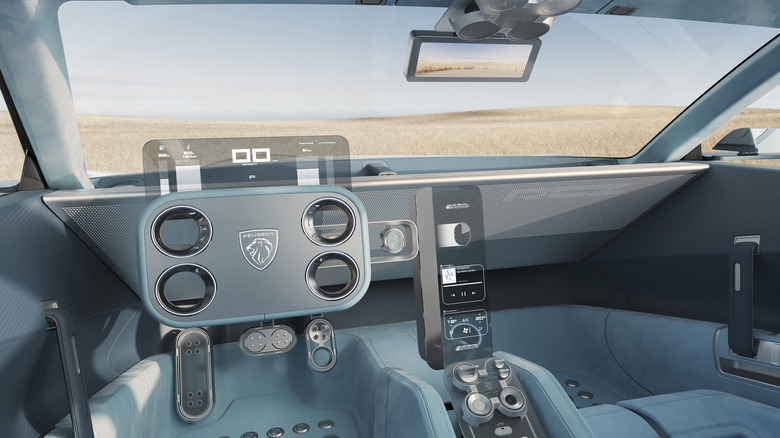
OK, the interior is obviously all concept-car stuff, but the packaging at least isn't that far-fetched. There isn't even really a dashboard per se, but an angled aluminum panel designed for maximum passenger room. Air vents disappear when not in use. It has transparent micro LED displays floating in front of the dash instead of traditional touchscreens, and a clock created by Serica is integrated into the support for the center display. Peugeot says it focused on reducing driver distractions and presenting information in a non-intrusive way, and to that end the center display can be completely switched off.
 Peugeot
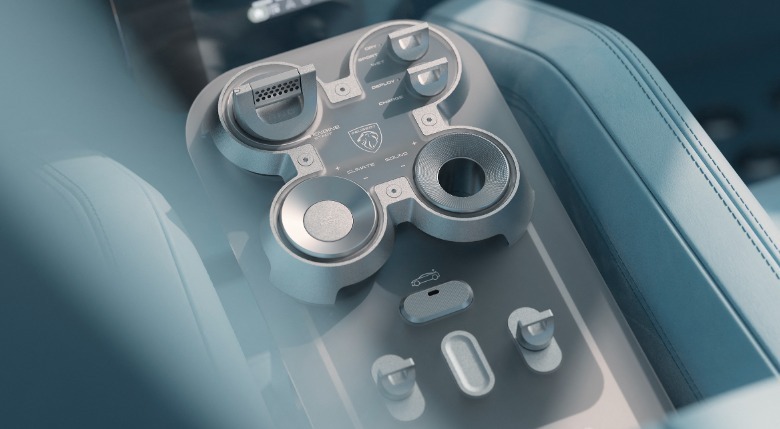
The frosted glass center console has a bunch of machined aluminum controls like toggle switches for drive modes, dials for climate and sound, and start/stop knob that looks wonderful to twist. The Hypersquare's four round holes are echoed there, in the console in the roof, and in details like the pedal shapes and floor mats.
 Peugeot
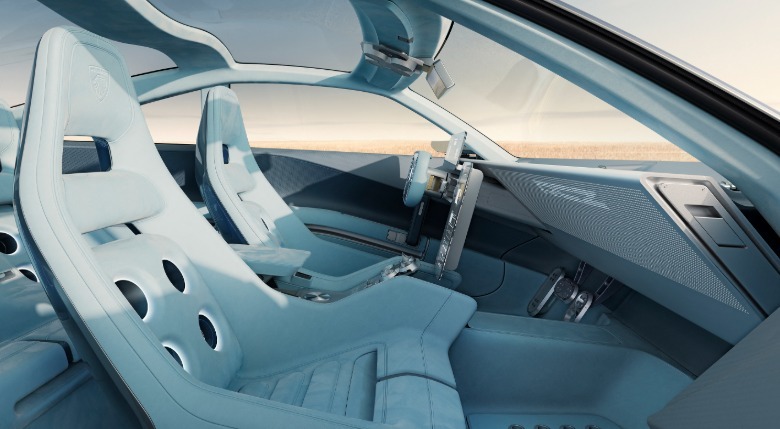
The bucket seats are asymmetrical, with taller bolsters against the center console (partially to protect it because it is glass, after all). The Pelinova leather upholstery was made using recycled offcuts from the leather industry, like untanned leather that would usually be unused, and the leather and Alcantara are finished in some lovely shades of blue.
Adults fit in the back
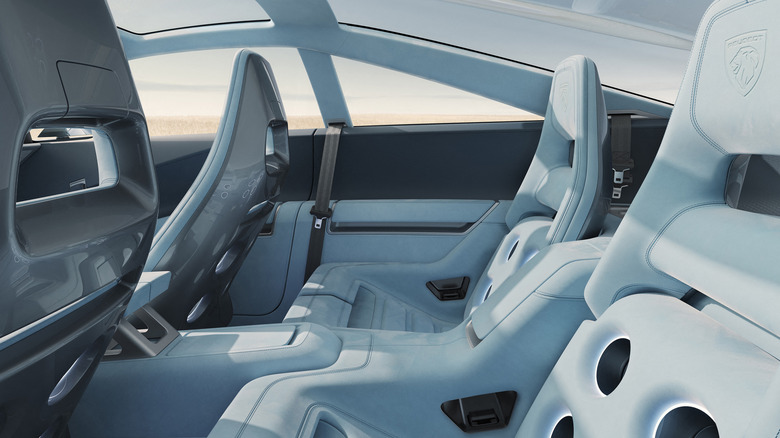
Peugeot says "passengers can easily access the rear" and that actual adults have enough space in the back seats, and those two rear seats' headrests can fold down for more cargo space. They're just as nicely sculpted as the front seats, with round cut-outs that have illuminated rings and the Peugeot logo embossed on the headrests. The original RCZ had a regular coupe-style trunk, probably because it would be very hard to engineer that double-bubble glass to be a hatch or liftback, and the same is probably true with the Vision, sadly. Visibility looks great, though, as does headroom for the back seats thanks to the bubbles.
 Peugeot
Don't expect to see transparent screens or glass-backed controls on production Peugeots yet, but the Feline Future is coming soon. Peugeot will be launching the new e-208 in a few months, which will have this same exterior design language and the Hypersquare wheel inside, and this look and technology should quickly spread across the whole lineup. Hopefully, in the near future, that will extend to a production RCZ.
"We are setting out our vision with a car firmly focused on the future, dedicated to delivering the ultimate driving pleasure. With emotion at its heart, this manifesto embodies the boldness of Peugeot and shows that design and technology can work together seamlessly to create an experience that is instinctive, refined and intensely desirable," said Alain Favey, Peugeot's CEO. To that, all I have to say is, "meow!"