

Modern Turbo-Four Muscle Cars Are Still Better Than Old V6-Powered Base Models
Base model muscle cars are all too often the butt of the joke in the world of automotive enthusiasts. Of course, the V8s that gave these cars their macho title in the first place are the preferred powerplants, but I am a huge fan of the idea of a more affordable yet still entertaining base-level muscle car. Back in the day, the base engines that automakers offered in their muscle cars were pretty pitiful, and often ended up being rather uninspiring V6s pulled out of a brand's family car. Modern base muscle cars catch a lot of flack for not even having six cylinders under their hoods, but rather a meager turbocharged four-cylinder, but I think this is a good change.
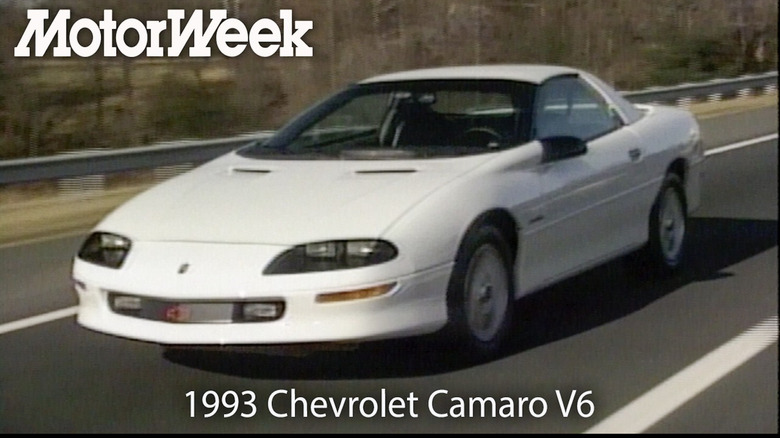
MotorWeek's latest Retro Review is centered around the 1993 Chevrolet Camaro V6, which was the base engine at the time. Though I'm aware that old automatic transmissions like the 4-speed auto in MotorWeek's test Camaro were the antithesis of sporty, I was still shocked by the 8.8-second 0-to-60 time of the base powertrain. That was over half a second slower than, wait for it, a Nissan Altima of the same model year. Granted the 1993 Nissan Altima that MotorWeek tested had a manual transmission, I still cannot imagine a world where even a base Camaro is so handily beaten by a four-cylinder Nissan Altima.
We've come a long way since 1993
Sadly the Chevrolet Camaro has been discontinued again, but when its most-recent generation debuted in 2016, the base turbocharged 2.0-liter four-cylinder engine produced 274 horsepower and 295 lb-ft of torque. Car and Driver clocked a 5.4-second 0-to-60 time in a 2016 Camaro 2.0T with the six-speed manual transmission, which is over half a second quicker than a V6-powered Nissan Altima of the era. Plus its lighter weight meant it received ample praise for providing genuinely athletic handling dynamics, which is something that the 1993 Camaro could claim.
The Ford Mustang EcoBoost is a similar story, and thankfully one that's still on sale today. Its turbocharged 2.3-liter four-cylinder engine produces 315 horsepower and 350 lb-ft of torque, and though it's only available with a 10-speed automatic transmission, it returned a 4.5-second 0-to-60 time in Car and Driver's tests. That's significantly quicker than any family sedan, even a whole-second quicker than the hallowed Honda Accord 2.0T. When MotorWeek tested a 1997 Mustang V6 convertible with the four-speed automatic, it returned an even sadder 0-to-60 time of 10.1 seconds. Even a now-outdated 2015 Mustang EcoBoost Convertible with the six-speed automatic did the sprint in a still-quick 6.1 seconds in Car and Driver's testing.
Turbocharged four-cylinders have another benefit when compared to V6s that is admittedly dependent on driving style, and that's fuel efficiency. When driven reasonably, turbo fours generally return better fuel economy than V6s, and though that isn't necessarily the case when the driving gets spicier, the end result is still a capability of achieving performance that's superior to a V6, efficiency that's superior to a V6, and weight savings when compared to a V6. Mercedes-AMG learned the hard way that you shouldn't replace a performance car's V8 with a four-cylinder and expect sales success, though, and I'm not here to argue with that.