

2026 Ford Mustang GT Manual Gets The Exact Same Gas Mileage That It Did Back In 2009
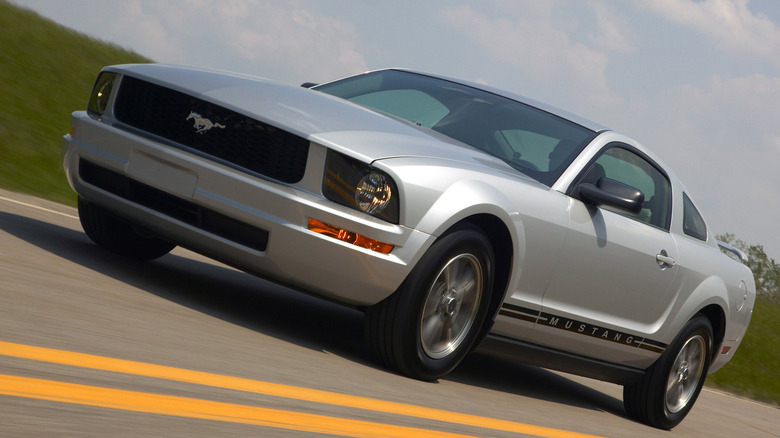
According to my doctors, therapists, and (most) former teachers, I'm a very normal boy with a normal brain that works normally and looks nothing like moldy, old Swiss cheese. Which is why, when I woke up this morning, my brain decided it was time to think about V8 fuel economy improvements over the years. And much like the morning I woke up thinking about Camry inflation, I found something fascinating. You see, a new Ford Mustang GT with a manual gets exactly the same gas mileage that it did all the way back in 2009.
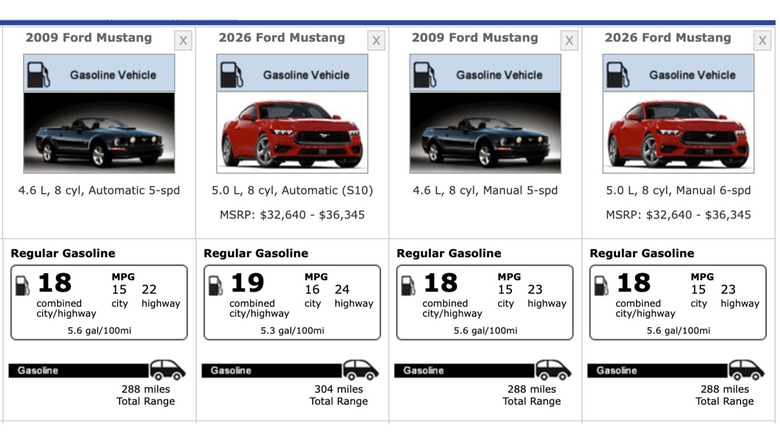
This isn't one of those situations where I tell you 11 mpg and 13 mpg are basically the same, even though a mere 2 mpg pencils out to an 18% improvement, either. No, I mean quite literally, if you head over to fueleconomy.gov, you'll see a 2026 Ford Mustang GT with a manual transmission is officially rated at 15/23/18 mpg (city/highway/combined), while the 2009 Ford Mustang GT with a manual transmission was rated at 15/23/18 mpg. Not almost the same. Exactly the same. After 17 years.
Switching to a modern 10-speed automatic instead of a five-speed auto did help the two-pedal '26 Mustang GT, though. After 17 years of development, instead of the '09's 15/22/18 mpg, a new automatic Mustang GT gets a far superior 16/24/19 mpg. Looking at the last four generations of automatic Corvettes (since the newest Corvette is automatic only), you see the same thing. Combined fuel economy for base-model 2004, 2013, 2019, and 2026 Corvettes is 19, 18, 18, and 19 mpg, respectively. Over more than two decades, that's pretty consistent.
Without any additional context, some would argue this is just proof that American automakers are lazy cheapskates who can't be bothered to build better engines. And why would they, when so many dumb Americans continue to line up every year to buy their dumb American sports cars? Stupid Obama should have just let Ford die instead of giving it one of those Communist bailouts. The free market would have fixed this in no time!
More power, same gas
The problem with that line of thinking is — aside from the part where bailouts began under Bush, and Ford quite famously didn't receive any TARP funds — neither Ford nor Chevrolet has been phoning it in when it comes to engine development. At least not when it comes to their performance cars. The improvements have just been on the "going faster" side of things, and the fact that they're able to achieve modern power figures without sacrificing fuel economy is incredible.
Take the 2009 Mustang GT, for example. It was still powered by a 4.6-liter V8, one of Ford's Modular engines that first hit the market in 1991 and originally made 190 horsepower and 260 pound-feet of torque in the Lincoln Town Car. By the time that 4.6-liter V8 landed in the 2009 Mustang GT, power was up to 300 hp and 320 lb-ft. When Car and Driver tested one with the manual, it hit 60 mph in 5.2 seconds and ran the quarter-mile in 13.8 seconds at 102 mph. Today, the Mustang GT has a 5.0-liter V8 that makes 480 hp and 415 lb-ft, needing only 4.2 seconds to hit 60 mph on its way to a 12.5-second quarter-mile at 114 mph.
As for the Corvette, in 2004 it had a 5.7-liter V8 that made 350 hp and 360 lb-ft. Hampered by a four-speed automatic, it was several ticks behind the manual's 4.9-second zero-to-60 time, as tested by Car and Driver, making it through the quarter-mile in 13.4 seconds at 108 mph. Today, a new, base-model Corvette has a 6.2-liter V8 that makes 490 hp and 470 lb-ft. With its modern transmission and mid-engine layout Car and Driver found it only needs 2.8 seconds to hit 60 mph on its way to an 11.2-second quarter-mile at 122 mph.
So a stock, base-model Ford Mustang GT makes 60% more power, it's about 20% quicker to 60 mph, and it runs the quarter-mile about 10% faster. Meanwhile, the new Corvette makes 40% more power, packs a zero-to-60 time that's about 50% quicker, and its quarter-mile time is about 15% faster. All without sacrificing gas mileage. And as great as it would be to see a base Corvette return 35 mpg, I'd still argue the performance improvements we've seen over the years have been pretty darn impressive. Even if it's still a little weird seeing fuel economy stay completely flat for decades.