

A New Toyota Camry Costs Thousands Less Than It Did In 1997 (If You Adjust For Inflation)
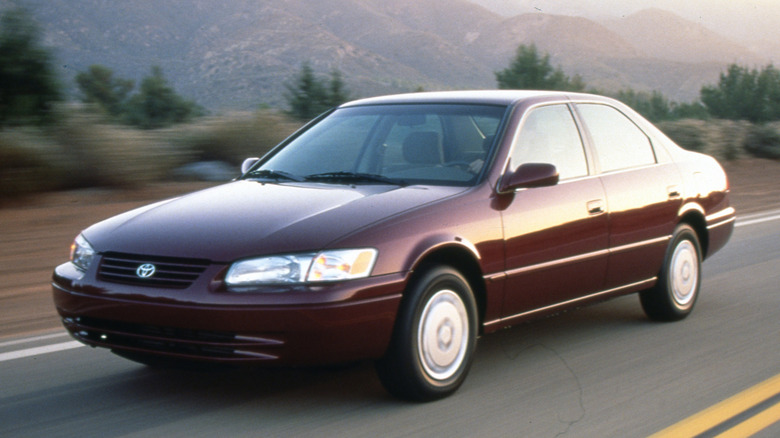
With the average transaction price on a new car right around $50,000 and the median full-time income slightly over $62,000, it's no wonder so many people feel like cars have gotten too expensive. Sub-$50,000 options still exist, sure, but you quite literally can't buy a new car for less than $20,000 anymore. And yet, a funny thing happened when I plugged the original MSRP of a base-model, first-year XV20 Toyota Camry into the BLS inflation calculator — the number it spit out was higher than the base price of a new Camry. Officially, a new Camry is more affordable than it was three decades ago.
Our friends over at Cars.com keep a handy database of old pricing, and it lists the original MSRP of a 1997 Toyota Camry CE at $16,448. Those who wanted an automatic transmission, however, were forced to part with $17,248. Head over to the inflation calculator, pick July 1997 as your starting point, and you get an inflation-adjusted price of about $34,220. Or, if you want pricing for the automatic, you're looking at $35,884. You can't get a new Camry with a manual anymore, but regardless of which XV20 transmission you prefer, the base price of a new Camry LE is $29,600 (not including destination fees).
Now, I'm no math expert, but I'm pretty sure $29,600 is several thousand dollars less than either $34,220 or $35,884. That's not the only example, either. Do the same thing with a sixth-generation Honda Accord, and $15,100 in July 1998 dollars turns into $30,895 today. Meanwhile, a new Accord starts at $28,395. Aside from full-size pickup trucks that are vastly different vehicles than they were back then — $14,505 for a 1997 Ford F-150 becomes $30,850, significantly lower than a new F-150's $37,290 base price — over the last several decades, mainstream car pricing appears to have generally tracked with or beaten inflation.
So what's going on here? How can new cars feel so unaffordable when they officially cost less than they did in the '90s? Money is made up, yes, but that's not the only issue. As a recent Financial Times article points out, "US corporate profits have hit a record high while workers' slice of the pie has sunk to historic lows, [fueling] discontent among many Americans and a growing political backlash."
That can't be right

Citing Bureau of Economic Analysis data, the Financial Times reports that annualized pre-tax earnings for U.S. companies hit $4.8 trillion in Q2, or 18% of the national income. That's reportedly the highest share we've seen since the end of World War II. Meanwhile, workers' compensation, including wages and benefits, dropped to 60%, which is as low as it's been since the 1950s.
"Regardless of what measure you look at, workers, in terms of employee compensation, have been receiving an increasingly small share of national income over time," JPMorgan economist Abiel Reinhart told FT. "And the flip side of that is: where is that income going? It's got to go somewhere. And a good chunk of it is showing up in corporate profit margins."
Additionally, FT writes that:
Bumper returns largely benefit richer Americans, who receive much of their income from investments, while middle- and lower-income households rely more heavily on pay cheques.
Inflation has also outpaced wage growth, causing real hourly earnings to fall by 0.2 per cent in July versus a year earlier.
Republican economic policies have only made the problem worse, handing out tax cuts to corporations and wealthy business owners, while cutting programs that benefit middle-class Americans. Workers have been taking home progressively smaller shares of the pie since Reagan declared open season on unions, but the decline really picked up post-COVID "and especially over the past 12 months." You know, the last 12 months that Donald Trump's been president.
Corporate executives have done a fantastic job convincing us that money is always tight, and it's unrealistic to expect regular raises, even if they don't match inflation. They've convinced us it's normal to take on more (unpaid) responsibilities in the hopes of maybe earning a promotion eventually. And unfortunately, they've convinced us that cars have gotten too expensive, when the truth is, they've been systematically chipping away at our pay to keep a bigger piece of the pie for themselves.