

JCB Proved Bonneville Will Always Be Speed's Final Frontier
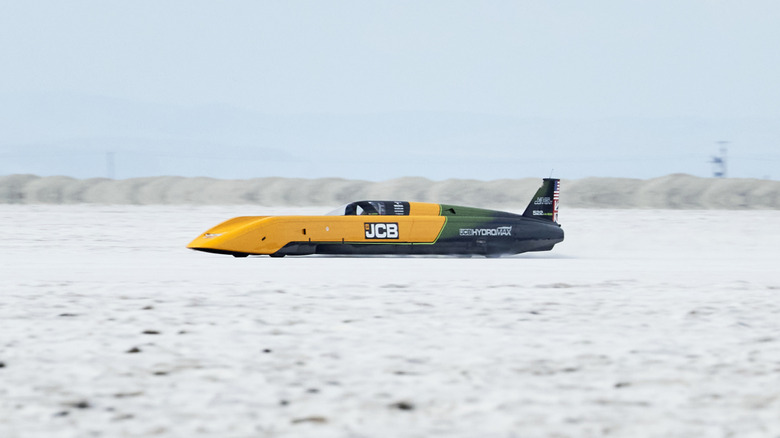
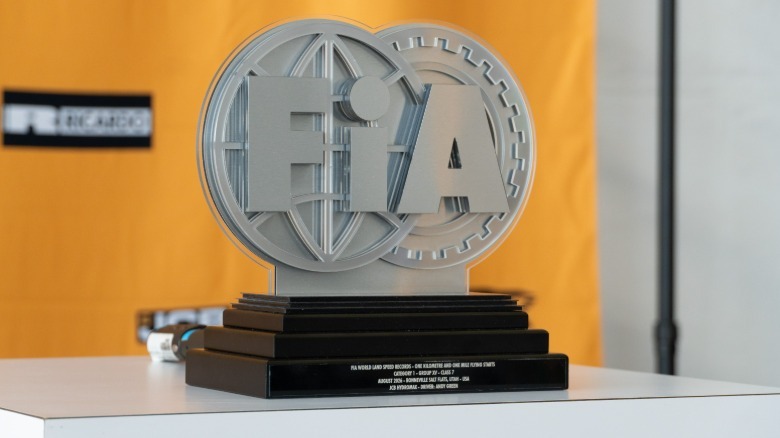
Very few of us will ever have the opportunity to set foot on another world, but the Bonneville Salt Flats are one of the few corners of our Blue Marble that truly feel extraterrestrial. The open expanse in Utah is so sprawling that the Earth's curvature is noticeable at ground level, making it the perfect place to push cars to their absolute limit. JCB successfully broke the hydrogen-powered land speed record on the famed salt flats in August. The Hydromax streamliner reached a staggering mark of 406.320 miles per hour, and I was there to witness it.
The JCB Hydromax's effort continued a long lineage of land speed record attempts at Bonneville. While the United States and the Soviet Union raced to put a man on the Moon during the 1960s, the outright record was broken ten times in Utah. The flurry of ever-faster runs culminated with Blue Flame, driven by Gary Gabelich, going 622.407 mph over the flying mile. That rocket car's record stood for 13 years. The outright record runs since have been in Nevada's much larger Black Rock Desert.
Full Disclaimer: JCB flew me out to Bonneville for the attempt and put me up in a casino in Wendover, Nevada, the nearest patch of civilization to the salt flats.
The JCB Hydromax was a challenger built around a production powerplant
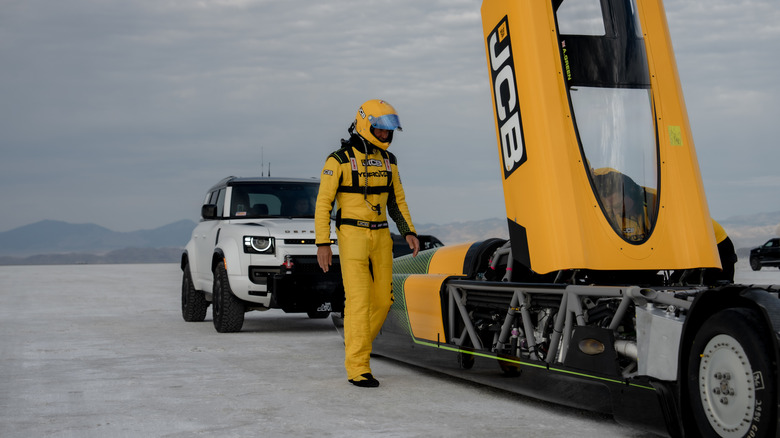
The Bonneville Salt Flats first gained its global notoriety after Sir Malcolm Campbell became the first person to drive a car over 300 mph there in 1935. JCB chairman Anthony Bamford said learning of Campbell's record and following the '60s British challengers as a teenager sparked his passion for Bonneville. He would take his heavy equipment company to Bonneville for the first time in 2006. The JCB Dieselmax, a streamliner powered by a modified pair of the manufacturer's industrial diesel engines, reached a record 350.092 mph.
Lord Bamford was eager to return to Bonneville to defend the diesel-powered record attempt, but the record hasn't been broken. Instead, he gave himself a new challenge: the hydrogen-powered record. The new JCB Hydromax was envisioned in a similar vein to its diesel predecessor. It's a Prodrive-developed streamliner built around two industrial hydrogen-combustion engines. Each 4.8-liter turbocharged four-cylinder motor is rated at 75 horsepower off the shelf, but Ricardo modified them to produce 800 hp.
For a driver, there was only one person with a resume as impressive as a 1,600 hp machine: Andy Green. The retired Royal Air Force fighter pilot drove the Dieselmax back in 2006 and broke the outright land speed record at the controls of the ThrustSSC in 1997. Green broke the sound barrier on the ground, hurtling 763.035 mph across the Nevada desert.
The road to history curves over the horizon
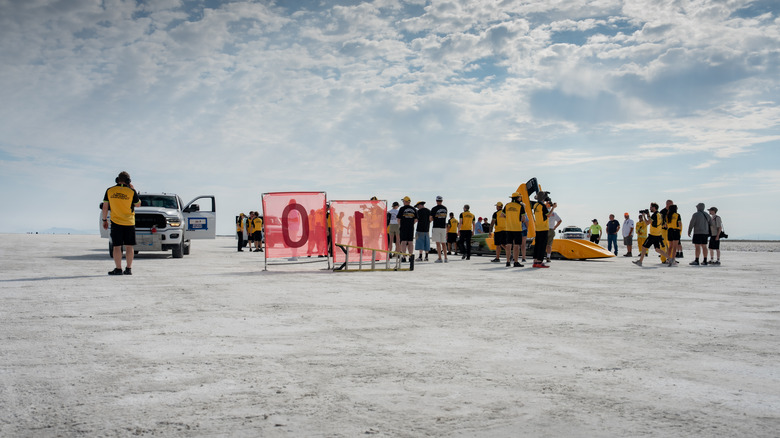
The Hydromax's record run was an unforgettable experience. To be fair, you can't forget what you can't see from the gazebo-shaded viewing position. The intense heat can feel suffocating, as if you inadvertently stepped out of an airlock without putting on a spacesuit. The straight 10-mile course has markers every quarter-mile, and each mile is highlighted with red markers. At one end is Interstate 80 and at the other end is Floating Island, an isolated mountain peak where the base is hidden by the curvature of the Earth.
The measured flying mile was between the fifth and sixth mileposts. From the viewing position alongside the flying mile, an observer can see only four miles of the course with the rest disappearing over the horizon. It might sound like a lot, but it's less than a minute of the actual run. If the Hydromax went 400 mph or faster, it would take roughly nine seconds to cover a mile. The streamliner tore across the salt flat so fast that I could barely keep up with a camera.
 JCB
JCB
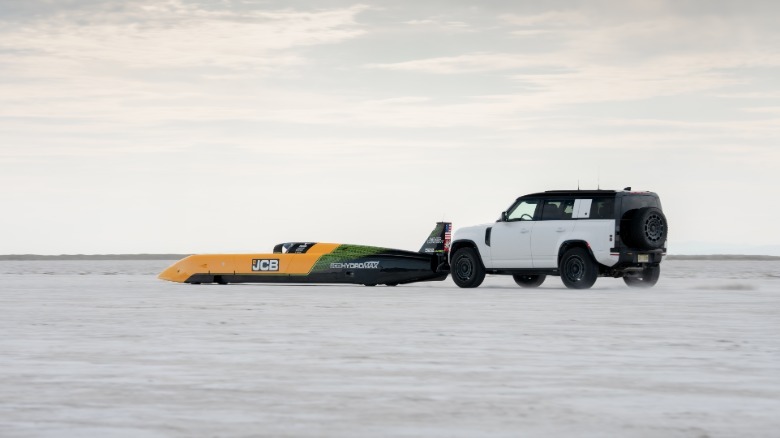
I didn't fare any better than the second time around. As with any official FIA land speed record attempt, it's the average of two runs in opposite directions through the flying mile within an hour. The turnaround process was easier said than done for the Hydromax. Its fuel tanks were purged during deceleration for Green's safety. The crew had to refill the tanks with hydrogen and replace the vehicle's bespoke Goodyear tires. Once the Hydromax came back the other way, it was just a matter of waiting for the FIA to verify and announce the speed: 406.320 mph.
The temperatures are nearly as high as the speed at 400 mph
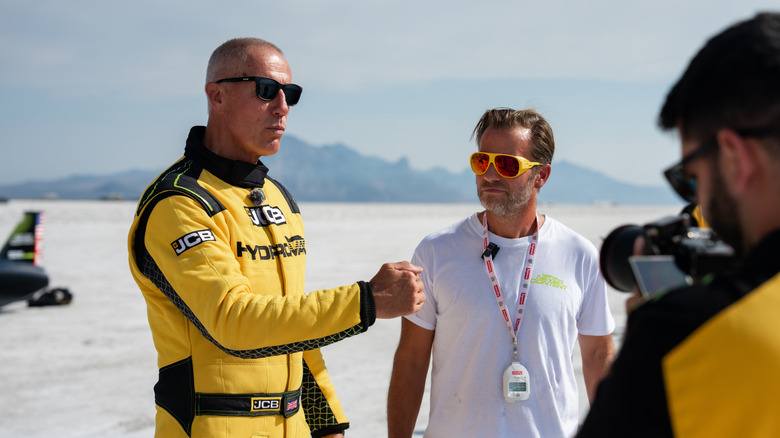
Andy Green was absolutely on the limit from his perspective in the cockpit. After the runs, he explained exactly what happened during the first pass moment-by-moment. Green shifted into second gear at 120 mph, then into third at 150 mph. He was still experiencing wheelslip from the Hydromax's torque this far into the wheel, leaving tire marks down on the salt. By the first mile marker, Green was traveling at 230 mph. At mile five, the moment of truth, he was in fifth gear going 410 mph.
 Ryan Erik King / Jalopnik
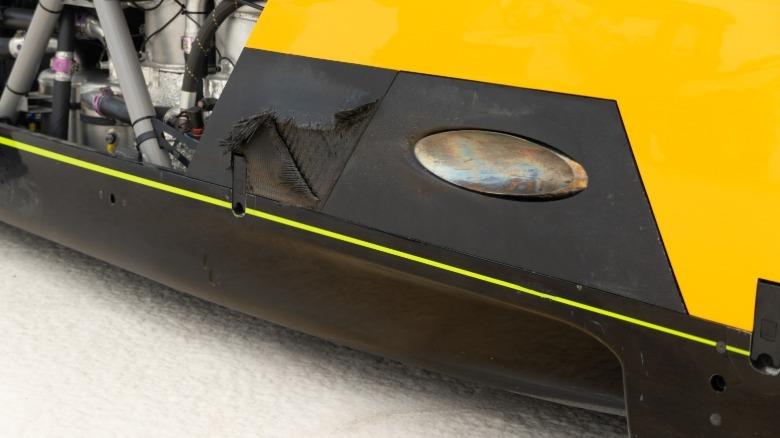
The scorch marks on the JCB Hydromax after the record run make it clear that the attempt wasn't a walk in the park. The exhaust melted away the carbon fiber bodywork behind it and stripped away part of the JCB logo decal on the vehicle's right-hand side through sheer heat. Thermal management was also vital for the air coming into the car. The turbochargers mounted to each engine compress 450 liters of air per second. Before combustion, an ice-fueled charge air cooling system lowers the temperature from 200 degrees Celsius (392 Fahrenheit) down to -10 degrees Celsius (14 degrees Fahrenheit). There is enough ice onboard the Hydromax for 75 seconds of cooling, just enough to reach the target speed.
 Ryan Erik King / Jalopnik
Lord Bamford hoped that the JCB Hydromax would create a new generation intrigued by Bonneville. When asked how he'd want the record run to inspire the next generation, Green answered, "Their future as kids is going to be about a high-technology, zero-carbon energy world." While hydrogen fuel stations for cars are non-existant in the United States outside of California, JCB is also aiming for hydrogen power to find a niche in industrial use where connecting to the electrical grid would be costly or physically impossible. Regardless, it's a noble sentiment for someone with the land speed record for three different types of combustion fuel.