

The Current Land Speed Record For Hydrogen Combustion Cars Is Held By A 22-Year-Old BMW
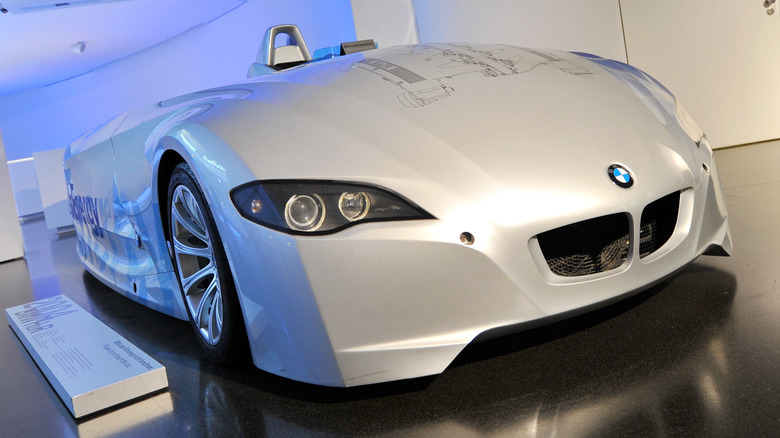
The 303-mph Venturi Buckeye Bullet 2 holds the FIA-approved land speed record for the fastest "hydrogen-powered vehicle." However, about 22 years ago, BMW set nine separate land speed records for a hydrogen-powered internal-combustion vehicle — not on the Bonneville Salt Flats, but at BMW's testing center in Miramas, France. All nine records were recognized by FIA, and with a top speed of 300.175 kmh (186.52 mph) — though it managed to hit 187.9 mph in one direction – the BMW H2R officially became the fastest hydrogen-powered ICE vehicle in the world.
BMW's H2R featured a modified 6.0-liter V12 that could burn liquid hydrogen and used good old combustion to extract over 285 horsepower. Much of the engine was carried over from a 760i, save for a few mods like the fuel injection system adapted for hydrogen's chemical properties and the use of integrated injection valves in the intake manifold. Underneath the 17.7-foot-long streamlined carbon bodywork sits an aluminum chassis built using borrowed bits from the Z8. With a weight of 3,440 pounds and a drag coefficient of just 0.21, the H2R gave works drivers Alfred Hilger, Jorg Weidinger, and Gunther Weber the platform needed to set its many records. Playing a crucial part in the process were the H2R's 245/40 ZR19 "extra load" Michelin tires, highlighting the importance of tire tech when it comes to land speed records.
Fast forward to today, and JCB — a British company specializing in excavators and construction equipment — is about to challenge BMW H2R's title at the Bonneville Speed Week in Utah this August.
Meet the challenger
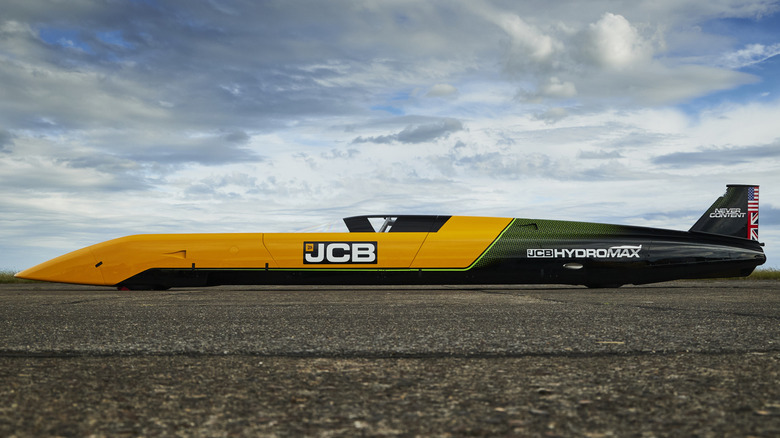
While we've seen our fair share of cars chasing and breaking land speed records, building fast streamliners for the Salt Flats is nothing new for JCB, despite its association with slow-moving diggers. The company's Dieselmax streamliner holds the diesel land speed record, having managed a cool 350.092 mph on the Flats back in 2006.
Taking things a step further is the JCB Hydromax, the company's latest attempt at breaking the land speed record for hydrogen vehicles. The Hydromax features two hydrogen-powered internal combustion engines, with each unit tuned to 800 horsepower. The same engines (albeit in production guise) are already available in the company's excavator lineup. Together with four-wheel drive and a combined output of 1,600 horsepower, the 32-foot-long Hydromax is looking to outpace its record-setting predecessor, targeting a top speed of over 350 mph. Piloting the streamliner will be Andy Green, the man who drove the ThrustSSC — the first land vehicle that officially broke the sound barrier — to a record-setting 763.035 mph.
In an interview with the BBC, Green hinted that the vehicle had already touched 180 mph during testing, so it looks as though BMW will be handing over the title to JCB if the Hydromax succeeds. And if you have any doubts about JCB's engineering, it's worth pointing out that it built the world's fastest tractor, with a top speed of 135.191 mph. It also holds the record for the fastest backhoe loader, which is capable of hitting 72 mph. Whether hydrogen fuel cars are worth it at all is an entirely different matter.