

7 Facts About The Iso Grifo, The Other Other American-V8-Powered Italian Exotic
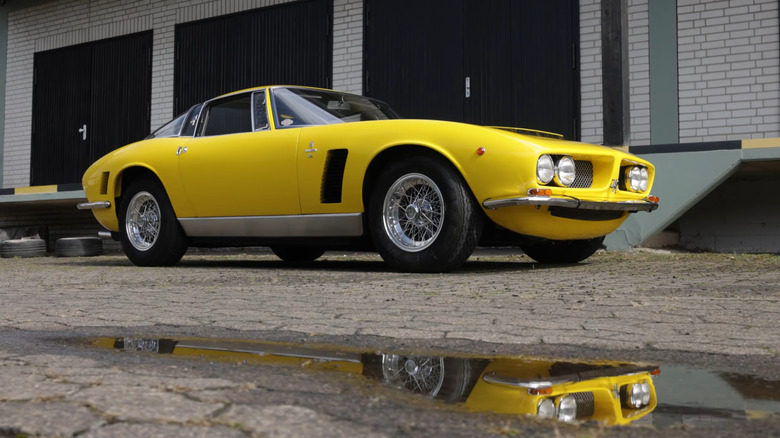
The Iso Grifo wasn't the first Italian exotic to make use of American firepower. In fact, that's an idea that has been carried out many times over, perhaps most notably in models like the Facel Vega HK500, Jensen Interceptor, and De Tomaso's Mangusta and Pantera.
However, it wouldn't be difficult to argue that the Iso Grifo did it best. The low-slung GT car combined drop-dead gorgeous lines with enough American grunt to see even the fastest sports cars of the era struggle to keep up. Only around 400 were ever made, across a near 10-year production run, and the automaker shut down once said run was over. However, over 50 years on, the Grifo is just as worthy of celebration today as it was when the cover first lifted off the Giugiaro curves back at the 1963 Turin Motor Show.
In an effort to get you up to speed with this Italian exotic from decades long gone, we've covered seven facts about the model below. We'll cover everything from the $300,000-plus valuations these cars command today to how the Grifo's 435-horsepower V8 compared to the likes of Lamborghini and Ferrari engines of the era.
The Iso Grifo was powered by numerous American V8s
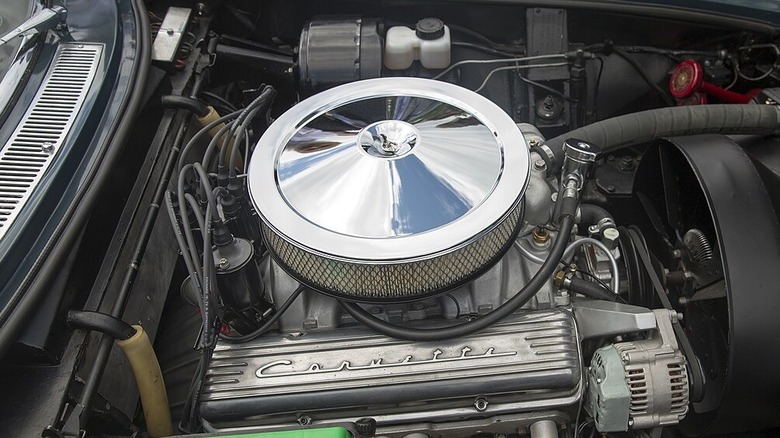
Buyers of the Ferrari 365 GTB/4 received a 4.4-liter Colombo V12, regardless of the model year. Miura buyers all received a 3.9-liter V12, and all Aston Martin DB5s were equipped with a 4.0-liter Tadek Marek-designed inline-six. In comparison, Corvettes in the late '60s were available with a multitude of small and big block V8 engines, and the same was true for the Mustang and other American performance models, too.
Interestingly, Iso was taking on the European elite, but it adopted not only an American heart, but also an American attitude in regard to powertrain choices. Throughout the Grifo's production run, buyers had the choice of a wide range of engines. The base Grifo in Series 1 guise sported a Chevy-sourced small block 327-cubic-inch engine, with output sitting between 300 and 350 horsepower. The option of a 350-cubic-inch Chevy small block was also made available for Series I cars.
For later Series II cars built from '72 onward, known as IR-8 cars, Ford's 351 Cleveland lump was supplied, producing around 330 horsepower. Only 37 of these Ford-powered Grifos were ever sold.
Big block options came in the way of Chevrolet's 427, with up to 435 horsepower and 460 pound-feet of torque on tap, courtesy of a Tri-Power setup (i.e., a trio of two-barrel carburetors). Certain models went larger still, sporting a 454-cubic-inch Chevrolet engine, which saw outputs sitting at 395 horsepower, alongside almost 500 pound-feet of torque.
Only 402 examples were ever made
So, while it's clear that Iso liked tackling some aspects of production like American automakers, other aspects were still decidedly European in their approach. That includes things like production numbers.
Naturally, with sky-high asking prices — which we cover in more detail further down the page — the Iso Grifo was never going to be a volume seller. Only 402 were made in total, although production spanned almost a decade — from 1965 through 1974 — which demonstrates just how tiny Iso's production capacity was.
That production story can easily be broken into various sections. In '63, the first prototype was displayed at the Turin Motor Show, then the first Series I cars hit the road in '65. A Targa model followed in '66, and then the big-block models made their first appearance in '68. Series II cars with stylistic tweaks debuted for '70, the 351C-powered cars arrived in '72, and then Grifo production ceased in '74, when Iso closed its doors. It's likely that the Oil Crisis of '73 influenced the Grifo's demise, although after a decade or so in action, the Grifo's story was surely coming to a natural end by this point regardless.
Precise production numbers are tricky to pin down. Chassis numbers went up to 412, but numerous cars were sent back to the factory and reworked — these cars received new chassis numbers at this point, which invites confusion into the matter. The most accurate breakdown would be 321 Series 1 cars, 79 Series II cars, and a pair of unique prototypes, resulting in 402 examples.
Iso also offered a Targa version of the Grifo
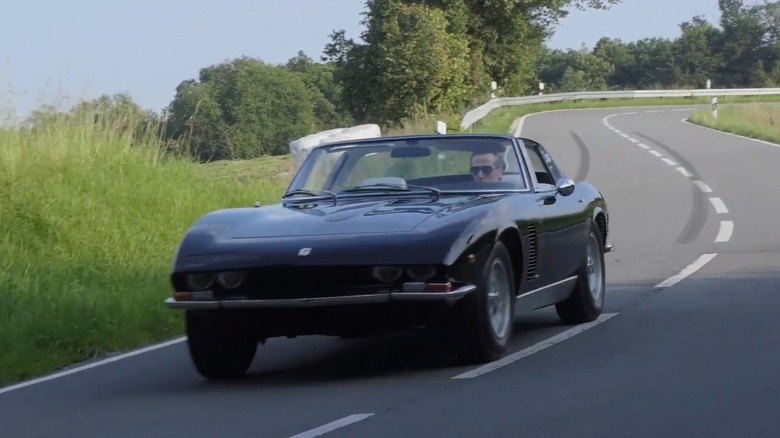
The Iso Grifo is best known as a sleek and curvaceous coupe, however, a number of open-top models were produced, too. First came the Iso Grifo A3/L Spider Prototype – a one-off that was displayed at the Geneva Motor Show in 1964. It changed hands a few times, before ending up in the possession of renowned collector Rudi Klein. It would sit in his famous junkyard collection until being auctioned off by RM Sotheby's in 2024, when it fetched a scarcely believable $1.875 million. At the same sale, a similarly dilapidated Series I Grifo achieved $162,400, demonstrating just how much value was placed on the Spider's one-of-one prototype status.
Prototype aside, Iso went on to produce a total of 13 Series I Targa cars, which took motivation exclusively from the aforementioned Chevrolet small block engines. During the Series II run, only four Targa models were produced, these, too, boasting Chevy small-block lumps.
The Grifo offered extraordinary performance for the era
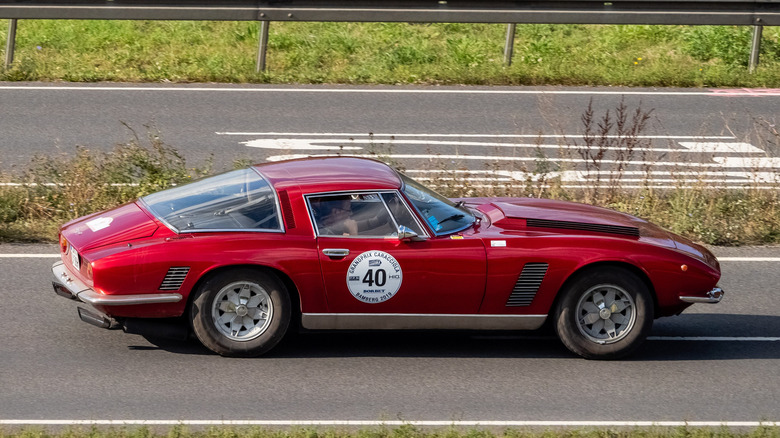
Iso created far more than just a good looking machine with its Grifo. As is likely easy to assume, given its range of powerful V8 engine options, it was a properly solid performer as well.
Period road tests confirm that even the earlier small block-powered cars were a force to be reckoned with, hitting 60 mph in 7.2 seconds, 100 mph in 19.4 seconds, and deemed capable of covering a quarter-mile in the low 15 seconds. That's all while being geared for a top speed easily north of 150 mph. Autocar managed to record a top speed of 161 mph in the 327-powered Series I car, which sat unchallenged by anything, until the Miura came along.
That's respectable but not quite sprightly enough to match Ferrari's 330 GTC or 427-powered Corvettes, but that's where the big block Grifo comes in handy. It's reported that later Series II cars, with the 395-horse 454-cubic-inch big block unit, were able to dart from 0 to 60 mph in just 5.5 seconds, with top speeds of around 165 mph.
As for the even more powerful 427-powered models, Iso made the bold claim that these Grifos were capable of hitting 186 mph, although no records of this speed being achieved are documented. Still, it's thought that the Grifo had more than enough grunt in this guise to crack 170 mph, which was about as good as it got in the late '60s and early '70s.
The Grifo was developed by Italian legends of the auto industry
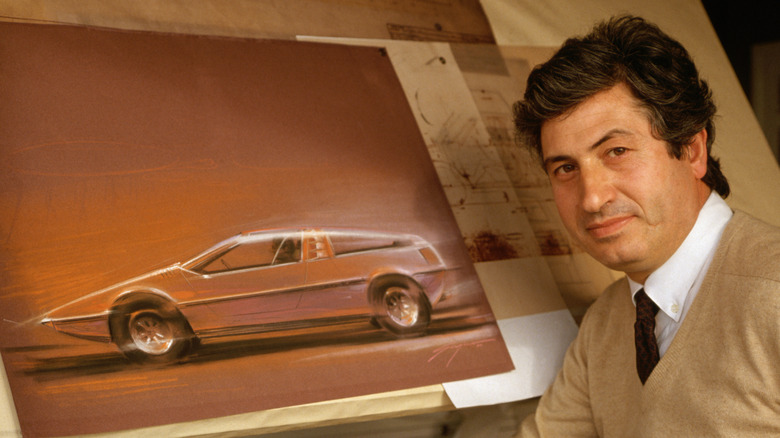
The trio of Italians that worked on bringing the Grifo to production are some of the most celebrated automotive minds of the 1960s. With names like Renzo Rivolta, Giorgetto Giugiaro, and Giotto Bizzarrini working on the project, it really is no surprise that it came out as sublime as it did.
Renzo Rivolta was the founder of Iso, and so, naturally, he was responsible for funding and directing this exciting project, which merged Italian elegance with American muscle. The other two names, Giugiaro and Bizzarrini, were the men in charge of seeing Rivolta's vision through to reality.
Giugiaro is one of those car designers that every gearhead should know, having been responsible not only for the Grifo's mesmerizing lines, but also those of the BMW M1 and original Volkswagen Golf. Without a doubt, Giugiaro is one of the most celebrated automotive designers of the 20th century, and it's easy to argue that the Grifo is one of his finer works.
As for Bizzarrini, he helped with the engineering side of things. Having worked for Ferrari in the past, and on some of the firm's most important models — including the all-important Ferrari 250 GTO – Bizzarrini was a master engineer when it came to developing Italian sports cars. He provided a chassis capable of making the most of Iso's American powerplants, enabling the firm's flagship to go up against the very best Europe had to offer.
Big block examples were modified in order for the new engine to fit
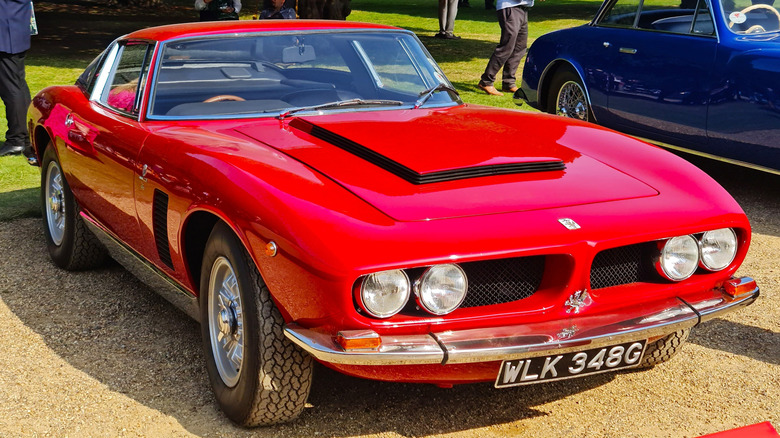
As covered, a number of engines were available throughout the Grifo's production run, although for those with a heavy right foot, it's the 427-equipped examples that surely sit as the most desirable. The decision to slot Chevrolet's venerable L71 big block engine under the hood came for the 1969 model year, likely as a response to new releases from the competition.
Lamborghini had just updated its Miura with a new P400 S specification, which boasted an impressive 370 horsepower, courtesy of a new set of camshafts, while Ferrari's then-new 365 GTB/4 was churning out 352 horses. Grifos with the small block up front made do with between 300 and 350 horsepower, so a 435-horse L71-powered update would ensure the Grifo kept up with the competition.
There was just one issue: The engine wouldn't fit. A very distinct hood scoop was required, as the L71 was simply too tall otherwise — at least this scoop makes a 7-liter Grifo easy to spot among lesser small block models. So distinctive was the scoop, it attracted nicknames such as pagoda or penthouse.
The hood design made it an instant icon, and in addition to the scoop, Iso engineers also had to strengthen the chassis on 7-liter cars. While it naturally had a whole heap more grunt than small block examples, the extra heft of the 427 reportedly leads to less desirable handling characteristics. Only 66 examples of the 7-liter Grifo were ever built, with just 6 being delivered to the U.S. when new. So, these are remarkably scarce cars.
They were laughably expensive when new and are just as pricey today
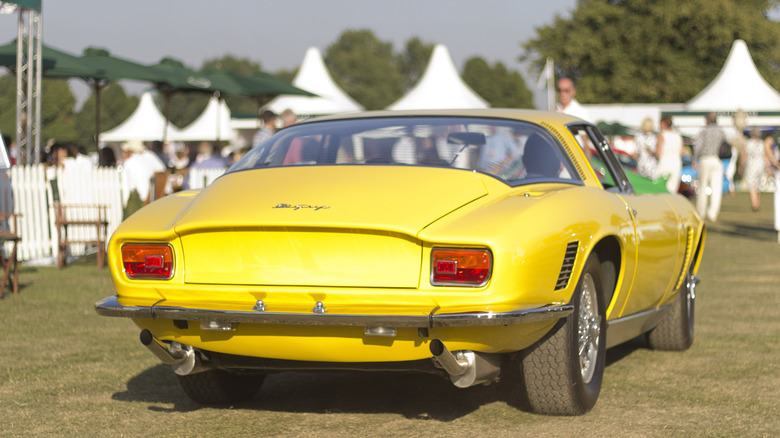
It should come as no surprise that the Iso Grifo was extremely expensive when new and that it remains expensive today. After all, a sleek, '60s Italian coupe with thunderous power — no matter where that power was sourced from — sounds like quite a desirable recipe indeed.
When new, an Iso Grifo would set buyers back around $14,000 in 1967. To put that into perspective, a 1967 Chevrolet Corvette commanded just $4,388 in its base coupe guise, and dropping a 430-horse L88 into one would only set buyers back an additional $947.90. Clearly, the Iso was geared toward a more well-heeled clientele. The 365 GTB/4 Daytona kicked off at $19,500 in '68, while prior to its arrival, a 330 GTS would set buyers back similar figures to what Iso was asking. For a little context, $14,000 in '67 is the equivalent to around $141,00 in today's money.
Sadly for interested parties, though, $141,000 in 2026 won't get them anywhere near an Iso Grifo. Appraisers suggest that buyers can expect to pay between $293,333 and $357,667 for a '67 Coupe GL, or between $411,333 and $492,000 for a slightly later 7.0-liter model from '69. Similar figures are commanded by the rarer Targa, with $369,667 to $436,333 given as a guide for '67 examples. The aforementioned competition-spec A3/C models command significantly more, around $1.5 million and above, as did the Grifo's '63 prototype.