

The Most Powerful Engines Available In Each Generation Of The Ford Mustang Mach 1
The Ford Mustang is one of the most impressive examples of a performance car standing the test of time, still going strong today with the same basic recipe that it debuted with over six decades ago. Of course, not every chapter of the Mustang's story has been an evergreen one — as trims like the SVO and SVT Cobra prove without doubt. However, several performance-oriented Mustang nameplates have survived the years, and the Mach 1 is the perfect example.
Having enjoyed four separate generations now, the Mach 1 is clearly a success story, but every iteration has differed quite dramatically from the next — something that's most clearly evident from the engines that motivated them. From big-block V8s with thunderous outputs, through to modern masterpieces knocking on the door of supercar territory, and then all the way back down to six-pots with fewer horses than a base-spec Corolla, the Mach 1 has seen it all. This article covers each generation and ranks the most powerful available versions in order of their highest available factory power outputs, from least to most powerful.
Ranking these Mustangs by order of their output isn't as straightforward as it might first seem, as Ford deliberately downplayed the grunt of earlier models in order to make insurance more affordable for buyers, and then the net vs. gross figures additionally complicate things. To keep things simple, each entry is scored based on its factory-rated horsepower figure, whether that be accurate or downplayed, gross or net.
Second-gen Mustang Mach 1's 302 Windsor V8: 140 horsepower
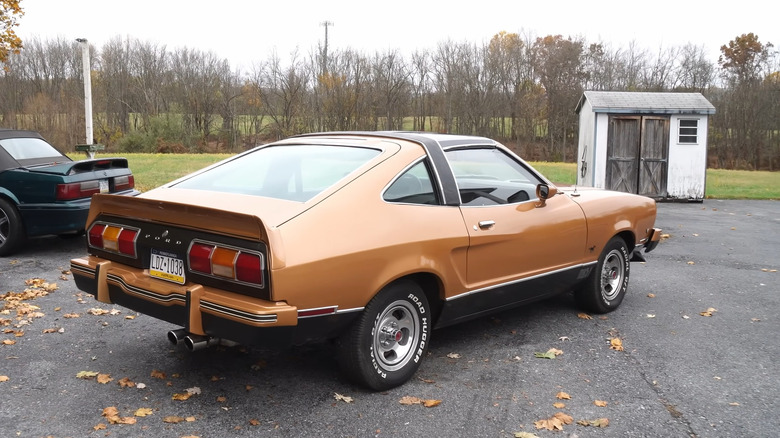
Chronologically speaking, the Mach 1 lineage gets off to a blinding start, as the first-generation model is a seriously potent and really desirable muscle car from the segment's golden era. However, since we're ranking the nameplate in order of its power output, that gets us off to something of a less impressive start. According to many, the second-gen Mustang is possibly the worst muscle car ever built, even in Mach 1 guise. It debuted for the 1974 model year with a measly 2.8-liter V6 under the hood, which peaked at just 105 horsepower.
Things did perk up slightly for the rest of the Mustang II Mach 1's run, with a 302-cubic-inch (5.0-liter) Windsor V8 joining from 1975 onward. No need to get excited, though, as the EPA's power-sapping emission-restricting devices were now in full swing, so that 5.0-liter lump only managed to churn out 140 horsepower and 240 lb-ft of torque. As a result, the Mach 1 name lost some of its luster, and consumer interest began to dwindle for the one hot nameplate. Naturally, the slowdown in sales resulted in Ford scrapping the Mach 1 name when the Fox body 'Stang was introduced for the 1979 model year, and it wouldn't return for almost 25 years.
Fourth-gen Mustang Mach 1's 4.6-liter modular V8: 305 horsepower
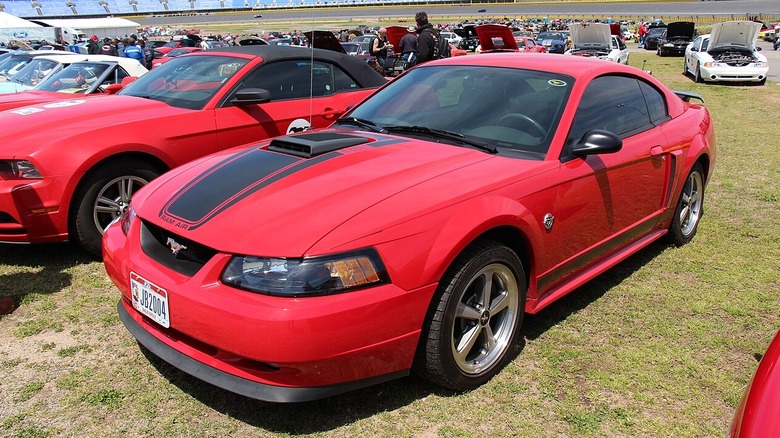
The Mustang's SN95 generation, which followed on from the Fox body years that saw no Mach 1 model introduced, briefly revived the nameplate. Only the 2003 and 2004 model years were offered as Mach 1s, and the once eclectic variety of engine choices available for the trim had dwindled to a single option. Much like the SN95 GT, the Mach 1 utilized Ford's modular 4.6-liter V8, although several fundamental tweaks were made to ensure it packed a meatier punch. It received dual overhead cams instead of a single-cam design, along with four valves per cylinder, instead of just two. Meanwhile, high-flow heads from the SVT Cobra brought the torque figure to a meaningful 320 lb-ft and power up to 305 hp. Buyers could choose between a five-speed manual or a four-speed automatic.
Despite enjoying such a short production run, Ford reportedly managed to squeeze almost 17,000 of these SN95 Mach 1 Mustangs into dealerships across the 2003 and 2004 model years, so the revival of the nameplate was clearly welcomed with open arms by enthusiasts. Perhaps surprisingly, though, despite the clear commercial success, Ford opted not to bring the Mach 1 name back when the S196 generation took over in 2005. Instead, buyers would have another long wait on their hands until the name returned once more.
Pre-facelift first-gen Mustang Mach 1's 428 Cobra Jet V8: 335 horsepower
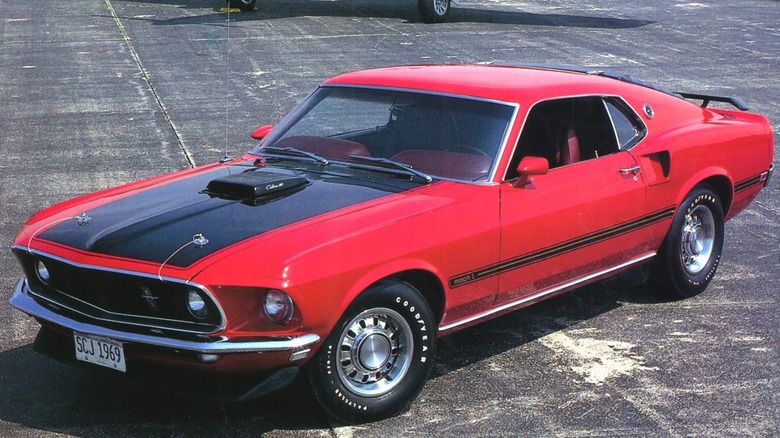
The year 1969 saw the debut of the Mustang Mach 1, which was offered with drivetrain options galore. Kicking things off was the 351 cubic-inch Windsor engine, which offered between 250 hp in two-barrel guise and 290 hp with a four-barrel engine running on premium fuel. Ford also offered the 390 engine with 320 horsepower on tap, which too sported a four-barrel setup. The following model year saw the 351 Windsor switch to a Cleveland engine, although displacement remained the same.
The 1969 Mach 1 was also one of the few Fords offered with the 428 Cobra-Jet engine. In fact, a pair of 428 Cobra-Jet engines were offered, one with Ram Air and one without, with both factory rated to 335 horsepower. Reportedly, power on the CJ's was actually closer to 400 horsepower, but we'll stick to official ratings. Torque came in at 440 lb-ft, again for both the Q- and R-code 428 engines. Buyers also had the pick of a three-speed manual or three-speed automatic transmission, plus an optional four-speed manual 'box.
There was also a Super Cobra Jet option, although don't go looking for it in any old brochures, because not even Ford advertised it. Buyers would stumble upon the secret option when spec'ing either CJ engine with "Drag Pack" options. In this guise, the SCJ engine boasted numerous upgrades over standard CJ engines, including cast-aluminum pistons, an external oil cooler, and revised flywheel. The engine alterations technically came free of charge when either 3.91 or 4.30 Traction-Lok "Drag Pack" options were selected for $155.45, so that the 428 could handle the change in performance that came with such options (via Hemmings). These were rare, for sure, although power didn't officially peak any higher than the 335 hp gross rating of the standard CJ engines.
Post-facelift first-gen Mustang Mach 1's 429 Super Cobra Jet: 375 horsepower
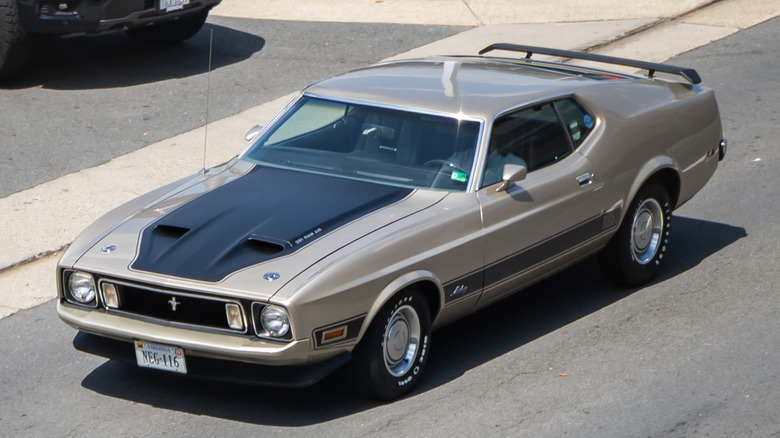
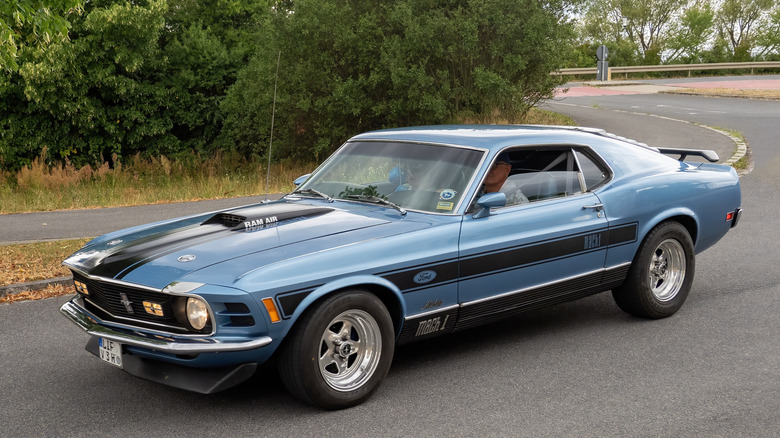
The 1971 model year saw the Mach 1 redesigned for the first time. Overall, the car got a little longer, wider, and heavier, plus it now sported molded micellar urethane foam body-colored bumpers and a striking new SportsRoof fastback profile. Aside from that, and more relevant to our focus here, was the plethora of engines afforded to the Mach 1 in 1971 and beyond, with options just as varied and intriguing as the original cars. The standard choice was a 210-hp 302 V8, and from here, buyers could make the next jump up into a 351 Cleveland V8. Once more, two- and four-barrel versions were available, with 240 and 285 horsepower respectively, while a 351 Cobra Jet with altered compression ratio arrived late in the year, with 280 hp to its name.
Just like the '69 and '70 models, both standard and Ram Air options were available on the Cobra Jet engine, which boasted a 429-cube displacement, plus an impressive 370 hp and 450 lb-ft. The Super Cobra Jet engine returned too, once again with Drag Pack options installed, and that saw output leap another 5 horsepower. On paper, the engine was tied in power with the Boss 429. However, things only went south from here. 1972 saw the 429 CJ engines dropped from the range, and horsepower ratings switched from gross to net. While that doesn't change anything physical with regard to the grunt on tap, it certainly makes the performance look a little less impressive on paper. The silver lining was the arrival of the R-Code 351 High-Output engine with 275 horses to its name, but this rare Boss 351-derived option lasted just one model year.
Sixth-gen Mustang Mach 1's 5.0-liter Coyote V8: 480 horsepower
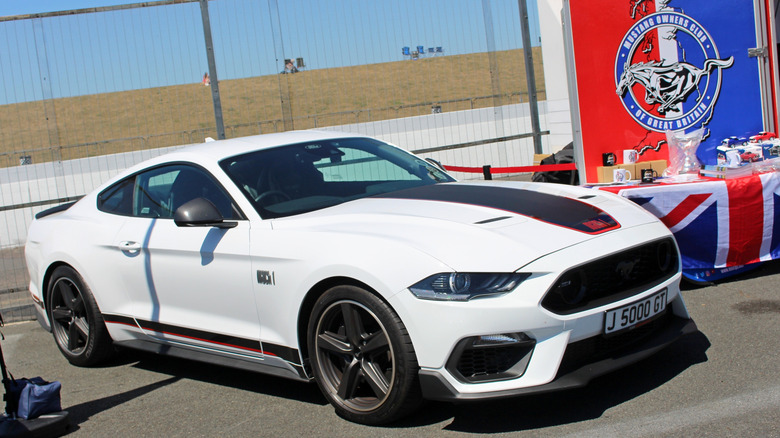
It likely comes as no surprise that the most powerful Mustang Mach 1 is also the latest, arriving for the 2021 model year, built on the S550 platform. Much like with the nameplate's SN95 generation, the S550 Mach 1 enjoyed a short production run, but that doesn't mean the model itself is particularly scarce, with enthusiasts estimating that around 15,000 were produced between 2021 and 2023. Just a single choice of engine was given to S550 Mach 1 buyers, it being a Bullitt-derived 5.0-liter Coyote V8, boasting an impressive 480 horsepower and 420 lb-ft of torque.
As for transmissions, a 10-speed automatic was optional at $1,595, while a six-speed manual was given as standard. Interestingly, the Mach 1's manual transmission was the GT350's Tremec TR-3160, as opposed to the GT's Getrag-built unit. Impressively, the S550 Mach 1 Mustang hasn't depreciated much since it first debuted, dropping only around 20% of its value in the time, so it's proven to be quite a safe place to park a chunk of money — and no doubt more fun than sticking it into a savings account, too.