

How Police Car Brakes Differ From The Ones On Regular Cars
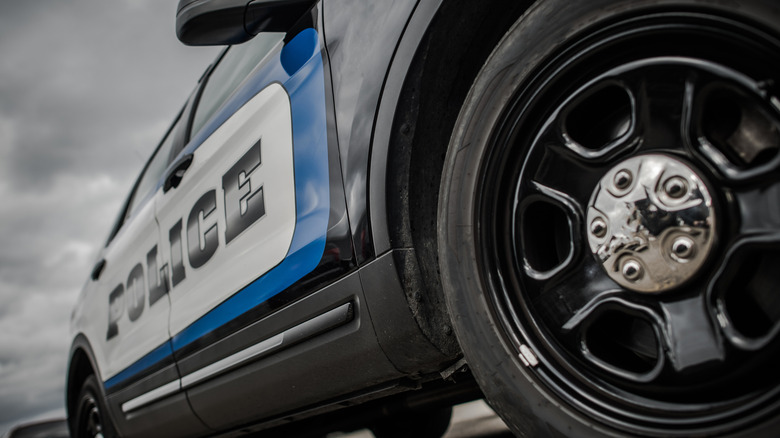
Police cars may look like regular cars with an eye-catching livery and flashing lights, and they're only a few hundred pounds heavier. But they're much tougher on their brakes, so automakers routinely upgrade them as part of a pursuit package. Just as police cars can get different tires, there also are bigger rotors with added ventilation, brake pads with higher heat capacity, and even reprogrammed antilock brake and stability control systems to differentiate police-car brakes from those on regular cars.
It isn't so much about shorter stopping distances as it is the "duty cycle." After all, civilian cars are made to conform with federal law, and even the most basic commuter hack has antilock braking and can manage the occasional emergency stop when the driver isn't paying attention to the lines of traffic lights and the rapidly approaching brake lights of the car ahead.
But police cars often have to deal with repeated high-speed stops, more akin to what a racing car might experience. It's important that the cop behind the wheel can safely continue to drive even after the brakes have been used heavily, without a reduction in braking performance or confidence in the police car's brakes.
Police cars are put to the test by the cops themselves
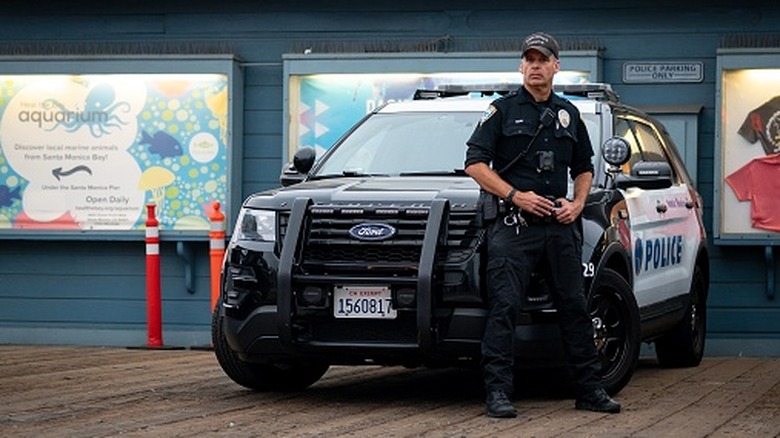
Police departments across the U.S. don't rely on the automakers to tell them the cars are up to the job. Some instead conduct extensive tests themselves. For example, the Michigan State Police started testing all available patrol cars in 1974 as it became clear that price alone wasn't enough of a differentiator. Los Angeles County started testing the same year and published its 51st annual Law Enforcement Vehicle Test and Evaluation Program report in 2026.
It clearly defines the rigorous testing each car is put through, including 28 high-speed laps of a 1.46-mile test track and two laps of a 1.6-mile city course. Lap times are recorded throughout, but there's also subjective analysis of each police car's performance in several metrics. For example, the testers rate each car out of 10 for "Braking Performance" and "Brake Pull," and at certain times in the procedure the carmaker is allowed rebuild the entire brake system.
Straight after the grueling 28 laps, the car starts its separate brake-evaluation testing, undergoing a series of controlled tests from different speeds, with and without activating the antilock-braking system. This is designed to represent a wide range of conditions, from high-speed pursuit to everyday driving. The stopping distance is reported, as is any issue with the brakes.
The Michigan State Police, who also conduct annual testing, go hard on the brakes, too, even while rocking old-school-style lights. They carry out 10 successive emergency stops from 60 mph before allowing a cooldown lap and then another 10 full-effort stops. An average braking distance across the 20 tests is taken as the result, emphasizing a focus on durability and capability to soak up repeated heavy braking.
Police car upgrades since the 1920s
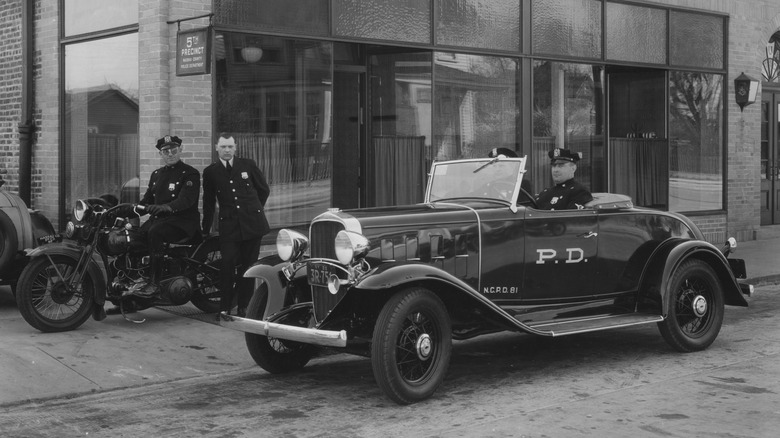
Police cars have been the subject of upgrades for nigh on 100 years already, though initially, American police departments carried out their own modifications to regular production cars. Dedicated factory police packages from the automakers surfaced in the 1950s; Ford was the first, with a Mainline police sedan available with up to 110 horsepower from its V8. Brake upgrades were offered soon after.
Chevrolet released its first police-car package in 1955. The Chevy One-Fifty sedan and Two-Ten station wagon could be had with special equipment — including upgraded brakes — straight from the factory.
Today, Ford has a large law-enforcement vehicle program, including the Police Interceptor Utility based on the Ford Explorer, and the F-150 Police Responder, both pursuit-rated and fitted with uprated brakes. Meanwhile, as part of its fleet business, General Motors offers three Chevrolet Police Pursuit Vehicles (PPVs). One of them is the Blazer EV, while the Tahoe PPV and Silverado 1500 PPV are based on the more familiar gas-powered SUV and truck. All come with upgraded Brembo brakes. Finally, there's the Dodge Durango Pursuit, featuring what's simply referred to as a heavy-duty brake system.