

More Than A Century Before The Slate Truck, Kits Turned Model Ts Into One-Ton Trucks
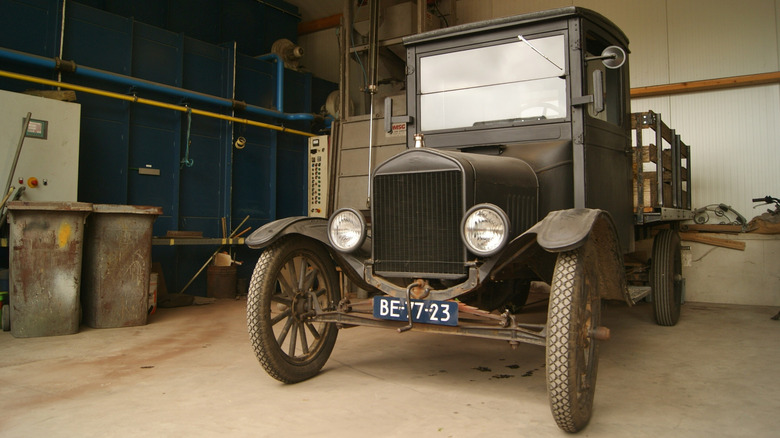
The majority of pickup trucks are expensive right now, with Cox Automotive highlighting the average price paid for a full-size last December was $66,386. While full-size models like Ford's F-Series range continue to top the sales charts in the U.S., customers on tighter budgets do at least have cheaper options worth considering. Trucks like Ford's Maverick, or the departing Hyundai Santa Cruz, prove that small, affordable trucks still have a place in the market, with both sporting MSRPs of under $30,000, before dealer and destination fees have been applied, at least.
The competition at the smaller end of the segment hasn't been fierce in recent years, with the Blue Oval dominating. However, newcomer to the scene Slate Auto is looking to challenge the favorite with its all-electric modular compact pickup, with prices starting from just $24,950. But while the Slate's modularity sounds new and exciting, Ford was doing something remarkably similar over 100 years ago.
The Slate Truck is entirely customizable — it doesn't even come with paint — meaning buyers pay for what they need, and nothing else. If two seats and a bed is all they need, so be it, but if options like roof racks, colored wraps, and auxiliary lights are desired, they can be specified separately.
That's remarkably similar to how Ford began marketing the Model T, after clocking that buyers were modifying them for commercial work. The Blue Oval brand began selling the Model T as a rolling chassis, so that it could be modified for any job at hand with ease, without the buyer having to first pay for components they were simply going to remove at a later date.
Third-party firms developed kits before Ford's official T-based truck launch
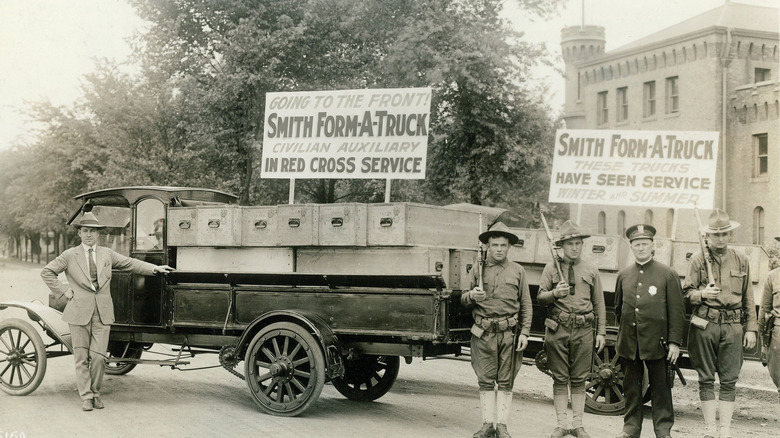
The first Model Ts hit the road in 1908, and before long, external outfits were modifying these early cars to suit commercial use. Common conversions included adding enclosed cargo areas, or open beds. By 1914, these third-party firms had developed seriously heavy-duty conversions, capable of hauling up to three tons.
Among the more popular conversions was the Smith Form-A-Truck, which sported a huge bed with an extended, reinforced frame. Other builds, such as the 'Cook Wagon' which proved a popular food-delivering tool during the First World War, proved the Model T was an extremely versatile machine capable of fulfilling many roles – just like what the Slate Truck promises to be.
Ford had experimented with commercial Model T builds in the past, such as with the 1911 Light Delivery Car, which boasted an enclosed cargo area. Despite being priced keenly, at $700, it didn't prove a popular addition to the range, and so Ford removed it from the line-up just two years later.
In 1916, Henry Ford called for the adaptation of Ford chassis' into heavy-duty trucks through his dealer network to be stopped, blaming various safety concerns for the decision. Of course, this cleared the way for Ford's one-ton chassis, which arrived in January 2017, to enter into a less-saturated market. Priced at $600, the Model TT as it was called sported a notably pricier sticker than the $325 Model T chassis. Still, with in the region of 1.5 million produced throughout the following 10 years, it was clear Ford's official one-ton offering was a significant success for the Blue Oval brand.