

How Engineers Designed Concrete Highway Barriers To Maximize Safety
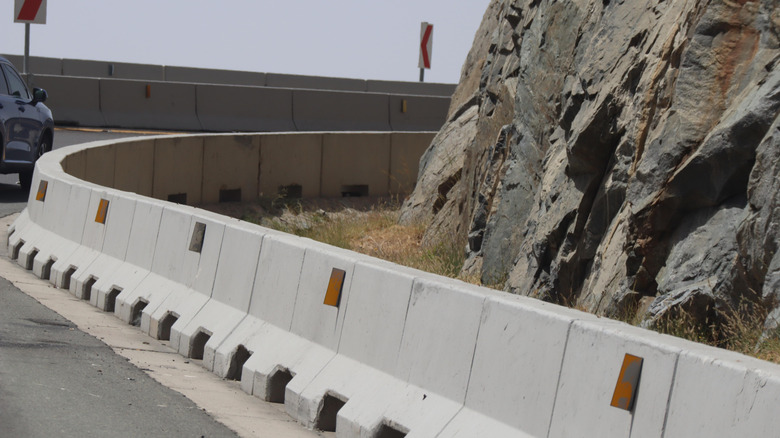
Roadway safety conventions tend to fall into one of two buckets. First, there are the things that help you avoid a crash. This includes everything from basic signage and high-tech traffic light systems with sensors, to road reflectors and those half black-and-white highway strips used to delineate lanes. The other bucket contains things intended to reduce crash severity, like guard rails, wide grass medians, and concrete highway barriers.
At face value, the idea of crashing into concrete barriers sounds more like a dare than a safety measure. And given that concrete is literally everywhere — the Science Museum, London, notes that there's more of it than any other manufactured material on Earth — it's easy to ignore them. It's true that they are tough, durable walls that can divide oncoming traffic lanes, and reduce head-on collisions. But they're also engineered to maximize safety by preventing rollovers, and helping guide vehicles in the forward direction they were traveling at impact.
Concrete barriers have been refined over the decades to meet new safety standards, vehicle sizes, and needs. The most well-known design is still the Jersey Barrier, which, contrary to its name, was not intended to keep things in or out of New Jersey. The Garden State famously engineered the shape and structure in the 1950s after California began tinkering with concrete dividers in the late 1940s, but the basic principles remain the same today as they were back then.
Evolving barrier designs and refinements
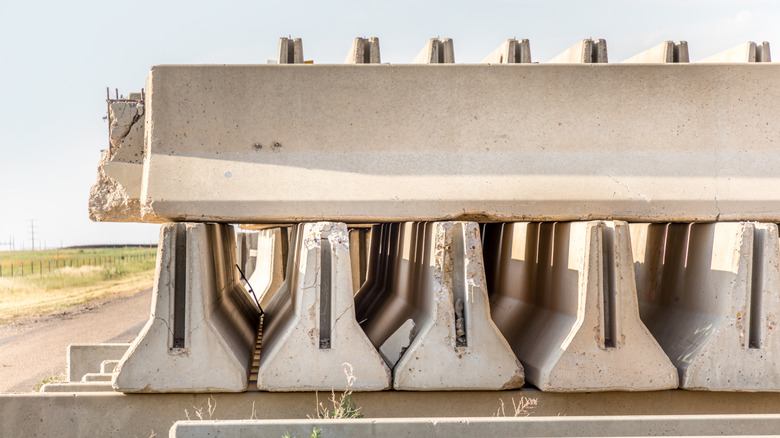
One of the first things you'll notice about a Jersey Barrier, known as a K-rail in California, is its flared or safety shape profile, featuring a wide base that tapers up from the bottom. There's 3-inch vertical rise, and then the wall slopes in until it reaches 13 inches up the face, where it flattens out all the way to the 32-inch top of the barrier. Some states have 42-inch barriers to help deal with retina-searing headlights from oncoming traffic.
The real point and genius of this design is that it sends vehicles climbing up the wall upon impact to help dissipate energy, mitigate rollovers, and reduce damage and injuries. Naturally the results will vary based on speed and vehicle size. This is why the F-shape barrier was engineered. It looks like a Jersey Barrier, but the slope stops at 10 inches above the ground, specifically to help prevent small cars from rolling over.
Texas and California also have single-slope barrier variants of 10.8 and 9.1 degrees respectively, from base to the top of the wall. These help with rollover prevention, but don't lift the vehicle in the same way as that 3-inch bump at the base. That means more damage and energy can be transferred to the vehicle and occupants. Completely straight walls behave like single-slope walls, with the added danger of a driver's head hitting the wall, if it's tall enough and there are no side-impact airbags involved.
Ever-changing vehicles and barrier safety considerations

No highway safety barrier is perfect. Concrete found favor because the wooden rails that California was using were compromised by cars and trucks using them to slow down. Some steel guardrails can deform and absorb impact energy, but can't seem to stop EVs. Hitting anything on a motorcycle is bad news, but cable barriers have drawn the ire of riders, while the Federal Highway Administration (FHWA) said it's the posts that punish. You'll also see plastic, water-filled barriers in various shapes, which are relatively easy to move, and great for temporary construction zones with reduced speeds.
The above reference to EVs isn't a dig, rather it's a reflection of how vehicle designs change over the years, and the ongoing need for safety barrier standards to evolve in lockstep. In recognition of the fact that cars and trucks are getting bigger, the American Association of State Highway Transportation Officials (AASHTO) in 2009 introduced its Manual on Assessing Safety Hardware (MASH) to replace outdated 1990s benchmarks, adding more vehicle categories, higher speeds, and various crash angles.
MASH was updated in 2016 and revised in 2022, and the FHWA mandates full compliance. If you're wondering how much a barrier can take, the revised testing levels range from TL-1 for cars and trucks at 31 mph, to TL-3 for cars and a 5,000-pound truck at 62 mph, all the way up to TL-6, which sees cars and trucks at 62, and raises them a tractor-tank trailer at 50 mph.