

Wallace, Idaho Held A Funeral For The I-90 Highway's Last Stoplight
Despite the fact that a whole lot of Americans aren't sold on a car-centric lifestyle, the country's Interstate Highway System is the backbone of American transportation, covering over 46,000 miles of American roadway and helping the country's some 240 million licensed drivers travel from coast to coast with relative ease. The Interstate Highway System as we know it now is the result of the Federal-Aid Highway Act of 1956, which was signed into law by President Eisenhower and initiated what has since been called the U.S. Department of Transportation claims it's been hailed as the greatest public works project in history – though personally I'd give that to something like Japan's robust train system, including the world's fastest passenger train at 375 mph or China's 28,000 miles of high-speed rails.
But the Interstate Highway System is crucial to American life, as it's the primary method of transportation for freight. Semi-trucks carrying 12.8 billion tons of freight rely on highways throughout the country to deliver everything from groceries and furniture to wind turbines every year. This is all to say: Highways in the United States are a big deal. And as such, it makes sense that Americans would recognize momentous occasions for such a big part of American life.
That's exactly what the residents of Wallace, Idaho did on September 12, 1991, when I-90's very last stoplight was discontinued and removed from the road. That beloved stoplight had long been Wallace's claim to fame, and when it was retired, townsfolk held a bona fide funeral for it, complete with a horse-drawn hearse and the dirge of bagpipes. Today, the stoplight sits in eternal slumber at the Wallace Mining Museum in its coffin, which is still filled with plastic flowers.
Can somebody please explain why I-90 had a stoplight in the first place?
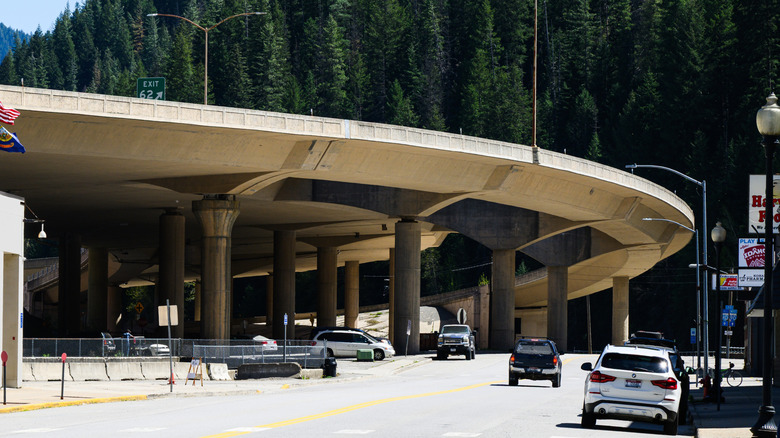
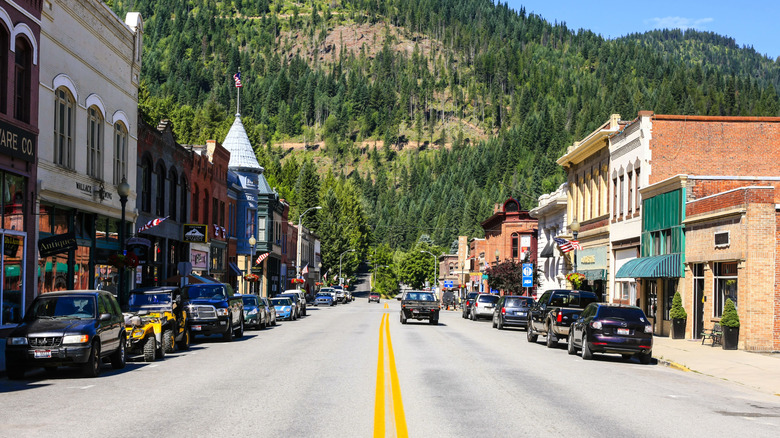
Ostensibly, the point of the Interstate Highway System is to provide quick and efficient transportation throughout the country, right? And a big part of being quick and efficient like that is not having to stop. So why on Earth would there be a stoplight on one of the country's biggest interstates as late as 1991? The answer has to do with the unique geography of the area surrounding Wallace. While it's not quite as desolate as the 240-mile stretch of Alaskan Highway with no services at all, Wallace finds itself nestled in an incredibly tight valley, and there was not enough space to install the interstate there without demolishing large portions of the town and bisecting it completely.
After the State Highway Department brought six different development plans for this section of I-90 before the Wallace City Council, it was decided that an elevated freeway bypass would be built over the town. However, the plan wasn't necessarily popular with the people in town, and an injunction filed by local Harry Magnuson delayed the project. During that time, Wallace citizens led by Nancy Lee Hanson began the work of getting Wallace's many buildings on the National Register of Historic Places. That's how the entire downtown area of Wallace, Idaho came to be designated as of historic significance in 1979. In the meantime, plans for how to safely build the interstate through the area were refined.
Until this last section of I-90 was completed in 1991, drivers had to exit the interstate at Wallace onto U.S. Route 10, which ran through the center of downtown. The iconic stoplight was located in the heart of Wallace along Route 10. Now, an elevated viaduct guides drivers over Wallace without stopping.