

Japan's L0 Series Maglev Is The Fastest Passenger Train Ever Made At A Verified 375 MPH
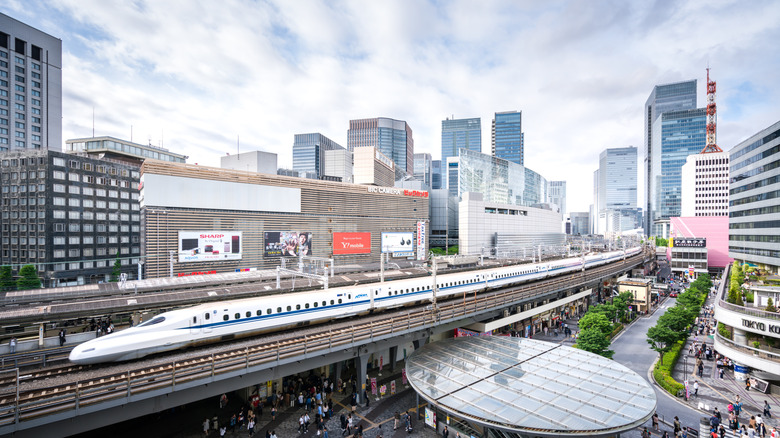
In the world of speed records, it's best to keep a passel of asterisks in your back pocket. More than a decade ago, in 2015, the Central Japan Railway Company's L0 train set a Guinness World Record for the fastest magnetically levitated (maglev) train, hitting 603 kph (375 mph).
It is not, however, in regular operation. The fastest maglev train passengers can ride regularly is the Transrapid Maglev Shanghai. It makes an 18-mile run between Shanghai's Pudong District and Shanghai Pudong International Airport in about eight minutes, reaching speeds of 267 mph. It holds the Guinness World Record for the fastest maglev in regular service, with a top speed of 311 mph.
But we should put the brakes on speed records for a beat here and explain what the heck a maglev is and why it's necessary technology for achieving ultra-high speeds. Also, we'll dig into why China may get trains that are faster than planes before Japan. Because, to start with, last year researchers from that nation's Donghu Laboratory High-Speed Magnetic Levitation Electromagnetic Propulsion Technology center in Hubei province demonstrated trains that can rocket along at 800 kph – which is just shy of 500 mph.
But you can't get on that train yet. However, it's possible (sort of) to ride Japan's L0, even way before the long-delayed Chuo Shinkansen line is set to open. That isn't until 2037, since construction and environmental issues have slowed its debut. But there is a clever "hack" that Japan's Central Railway has made available to "densha otakus," or in English, train nerds.
How does Japan's L0 Series maglev work?
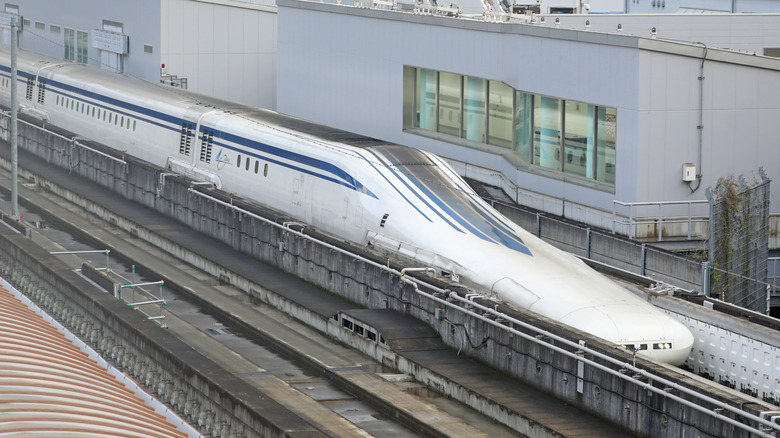
A maglev can be thought of as a giant, very long, and very fast bobsled held in place by magnets. Rather than tracks, what's called a guideway creates the path that levitates the train and keeps it elevated. If you've ever tried to push two magnets together and had them resist that effort, that's what's both lifting the train and keeping it centered.
The Japanese L0 Series uses wheels when traveling below 93 miles an hour, but above that speed, the pulse of the magnetic force between the guideway and electromagnets on the outside of the train increases enough to lift the L0 four inches off the ground. Once airborne, any friction between the train's wheels and the track is no longer a concern. Interestingly, Japan's L0 Series rides higher than the Shanghai train to provide a buffer against track distortion in the event of an earthquake, which Japan is famously known for. In theory, Tesla's Hyperloop would also be a maglev – save that the Hyperloop is hyper dead.
One pragmatic issue with using magnets for levitation, guidance, and propulsion is that they tend to superheat when you try to push a strong current through them. Japan's L0 has overcome that problem by cooling the electromagnets with liquid helium and nitrogen and insulating this system. And they're working on developing magnets from other materials, which Japan Railway says will reduce the complexity of the system, and possibly require less severe cooling.
Riding a maglev train
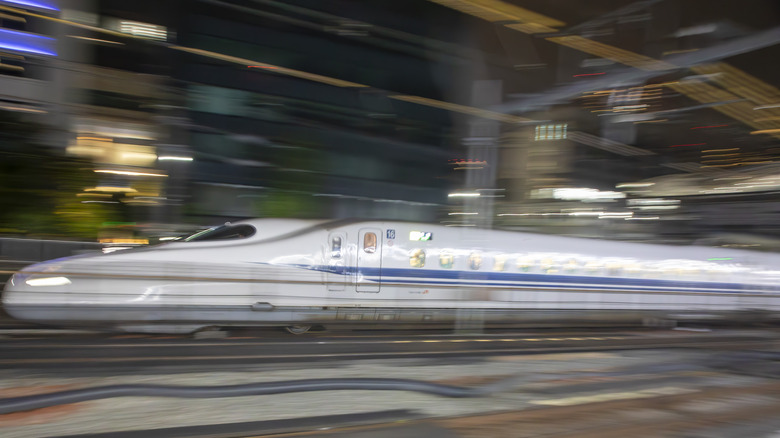
You can ride a few different maglevs worldwide. The fastest commercial line is still (relatively) slow. The 18-mile Shanghai maglev is such a short run that by the time the train gets going, it must start decelerating. So its average speed of 225 kph (140 mph) makes it somewhat slower than China's CR400 Fuxing conventional bullet train, with its maximum speed of 217 mph, and Japan's Tokaido Shinkansen, with its top speed of 177 mph.
If you have time to kill outside Seoul's Incheon International Airport, you can ride Korea's pokey, 40 kph (25 mph) Incheon Airport Maglev. In Japan, Nagoya's Linimo line is somewhat more pragmatic and links that city to tourist attractions, like the Toyota Automobile Museum. But it's also not quick, with a top speed of 100 kph (62 mph).
To shoot along at 311 mph, you'll want to enter a lottery to ride Japan's L0. There's no set schedule, though the Japan Railway operates semi-regular runs open to the public. Tickets cost 4,400 yen (about $27).
Like other maglevs projects, the Japanese maglev, which eventually connects Tokyo with the city of Nagoya, has been plagued by cost overruns. The original 5.52 trillion yen, or $34 billion, has shot up to an estimated 11 trillion yen, or roughly $68 billion, due to increases in material costs, and the cost of construction in difficult areas.