

FAA Fires Two LaGuardia Controllers For Leaving Work Early Before Fatal Crash
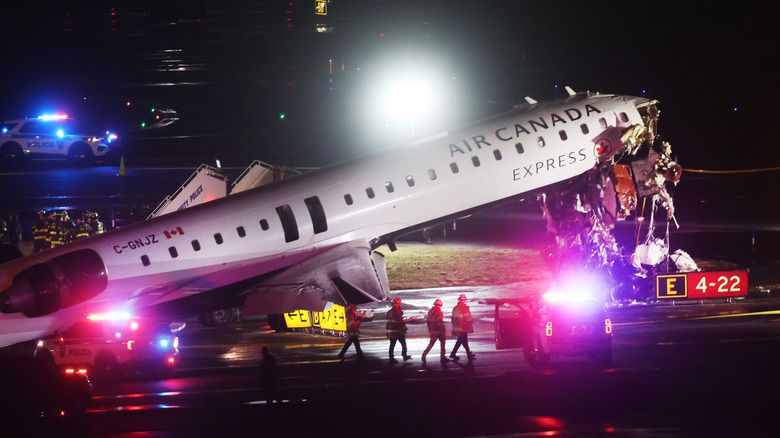
It's been five months since an Air Canada regional jet slammed into a firetruck while landing at LaGuardia Airport in New York. The crash killed both pilots. The Federal Aviation Administration later discovered that two air traffic controllers left their posts early before the crash. The agency is now moving to fire the employees this week. While the FAA isn't certain if the early departures played a direct role in the crash, the surprisingly widespread practice might be inflating official staffing statistics at notoriously understaffed air traffic control facilities.
Only two controllers were in LaGuardia's tower when the March crash occurred. Investigators were initially confused because it didn't reflect official records. According to the New York Times, veteran controllers revealed that it was common for shift supervisors to let overworked controllers go home early as a reward. These frontline FAA personnel are also questioning why the agency is taking a hardline stance against early departures now. Transportation Secretary Sean Duffy said:
"But when a small percentage of individuals take advantage of the American taxpayer, unfairly add additional work to their fellow controllers and impact the airspace — we have no choice but to act. We will not tolerate fraud, and we are taking appropriate action to hold folks accountable and prevent unlawful practices from disrupting the traveling public."
Sean Duffy thinks AI could solve the ATC staffing crisis
Yes, the FAA views early departures as a form of timecard fraud. Duffy and the agency are seemingly pulling every lever they have to deem the air traffic controller staffing crisis over. The Secretary of Transportation requested $10 billion in April for AI air traffic control software. He wants computers capable of rescheduling flights without human intervention. The ultimate goal is to automate a controller's workload to the point where fewer personnel are needed. Earlier this year, the FAA estimated that only 12,563 controllers are needed to meet staffing targets, over 2,000 fewer than the previous target.
There are just some tasks that can't be automated away. Based on communications recordings, there was a single controller responsible for both air and ground traffic at the time of the crash at LaGuardia. It was a busy night at the airport due to inclement weather causing delays earlier in the day. When a United Airlines flight was forced to abort takeoff and had no gate available to return to, the flight crew declared an emergency. That's how a firetruck without a transponder ended up in a position to be hit by a plane.