

6 Japanese Performance Cars That Skyrocketed In Value (And 5 Cheaper Alternatives)
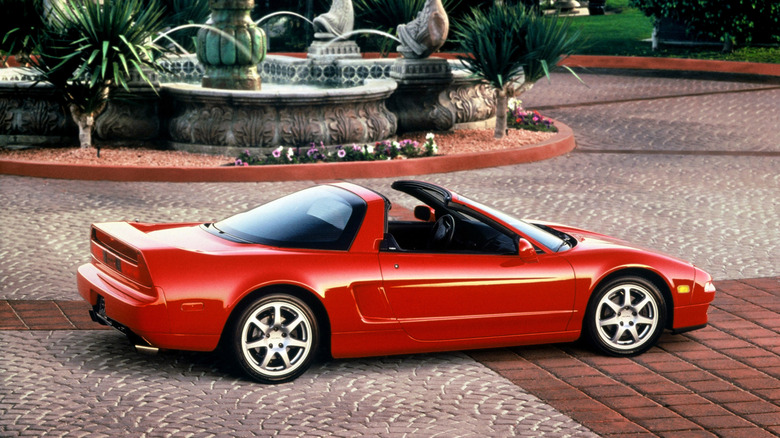
The Japanese performance car landscape is weird. During the 1990s, it gave us so many sports cars to dream about, from affordable fun-to-drive machines to supercar-rivaling legends. And they felt within reach. If they weren't available at the dealer's price, surely they would get cheaper with time.
Unfortunately, a series of events turned Japanese performance cars into prized possessions. The 1997 "Gran Turismo" game introduced the world these amazing machines, and 2001's "The Fast and the Furious" movie showed them being tuned to beat Ferraris at the traffic light. As a result, the new Japanese automotive culture was born, pushing second-hand prices through the roof.
Indeed, there is no shortage of Japanese performance cars that skyrocketed in value, as some of our entries below demonstrate. However, there are also cheaper alternatives that give you largely the same driving experience, minus the extra cost. You'll find great, lower-cost substitutes for the Integra Type R DC2, Nissan 240SX, and even the Toyota Supra MkIV on this list. There is one Japanese classic with no alternative, though — but let's keep that wrapped up for until the very end of this article.
The skyrocketed icon: Acura Integra Type R DC2 (avg: $25,500)
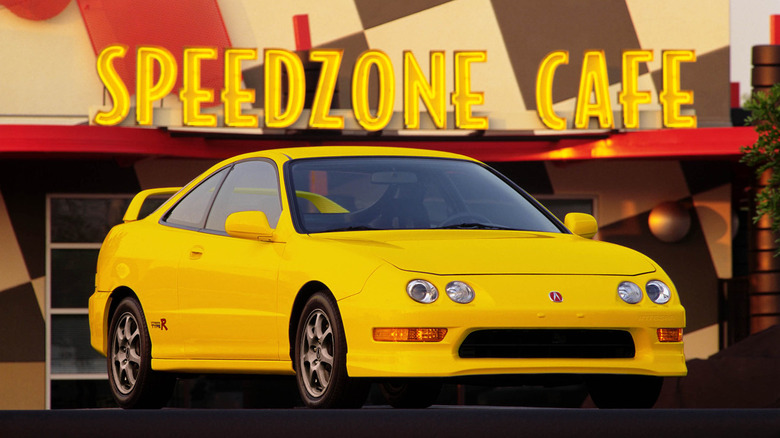
You might think real sports cars should be rear-wheel drive. That statement holds true only if you've never driven an Acura Integra Type R DC2 (with "DC2" denoting its chassis code), often considered as the absolute best-handling FWD car by reviewers and enthusiasts. That's partially because it's incredibly light at only 2,400 pounds. And yet, the rigid subframe, double-wishbone front suspension, semi-trailing arm rear suspension, and limited-slip differential make it feel like a race car for the road.
That's not even mentioning the high-revving, hand-built B18 engine. The 1.8-liter four-cylinder legend produces 195 horsepower, revs to 8,400 rpm, and sounds like a true racing engine. The buzzy block is exclusively paired to a five-speed manual gearbox, while the direct, engaging steering further amplifies the driving experience. You could say that the DC2 Integra Type R is an attack to all your senses — which is what enthusiast cars should be all about. Yes, its 0-60 time of 6.6 seconds (via Car and Driver) is slow by today's standards, but the experience is still stellar.
Naturally, this unique cocktail of characteristics has turned the DC2 Integra Type R into a prized possession. Classic lists an average price of $25,572, with a top sale of $56,000. However, one 4,800-mile 2001 Integra Type R reached a price of staggering $204,204 at a 2025 Bring a Trailer auction, demonstrating the thirst for this particular Japanese FWD legend.
The cheaper alternative: Acura RSX Type S DC5 (avg: $13,000)
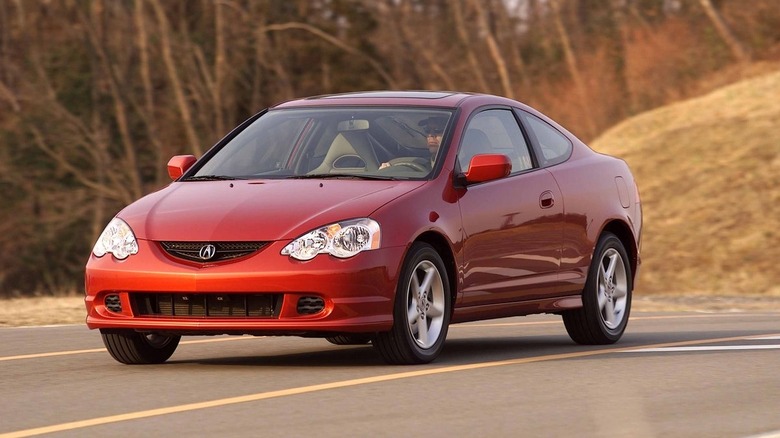
Want a lightweight, high-revving, and engaging Acura coupe that's also easy on the wallet? Look no further than the Integra Type R's successor. Yeah, Honda/Acura purists will quickly point out that the RSX Type S isn't as focused. It has a simpler front MacPherson strut suspension setup, no limited-slip differential, and a higher 2,775-pound curb weight. But it also has the K20C, a 2.0-liter, four-cylinder, i-VTEC monster that produces 200 horsepower (increased by 10 for 2005), revs to 7,900 rpm, and propels the coupe to 60 mph in as little as 6.2 seconds. The engine sounds almost as good as the Type R's, too.
The RSX Type S is also known to handle corners pretty well. Yes, its suspension isn't as sophisticated, but it has a stiffer body shell that produces less roll in the corners. Like its predecessor, the RSX Type S has a direct front end, but it's more balanced throughout. Its steering is praised by reviewers, with plenty of positivity around the standard close-ratio six-speed manual — despite utilizing a simpler cable setup rather than a direct mechanical connection. To top it all off, the RSX Type S is a more comfortable car, which is important for those who want a fun daily driver.
The clincher, however, is that the RSX Type S is much cheaper. Classic lists an average price of $13,000, with the most expensive unit sold at $26,500. That's not an insignificant difference, especially considering how you're getting a newer car than the Type R.
The skyrocketed icon: Nissan 240SX S13/S14 (S13 avg: $13,700; S14 avg: $19,000)
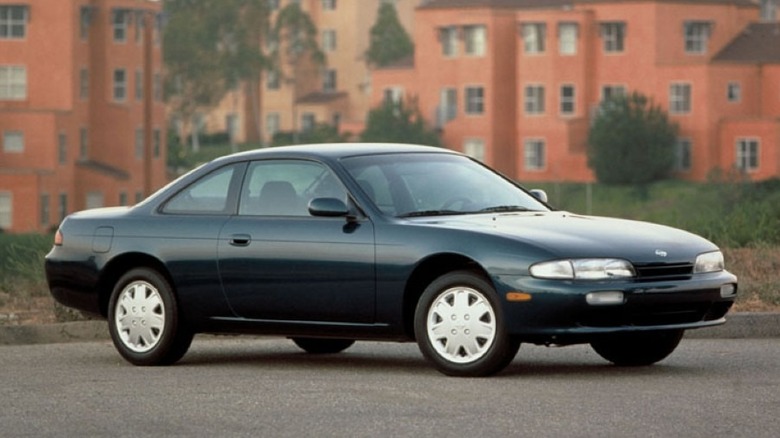
The Nissan 240SX (Silvia in Japan) S13 and S14 generations started their life as budget-friendly, fun-to-drive sports cars. They had all the ingredients to put a smile on your face: low weight, front-engine/rear-wheel-drive layouts, and a multi-link rear suspension. Add in its outstanding aftermarket support, and you have the perfect recipe for an awesome drift car.
For the sake of this article, though, the CA18DET and the special SR20DET turbocharged engines are being left out of the equation because they were never available in the U.S. Instead, Nissan equipped the S13 and S14 240SXs with naturally-aspirated 2.4-liter KA24E and KA24DE engines, which produced up to 155 horsepower. For comparison, the most potent Japanese Silvia produced 217 horsepower from the factory, and it has a far higher tuning potential.
Before you mention that swapping in an SR20DET into a 240SX is a straightforward procedure, keep in mind that this adds cost and complexity. And the 240SX isn't cheap; the average price of the S13 model is $14,408 (via Classic), while the S14 is even more expensive at $19,034 (also via Classic). Not to mention, you probably won't be getting a clean, low-mileage car; most 240SXs have been modified, raced, or crashed. Yes, you could import an SR20DET-equipped JDM Silvia, but it will suffer from the same issues —with the added quirk of right-hand drive.
The cheaper alternative: Nissan 350Z (avg: $14,000)
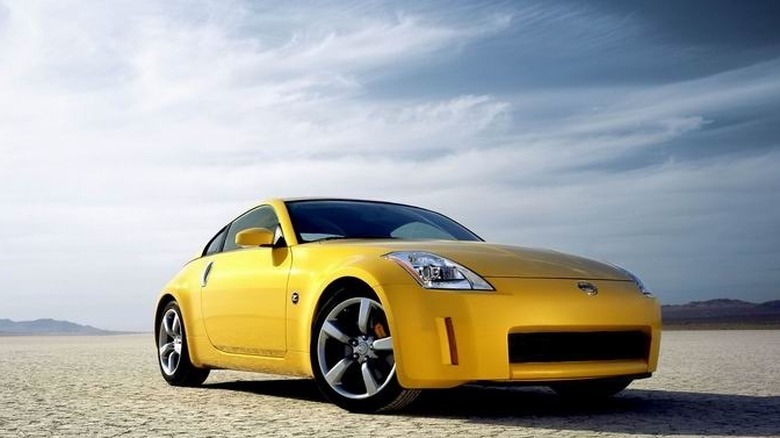
Unless you are a hardcore Silvia fanboy or a drifter, it's probably more worthwhile to spend your hard-earned money on a Nissan 350Z. Classic lists an average price of $13,958 for the model, and we found a mint $18,000 350Z convertible with only 17,624 miles on the clock last year. That seems like a small gap to the S14 until you remember you're getting a more modern vehicle. Let's not forget that the 350Z is part of Nissan's legendary Z lineage of sports cars, which sits above the Silvia/240SX.
Crucially, you get a real performance engine in the 350Z with two more cylinders. The 3.5-liter naturally-aspirated V6 is significantly peppier than 240SX's 2.4-liter four-cylinder, producing up to 306 horsepower and revving to 7,500 rpm in its last 2007-2009 iteration. This gets you a 0-60 time in the mid-to-low 5s, depending on the model year, and a 156-mph top speed.
Yes, with a curb weight of 3,322 pounds (early models), the 350Z is hefty compared to the 240SX (2,753 pounds), but it's still a good driver's car. Thanks to the front mid-engine RWD configuration and multi-link suspension on both ends, the 350Z is often praised for being fast and stable in the corners. It also has good steering, and it came standard with an excellent six-speed manual.
The skyrocketed icon: Toyota Supra MkIV (avg: $77,000)
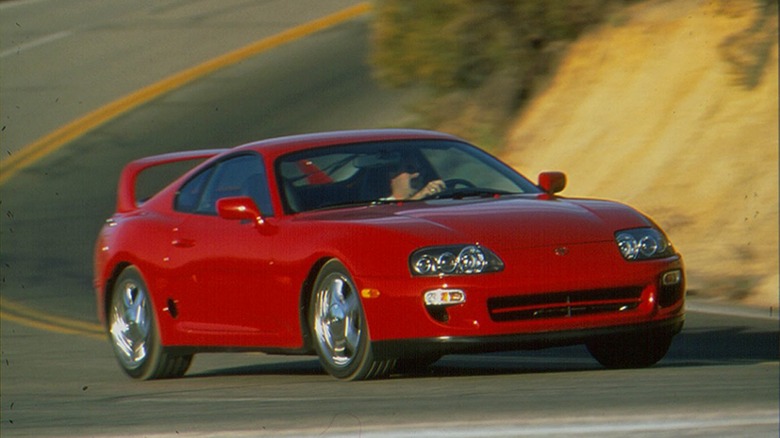
The Supra MkIV is the car that benefited the most from the "Fast and Furious" franchise. The first movie, in particular, demonstrated the Supra as a tuning powerhouse, with a special nod to its 2JZ engine. Indeed, Toyota's 3.0-liter inline-six is a legendary engine, iconic for its unmatched tuning potential and longevity. That's particularly true for the twin-turbo variant (2JZ-GTE), which produced 320 stock horsepower, but was capable of four-digit figures.
Enthusiasts, of course, love high-horsepower numbers. So the average price for a Supra MkIV is currently $76,820 (via Classic) — and that's including the less desirable bone-stock Supra with the naturally-aspirated engine. If you want a Supra Turbo, be prepared to shell out well-over $100,000. Heck, listings for low-mileage examples with the turbo go are priced at nearly $400,000.
Does the Supra MkIV justify its market value? Well, if you like pushing the horsepower performance envelope and owning one of Japan's most recognized classics, then yes. But if you want a reliable, powerful, and good-to-drive Japanese sports car, you should look elsewhere. It's not that the Supra is bad; in a 1993 Car and Driver sports car comparison, the Turbo variant mopped the floor with rivals like the Mazda RX-7 and Nissan 300ZX Turbo. It's fast, handles well, and has a direct, engaging six-speed manual (though it was also offered with an automatic). Still, Supra MkIVs aren't exotics, and they really shouldn't cost that much — regardless of the 2JZ-GTE.
The cheaper alternative: Lexus SC300/SC400 (SC400 avg: $10,000; SC300 avg: $14,000)
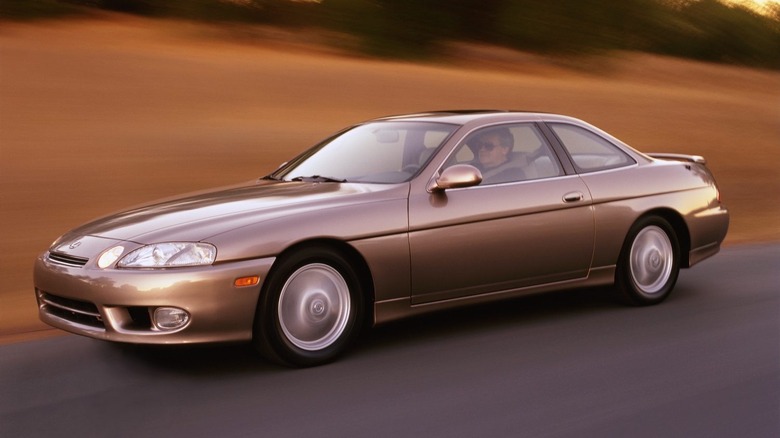
Want to avoid the Supra tax while getting a similar vehicle? The first-gen Lexus SC sits on an elongated Supra MkIV platform with a 5.5-inch longer wheelbase, making it less playful but also more stable in the corners. As a result, the SC — and its JDM twin, the Toyota Soarer — are very popular drifting weapons.
The base SC300 also shares Supra's naturally-aspirated 2JZ-GE engine with 225 horsepower, which was also offered with a five-speed manual (though most models were equipped with a four-speed auto). Meanwhile, instead of the twin-turbo inline-six, the high-end SC400 packs a 4.0-liter naturally-aspirated V8, good for 250 horsepower. Yes, this means you get no 2JZ-GTE, but Toyota's 1UZ-FE V8 is a legend in its own right, considered by many as a million-mile engine.
Here's the catch: The V8 SC400 was available only with a four-speed auto. But you can still swap in a manual and own a sleek, luxurious, and engaging Japanese GT with reliable V8 power. These conversions are relatively cheap; Grannas Racing offers a T56 Magnum-F six-speed manual kit for only $899.95. Fascinatingly, due to the 2JZ tax, SC400s are also cheaper to buy than SC300s. Over at Classic, the average SC300 price sits at $13,697, while the SC400 average is laughably low at only $10,266. Add a few thousand for the manual conversion, and you're still massively undercutting the Supra's price.
The skyrocketed icon: Mazda RX-7 FD (avg: $42,000)
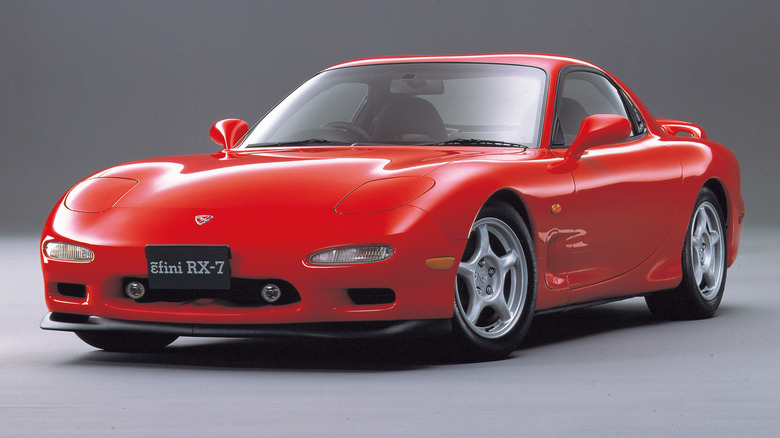
The RX-7 is Mazda's most famous rotary-powered car, and that's especially true for the last FD generation. This highly-unique Japanese classic packs a 1.3-liter, twin-rotor, sequential twin-turbo engine that produces 255 horsepower and revs to 8,000 rpm. Yes, that doesn't seem like much when compared to the Supra Turbo, but the RX-7 FD is also incredibly light at 2,850 pounds, so it still sprints to 60 mph in just about five seconds.
Experts consistently heap praise on RX-7's handling balance, and that shouldn't surprise anybody. The FD RX-7 has a perfect 50/50 weight distribution, a limited-slip diff on the rear wheels, a double-wishbone front suspension, and a multi-link rear suspension. The precise, mechanical-feeling five-speed manual only amplifies the fun-to-drive aspect of Mazda's legendary rotary sports car. And then there's the low-slung, swoopy shape of its chassis that looks fast and has aged remarkably well.
Fact is, everyone knows the RX-7 FD is a special car, and second-hand prices surged accordingly. Over at Classic, its average price is $42,068, with the top sale sitting at $99,000. You also have to deal with the 13B-REW rotary engine, which usually requires more care than a reciprocating piston engine. Finally, the RX-7 FD was only sold from 1993 to 1995 in the U.S., meaning you can only get the improved 1996 to 2002 variants as imports. In fact, rare 276-horsepower variants of the RX-7 — like the 2002 Spirit R and Type R Bathurst – won't be importable until next year.
The cheaper alternative: Mazda RX-8 (avg: $13,000)
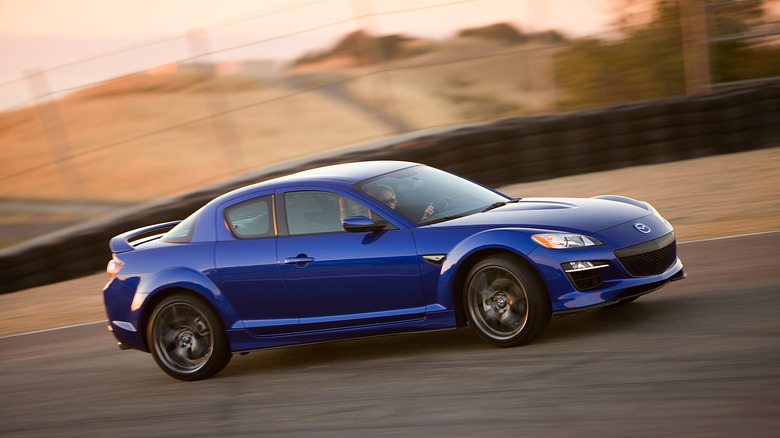
If the RX-7 FD is too expensive for you, but you're still craving a rotary, the RX-8 is an underrated gem you should definitely consider. Yes, it might not be as legendary as its predecessor, but it has its own merits. Chiefly, its twin-rotor 1.3-liter "RENESIS" power train is naturally-aspirated and spins to 9,000 rpm. With 232 horsepower on tap (alongside a manual transmission), it's reasonably quick, too, reaching 60 mph in just under six seconds. The RX-8's power train should also be less problematic, though both it and the RX-7's rotor are thirsty for fuel and oil — and they require religious maintenance.
Crucially, the RX-8 scores where it really counts: the driving experience. It sits on a RWD chassis with a perfect 50/50 weight distribution, and it's often lauded for its exceptional handling and balance. The car's stick-shift also offers that mechanical feel enthusiasts love, while its steering is direct and communicative. The fact that Mazda achieved all this while making the RX-8 practical as a daily driver also deserves mention. Small rear-hinged doors and usable rear seats allow your friends to also be part of the experience.
But of course, the main reason why you should consider the RX-8 is that it's relatively cheap. The average price for one at Classic is $12,654, with a top sale of $33,250. That's a fraction of RX-7's price, and you're still getting a newer, more modern car. Just make sure you don't buy an auto-equipped version, as it's less potent (212 horsepower) and only spins to 8,300 rpm.
The skyrocketed icon: Mitsubishi 3000GT VR-4 (avg: $19,000 to $55,000)
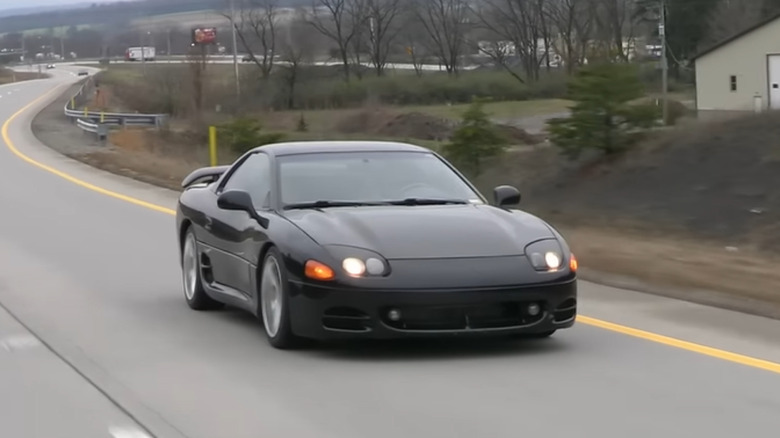
The Mitsubishi 3000GT VR-4 isn't often mentioned in the same breath as the Supra Turbo, GT-R, or RX-7 FD — yet it's one of the most interesting 1990s Japanese sports cars out there. Back then, it was Mitsubishi's rolling laboratory, featuring tech that would look exotic even on a modern sports car. The 3000GT VR-4 had active aerodynamics, active exhaust sound control, an electronically-adjustable suspension, and parallel all-wheel steering. Mitsubishi even offered a Spyder version with a power-retractable hardtop, adding to the car's complexity.
Unfortunately, the 3000GT VR-4 lost the adjustable suspension and active aero for 1994, but not Mitsubishi's trick AWD system with a viscous coupling and a 45:55 torque split. Base models were only front-wheel drive, though, and came with two forgettable naturally-aspirated 3.0-liter V6 engines with 164 horsepower and 222 horsepower, respectively. What you really want is the twin-turbo engine, which initially produced 300 horsepower (with the five-speed manual) and was bumped to 320 horsepower (with the six-speed manual) for 1994. The 3000GT VR-4 is a weighty machine (3,737 pounds), but thanks to the AWD system, it still sprints to 60 mph in less than five seconds.
The 3000GT VR-4 varies greatly in price depending on the generation. Early 1990-1993 models are quite affordable, with an average price of $18,919 (via Classic). Still, 1994-1996 models reach averages of $24,953, while the latest 1997-1999 VR-4s go for more than double that price. The 3000GT was also sold as a badge-engineered Dodge Stealth from 1991 to 1996. It's the same car, though make sure you look for VR-4's counterpart, the R/T Twin Turbo, which has an average cost of $16,303 at Classic.
The cheaper alternative: Subaru SVX (avg: $5,000)
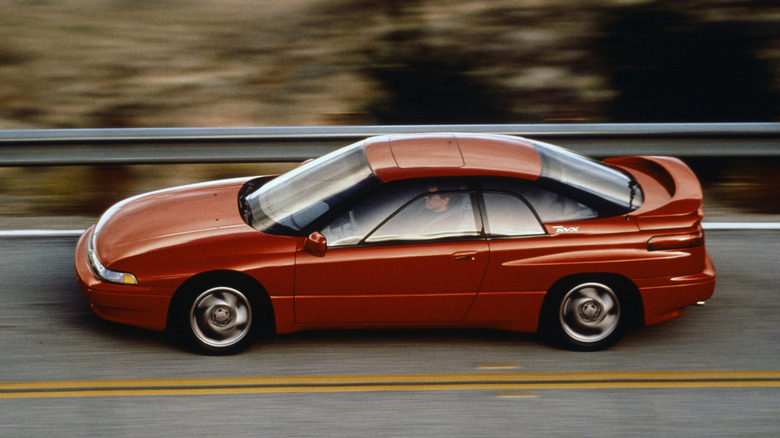
You must be thinking that early 3000GT VR-4s aren't that expensive, but next to the Subaru SVX, they are astronomical. Subaru's failed attempt of breaking into the luxurious GT category car has an average price of only $4,983 at Classic, yet it remains as one of the most captivating Japanese performance cars ever made. So, what made the SVX special? For starters, it has a very futuristic, jet-fighter-like design penned by Italdesign Giugiaro, as well as a luxurious (albeit a tad weird-looking) interior. The double side windows also make residing in the cabin a bit more special both for front and rear passengers.
Still, the defining characteristics of the SVX are the 3.3-liter flat-six engine with 231 horsepower and a standard all-wheel-drive system for cornering stability. They worked well together, resulting in universal praise for the SVX from most publications. The elephant in the room is that the SVX only came with a four-speed auto and no manual option. This has made the SVX slower than it should've been (0-60 in 7.3 seconds), and the gearbox isn't the most reliable either. Fortunately, the overheating issues plaguing the transmission are solvable with aftermarket cooling.
Many would like to point out that the SVX flopped because of the lack of a stick-shift, but the real reason is that it was more expensive than all of its Japanese rivals. Of course, this means you are getting it at quite the discount today.
The skyrocketed icon with no alternative: Acura NSX Gen 1 (avg: $125,000)
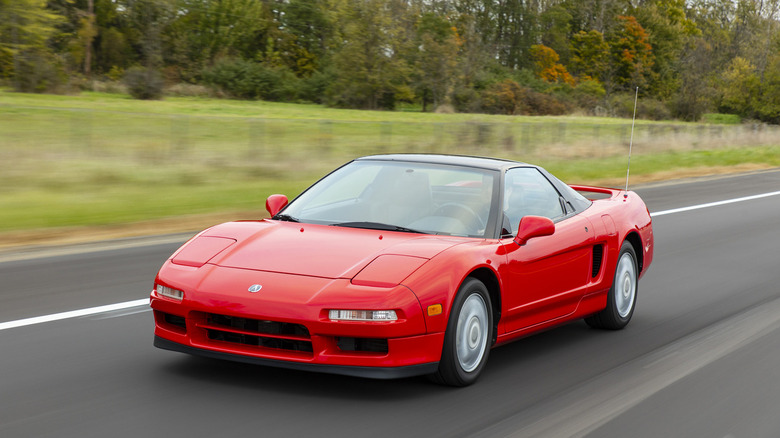
There is one classic Japanese performance car that sits in the category of its own: the first-gen Acura/Honda NSX. While most of its Japanese rivals went with a front-engine and either rear-wheel or all-wheel drive, Acura went with the classic supercar formula: mid-engine and RWD. Moreover, instead of turbocharging, the NSX packed a 3.0-liter VTEC V6, good for 270 horsepower and 8,700 rpm. For 1997, the displacement was bumped to 3.2 liters, resulting in an output of 290 horsepower.
And that only scratches the surface; the NSX also utilized a lightweight aluminum semi-monocoque chassis, resulting in a curb weight of only 3,010 pounds. That, along with the balanced mid-engine configuration and input from F1 legend Ayrton Senna, made the NSX one of the best-handling cars of its era according to multiple experts. The fantastic shifting of the five-speed (later six-speed) manual, excellent steering, and sonorous engine added that extra touch of quality you'd expect from an exotic supercar.
Unsurprisingly, the Acura NSX also commands exotic prices today. Over at Classic, the average price is $125,900, with a top sale at a whopping $350,000. Last year, we found a 1991 Acura NSX offered at relatively affordable $54,999, but with 259,000 miles on the clock and a number of aftermarket mods. You can get a cheaper mid-engine Japanese classic in the excellent second-gen MR2 Turbo W20, which has an average price of $22,935 over at Classic. But its turbo-four isn't as responsive, and its at-the-limit handling is downright tricky. It's not a bad alternative, but it's hardly a replacement for the NSX.