

New NASA Pictures Reveal SpaceX Crash's Devastation On The Moon's Magnificent Desolation
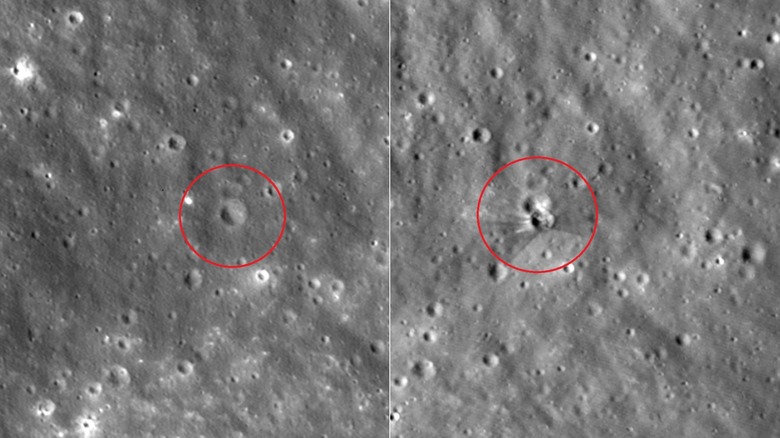
The Moon has a new crater. After launching commercial lunar landers last year, the upper stage of a SpaceX Falcon 9 rocket slowly made its unintended way towards our closest neighbor, slamming into it at 5,400 miles per hour on August 5. This upper stage had been essentially thrown away as space junk after its mission, but it just so happened to get sucked in by the Moon's gravity. Now, NASA has released photos of its impact. You can see that the new crater overlaps a pre-existing one, making a sort of lunar Venn diagram. The new crater is 60 feet wide and under 10 feet deep. It should probably get a name, too. How does the "SpaceX Space Junk Crater" sound?
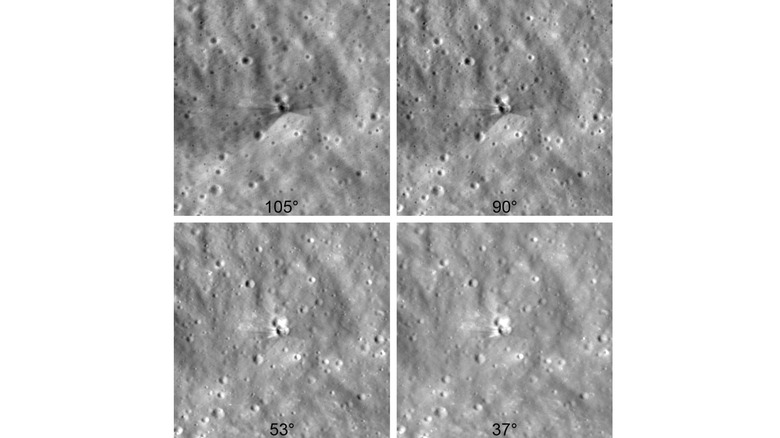
These images were taken by NASA's Lunar Reconnaissance Orbiter (LRO), a terrain mapping satellite. 60 miles above the surface and moving at 3,600 mph, it goes around the entire globe every two hours. These actually aren't the first photos of the Moon's newest crater: Those were taken by the Korea Pathfinder Lunar Orbiter, under guidance from NASA's Jet Propulsion Laboratory. Korea's mission was essentially just siting the exact spot of the crash; the LRO then followed up and took these much more detailed images. If you look closely, you can see both bright and dark streaks emanating from the crash site; the dark streaks are surface soil and rocks, blasted by solar radiation, whereas the light ones were scattered from deeper within.
Humanity's detritus
The more and more rockets humanity launches, the more and more likely we are to litter the lunar surface. There is very little regulation around what to do with spent rocket stages, so as happened here, sometimes "throwing them away" means polluting another celestial body. The Outer Space Treaty explicitly says that "States shall avoid harmful contamination of space and celestial bodies," but there's no strict definition of what this means, no enforcement mechanism, and no mention of private companies. As human activity on the Moon heats up, including full-on Moon bases, expect more detritus on what was once pristine soil.
This has already been ramping up over the last few years. In 2022, a Chinese Long March rocket stage unintentionally crashed into the Moon, leaving its own crater. In 2023, a Russian Luna-25 attempting to land a probe on the lunar south pole crashed — or, rather, "moved into an unpredictable orbit and ceased to exist as a result of a collision with the surface of the Moon," which is how I'm filing my next insurance claim.
It's an exciting time for humanity's voyage into space, but that comes with consequences. We haven't exactly been great about preserving our natural spaces here on Earth. Looks like the Moon is up next.