

Here's How Your Tire PSI Can Affect Your Fuel Economy
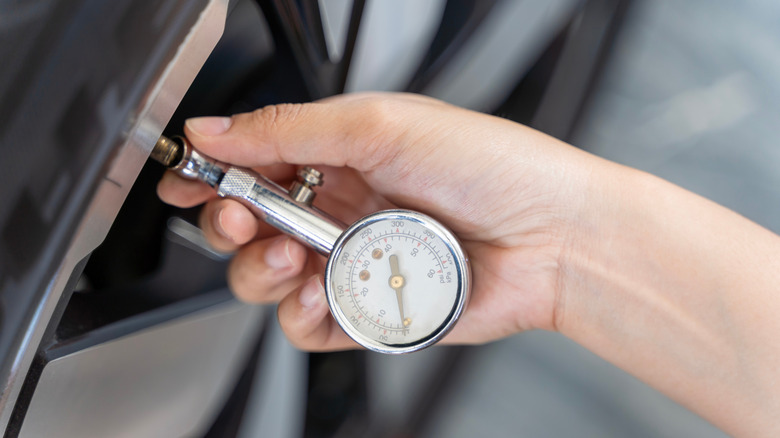
Every car on the market has a manufacturer-recommended tire pressure setting. If you open up your driver's side door, there will be a placard on the sill with recommendations for tire pressures. Sometimes, particularly for sports cars, those pressures will be different between the front and the rear. These pressure recommendations are set with a balance of safety, emissions, handling, comfort, and the vehicle's weight distribution in mind. As enthusiasts who frequently go to the race track will know, the difference of just a few pounds per square inch can make a big difference in grip and driver confidence. They can also have a sizable impact on your car's fuel economy.
With the cost of fuel through the roof in 2026, it makes sense that you might be looking for every little thing that could improve your fuel economy and save you some bucks. One thing is for sure: Running around on underinflated tires is absolutely costing you money at the pump, so check your tire pressures frequently. It might not be the worst idea to check them every time you fill up your gas tank, particularly as temperatures drop this fall.
The opposite is also true, because you can overinflate your tires beyond the manufacturer's recommendations. A higher pressure will usually bring fuel economy gains, though there are trade-offs to safety and tire wear that may counteract whatever money you save at the gas pump. Overinflated tires come with reductions in cornering and braking grip. We can't make your decisions for you, and everything in life is a compromise, so you'll have to decide if the money you save on gas is worth it.
The science behind it
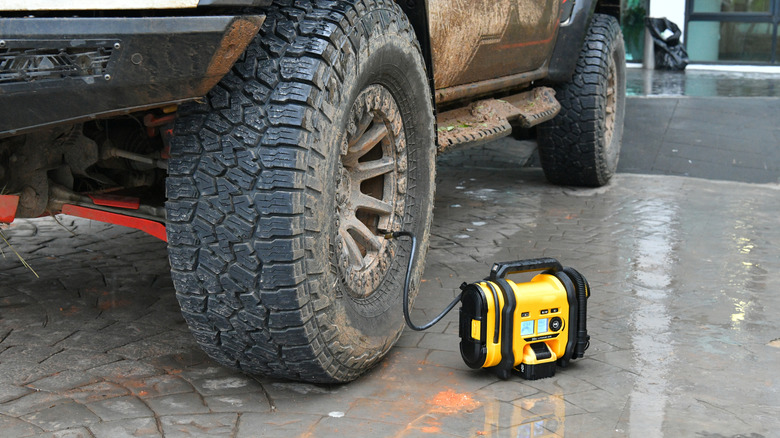
It has been proven time and time again that fuel economy improves as tire pressures increase. To understand this, think about how your tires react to their inflation levels. An underinflated tire pillows out and flexes as the tire expands its contact patch in length and width. The overinflated tire does the opposite, ballooning the tread of the tire out, rounding it where it should be flat against the ground, causing the center of the tread to bulge outward to become the only part of the tire still in contact with the ground. There are benefits and downsides to both, and the optimum tire pressure is one that levels the tread out flat across the surface of the tire, balancing a nice compromise between fuel economy and grip, while prolonging the tire's life.
A tire with lower pressure generally rides smoother and provides more traction, but the tire sidewall loses some of its lateral stability and can make cornering feel sloppy. The practice known as "airing down" in off-road driving uses an underinflated tire to the benefit of traction and lets tires roll smoothly over rocks and obstacles instead of bumping into them. An overinflated tire has less grip overall, extending your braking distances. An overinflated tire does make burnouts a lot easier, though.
There isn't a one-to-one improvement in fuel economy by boosting your psi, either. In this old "Mythbusters" episode, the cast discovered that mildly increasing your tire pressure by 15% resulted in about 6.2% better fuel economy, but significantly overinflating the tires by 71% resulted in a 7.6% fuel economy improvement. Likewise, underinflating the tires by 15% resulted in a 1.2% increase in consumption and going all the way down to just 10 psi, 71% under, consumed about 3.7% more fuel.
Should you run higher pressures than recommended?
Let's say for the sake of simplicity that you drive 10,000 miles in one year. With current fuel prices hitting a national average of $4.08, and the average fuel economy of cars in the U.S. sitting around 27 miles per gallon, a year of driving would cost you about $1,511.11. By running your tires 15% overinflated, based on the "Mythbusters" numbers you would save about $93.68.
Considering a set of new tires can cost near or into four figures, it wouldn't take much excess wear to negate your savings. There's not much data on how much quicker a set of tires would wear out when over-inflated by 15% because there are just too many variables to consider, but for the sake of argument, let's say this level of use would see your 60,000-mile tires wear out in just 50,000 miles, meaning you have to buy a new set of tires a year ahead of schedule. If that set ran you an even $1,000 with installation costs, you're losing about $170 worth of use in that set of tires.
Over the life of this set of hypothetical tires, you're still saving about $300 overall, or $5 per month of driving. Considering the trade-offs in loss of grip and the safety concerns, we can't recommend driving around for years at a time on overinflated tires. There are much safer ways to save $5 a month. You definitely want to stay topped up on tire pressure, but overinflating just doesn't math out. We can't stop you from doing it, but we hope seeing that it basically doesn't save you anything will make the math make sense.