

What Do The Restrictions On CDL Licenses Mean?
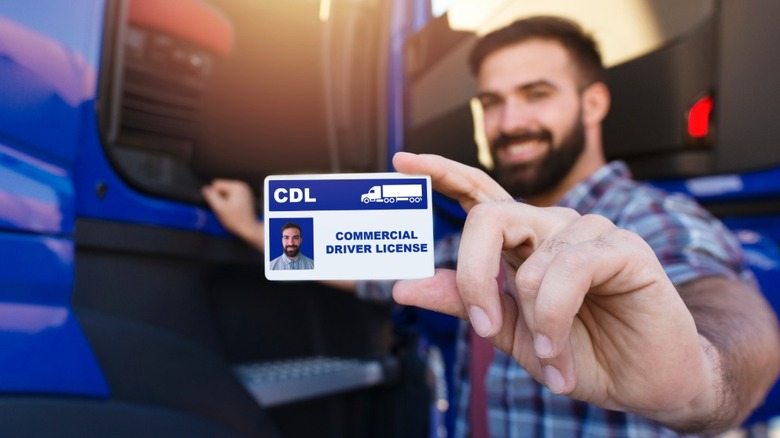
Getting a CDL (Commercial Driver's License) is a big milestone for an aspiring truck driver. But not all CDLs are the same. Each CDL specifies which class of vehicle the driver can operate, and lists restrictions for that driver.
Most federal restrictions have to do with the type of vehicle you're allowed to operate, and that's determined by the vehicle you brought to do your Skills Test in. For example, if the vehicle you brought is an automatic, that will get you an "E" restriction, which means you're not allowed to operate commercial vehicles with manual transmissions. Both "L" and "Z" restrictions prohibit drivers from operating vehicles with full air brakes, though for different reasons. Drivers with "Z" restrictions took their test in a vehicle with an air over hydraulic brake system. Drivers with an "L" restriction either took their test in a vehicle without a full air brake system or failed the Air Brakes Knowledge Test, and there's lots to know about air brakes. Other restrictions of this type include "O" (no fifth-wheel), "M" (only Class B and C passenger vehicles or school buses), and "N" (only Class C passenger vehicles or school buses).
There's also a "K" restriction, which prohibits participating in interstate commerce, which applies to cargo, not just the driver's route. The restriction can be for drivers under 21 years of age or drivers who have a limiting medical condition. The "V" restriction is for medical variances and exemptions, like corrective lenses, for example. And near the end of the alphabet, there's the "X" restriction, which denotes a driver who operates a military vehicle and is exempt from the CDL skills test.
States can add their own restrictions

The U.S. federal government has regulations regarding CDLs, but these licenses are issued by individual state governments. That means that states can add their own restrictions on top of the federal restrictions. However, the nature of the restriction has to be spelled out on the license. This makes sense, since a Montana state trooper who pulls over a trucker with a New York CDL can't be expected to know what New York's restriction codes refer to.
For example, New York CDLs may have the restrictions "A3", "S1", or "T1". "A3" has to do with whether driver needs to have a Medical Examiner's Certificate from the USDOT, something that's required in most cases, unless the driver only operates an excepted vehicle, like a school bus. The "A3" restriction indicates the driver operates only an excepted vehicle. "S1" indicates the driver only drives a school bus in New York. "T1" indicates the driver only drives a transit bus in New York.
Both Ohio and Minnesota have restrictions represented by "W". In Ohio's case, this restricts the driver to operating commercial vehicles for farm-related activities. In Minnesota's case, a "W" restriction indicates the driver is only allowed to operate a bus with less than 24 passengers. What's the moral of the story? Check with your local DMV or your state's DMV website to find out what restrictions apply where you live. State laws differ on this stuff the same way they do with other restrictions, like whether or not you need a CDL to drive an RV.
Classes and endorsements aren't the same as restrictions
While restrictions are about what you can't drive, classes and endorsements are about what you are allowed to drive. Classes are basically broad categories of commercial vehicles. Endorsements are required for specific vehicles that drivers need to be qualified for. In other words, you may have a Class A CDL, which is the broadest class, but still need an "N" endorsement to drive a tanker. Or, if you transport hazardous materials, you'll need an "H" endorsement. You'll need a "P" endorsement to carry passengers, and an "S" endorsement to drive a school bus.
With a Class A CDL, you can operate a combined vehicle with a GCWR of 26,001 or more, including a tow vehicle with a GVWR of 10,001 or more — typically much more than you'd be hauling in a regular pickup truck. A Class B CDL also enables you to drive a combined vehicle with a GCWR of 26,001 or more, but the tow vehicle must have a GVWR of less than 10,001. A Class C CDL enables the driver to operate a smaller vehicle that is neither Class A nor B, and carries at least 16 passengers. A Class A CDL covers B and C Class vehicles, while a B Class CDL covers Class C vehicles. We posted more details about the differences between CDL classes here, if you're interested. There's a lot to sort through, but once you zero in on the specific kind of license you need, everything else should fade a bit into the background.