

Why The 1979 Ford Mustang Indy 500 Pace Car Was Such A Big Deal
April 17, 1964: Henry Ford II unveils the Ford Mustang at Flushing Meadows, New York. It was an instant hit, selling over 400,000 units in the Blue Oval's first year with the pony car. But things weren't always so rose-colored for the Mustang. By 1972, the Mustang's pony car market share shrank from 10.7% to 3.2%. Competition inevitably drove the Mustang to evolve, leading to the Mustang II and, eventually, the Fox Body Mustang.
Despite the Mustang II's success, the second-gen pony car was heavily criticized and short-lived. It bowed out in time for the 1979 Ford Mustang to replace it, putting an end to the facelifted Pinto jokes. The third-gen car rode in on the new "Fox" platform and sported an all-new look, though it wasn't alone, as many Ford Fox platform cars shared similar underpinnings both before and after its reveal. So, what was the best way for Ford to showcase the Fox Body Mustang? Send a triumvirate of new third-generation models to lead a parade of race cars at the hallowed Indianapolis 500, of course.
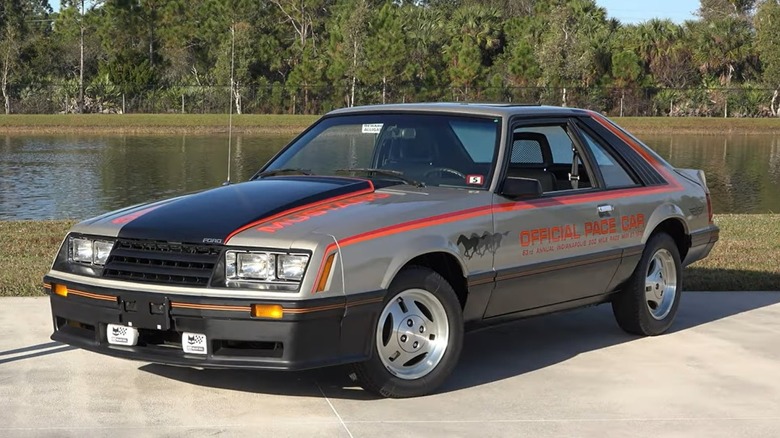
On May 27, 1979, three Mustang Indy 500 Pace Cars hit the track in characteristic liveries, including official "63rd Annual Indianapolis 500 Mile Race" graphics. More importantly, the pace cars gave Ford a chance to showcase the new Fox Body Mustang's updated looks to a roaring crowd. The 1979 Ford Mustang Indy 500 Pace Car was a big deal, but it wasn't just for being a kickass-looking means of regulating the field of race cars. It was also a chance to showcase the Mustang's new, evolved platform to the world, just in time for the inaugural year of the car's third generation.
A new era for the Ford Mustang kicked off with a Indy 500 Pace Car
In 1974, Ford launched the oft-joked-about Mustang II in response to its shrinking segment share (and not as a direct result of the oil embargo, as some might think). But the second-generation car was slandered by fans and critics alike, thanks to Pinto underpinnings and unimpressive specs. By the end of the Mustang II's run, the nameplate was ready for an update, and the Indianapolis 500 was a good place to showcase it.
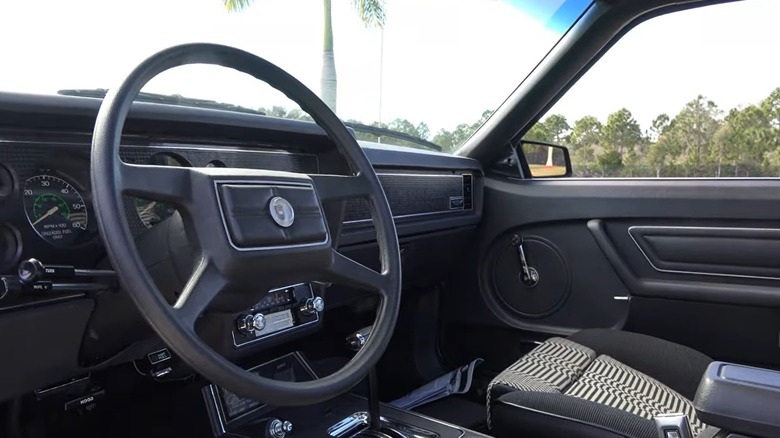
The new Fox Body Mustang ditched the Mustang II's sedate skin for a low belt line and an angular yet aerodynamic shape. While the Fox Body still featured a live rear axle, it adopted a new MacPherson strut front suspension setup. Thanks to updated material construction, the Fox Body even managed to shed 200 pounds compared to the Mustang II, despite being longer and more spacious. The result was a newer, lighter, more capable Mustang — and a desirable pace car to appeal to buyers.
See, Ford knew that the "Win on Sunday, Sell on Monday" way of doing things worked. Being seen on the track is good for the brand. The pace cars' showcase led to Ford selling 369,936 models in the Fox Body Mustang's first year, kicking off a generation that would last for over a decade. To this day, the third-gen 'Stang is still enough of a fan favorite to warrant a new Ford Mustang FX made as a rad throwback to the Fox Bodies of yesteryear.
302 reasons to love the 1979 Ford Mustang Indy 500 Pace Car
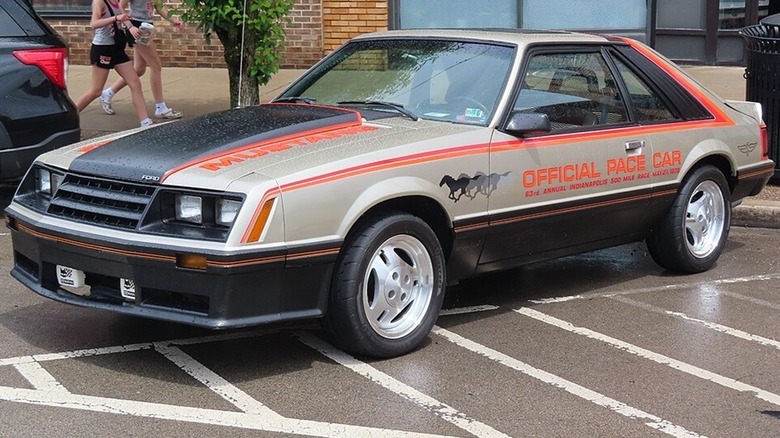
Though the 302-cubic-inch V8 disappeared from the third-generation Mustang's spec sheets in 1980 and 1981, it was available in the 1979 model as a carryover engine from the 1978 model. Florida's American Muscle Car Museum showcased a replica pace car with the 302 V8, rated at 250 pound-feet of torque and an admittedly-paltry 140 horsepower. 2,402 of them arrived with the 302 V8 hooking up to a four-speed manual gearbox, while 2,103 replicas swapped out the stick for a C4 automatic transmission.
The track-going trio of true pace cars, on the other hand, got the full Jack Roush treatment. Roush built all three 302 V8s from scratch with forged internals, a flat-tappet camshaft from a Boss 302, a dual-plane intake manifold, different cylinder heads, and an angry 600 CFM carburetor. As a result, the tinkered pace cars bumped output to 270 horsepower and 260 pound-feet of torque. Not exactly race car numbers, but a welcome increase over the stock mill. And it certainly helped to both sell the car and solidify the Mustang's legacy for years to come.
Want one for yourself? Ford made just under 10,500 of the replicas, so they're not exactly plentiful. However, when they do go up for sale, Classic.com puts the average sales price of the tribute model at $37,180. That's not too wild when you consider how it represents a period of change for one of America's most beloved cars. Not to mention, it's a cool nod to the sort of event that'll make you understand the appeal of racing.