

The 1982 Ford Mustang SSP Was The Last Thing Speeders In California Wanted To See In Their Mirrors
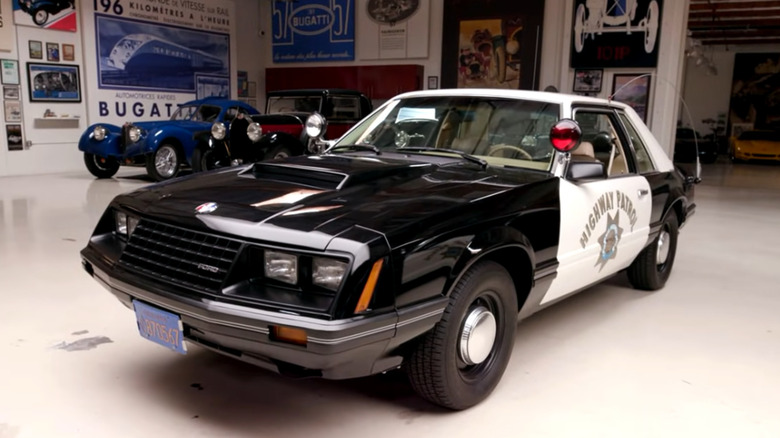
Let's say it's 1982, and you're whipping down the Pacific Coast Highway in your new Ferrari 308 GTB – Magnum P.I.'s Ferrari 308 GTS still being in Hawaii. Backed by your car's 230 horses — which were a lot at the time — you might think you've got nothing to worry about from the local California Highway Patrol (CHP). Yet you'd still want to stick to the speed limit if you saw a certain type of modified Mustang hanging around.
After all, the 1982 Ford Mustang SSP (with the Special Service Package) could out-accelerate the usual 308 GTBs of the time. The police special claimed a 0-to-60 sprint time of 6.3 seconds, putting it into what Car and Driver called "supercar territory at the time." The typical 308 GTB did the deed at 6.5 seconds. And that difference is despite the Mustang SSP only squeezing 157 ponies from its 302-cubic-inch V8.
Now, the Ferrari was noticeably faster on the top end. But according to the CHP, the Mustang was the only potential choice it tested to achieve at least 125 mph. So the car wasn't exactly slow, either. Plus, it welcomed suspension and steering enhancements from the Mustang GT along with upgraded wheels and tires.
Just keep in mind that the 1982 Mustang SSP wasn't Ford's first interceptor, and it wouldn't be the last. In fact, the current ones have changed with the times. Forget gas-only cars; the Ford Interceptor Hybrid Utility became so popular that the automaker had to stop production of retail models to meet police demands.
Did Ford make police cars before the Mustang SSP?
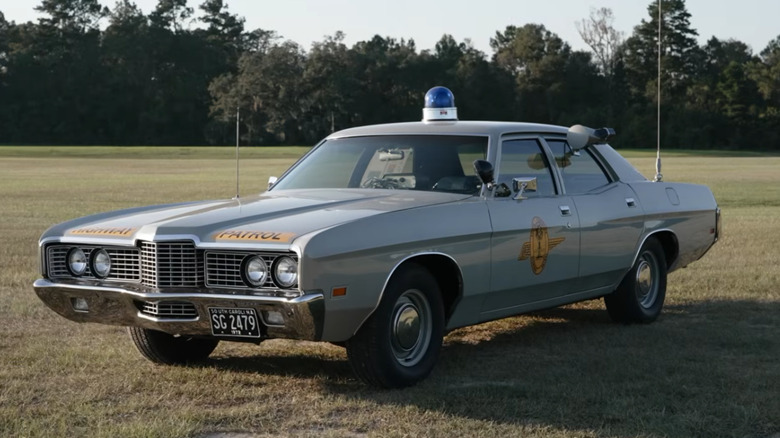
The first American police car dates back to 1899, and it was an EV. Built by the Collins Buggy Company for the city of Akron, Ohio, the machine was considered a patrol wagon and had a top speed of just 18 mph. Ford began getting in on the action around 1915, when Oakland, Calif., shifted its entire light-duty fleet to Blue Oval products.
Ford became the first company to offer a unique police package to its standard cars, too, in 1950. One highlight was its trio of engine alternatives. Police departments could choose from a 95-horsepower I6, a 100-horsepower V8, or, at the top of the output mountain, a muscled-up V8 making 110 horses. Two years later, a 125-horsepower V8 called the Interceptor was added to the options menu, and in 1954, the same name was first applied to a Ford police vehicle.
The 1960s saw Ford's police products really pick up their pace, as the automaker offered 26 different models to law-enforcement fleets. One highlight came from a new 428-cubic-inch Police Interceptor engine that could serve up 360 horsepower. By 1971, a separate 429-cubic-inch Interceptor V8 premiered with 10 more horses in the stable. At that point, however, a sort of malaise began coming over the auto industry, and the result would be a complete reset for vehicle performance that affected speeders and law enforcement alike. Remember, that first Mustang SSP may have been quick for the era, but it was down more than 200 horses compared to earlier Ford cop cars with the 428 V8.
Does Ford still make police Mustangs?
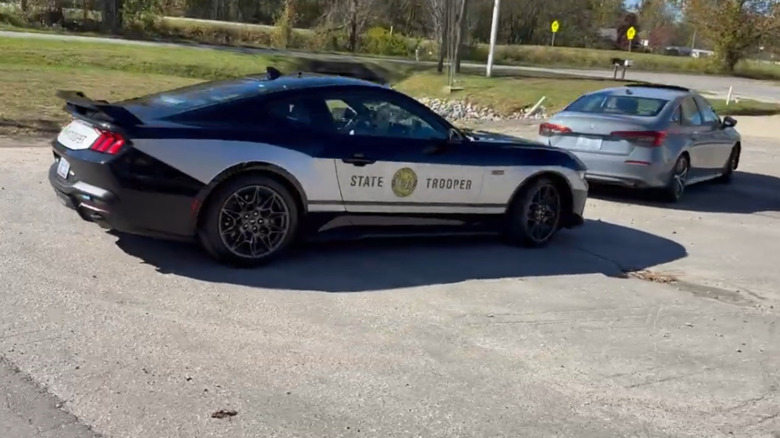
The introduction of the 1982 Ford Mustang SSP came right at the tail end of the Malaise Era, and it wouldn't be long before vehicle performance was on the rise again — but official Mustang police cars wouldn't be in the picture. Ford ended the Mustang SSP program in 1993 ahead of the introduction of the next-gen SN95 models. The automaker shifted gears to focus on the Crown Victoria instead, with impressive success. At one point, about 75% of the nation's police-car fleet was made up of Crown Vics and other Panther platform models.
Once the last of those was manufactured in 2011, Ford began taking a new, modern approach to police vehicles in which trucks and SUVs would be its primary focus — although the Taurus-based police car would remain in production up through 2019. The original Ford Interceptor Utility came out in 2011, with a pursuit-rated F-150 joining the force in 2017. Just keep in mind that Ford's first-ever police SUV was the 1967 Ford Bronco Special Purpose Vehicle.
Moreover, the Venn diagram of Ford Mustangs and high-powered pursuit vehicles still contains a few examples. It turns out that even though Ford no longer offers an official police package for its pony car, local law-enforcement agencies still purchase retail models and then convert them for police work themselves. For instance, both of the Carolinas – North and South — have bought Mustang GTs in the past few years to unleash on unsuspecting speeders.
Unfortunately, this could end up making their roads less safe if they actually put those Mustangs to the test. This could lead to the kind of high-speed pursuits that are dangerous for everybody.