

How Hill-Start Works On Manual Transmissions (And How To Drive Smoothly Without It)
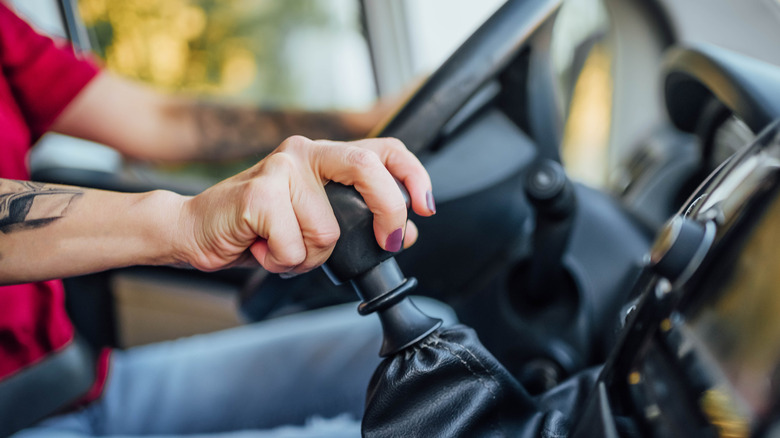
Whether it's handling stop-and-go traffic or executing smooth and fast shifts, an automatic remains the superior choice for most drivers by nearly every measurable standard of on-road ease and comfort, and modern hill-start assist (HSA) is a perfect example of this gap. It works beautifully on an automatic, while on a manual, it merely gets you by, never quite matching that same seamlessness.
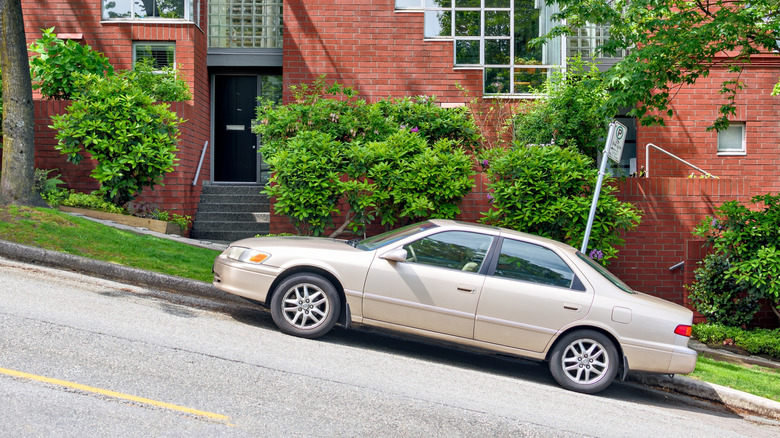
In the simplest terms, HSA on a manual holds the brakes to keep the car in place until the car has enough torque to start moving forward. When you're ready to go, you modulate the clutch and throttle to accelerate. Granted, most HSA systems simply hold the brakes for a fixed two-to-three-second window before disengaging them. With these systems, pressing the accelerator releases the brake immediately, so the two-second window only plays out in full if you haven't gotten on the throttle yet. Helpful as it is, HSA on a manual still demands a bit of awareness. If you're too late, you'll have to break and start over. And if you don't notice you've started rolling back, it can spell disaster. Let's explore how HSA actually works on a manual and how to develop that same smoothness and balance on your own.
The inner workings of a manual car hill assist system
Mechanically, modern HSA generally works with three parts: sensors, a central electronic control unit (ECU), and an ECU-controlled brake actuator that does the actual braking. Depending on the car model, sensors can read G forces, the incline angle, wheel torque, and even how much weight is pressing down on the car's suspension, sending all those readings to the ECU to work out how much resistance is holding the car back before telling the actuator how much brake force to apply. In many models, the release point isn't arbitrary — the brakes let go specifically once the clutch is disengaged to its biting point and engine torque reaching the drive wheels is enough to cancel out the pull of the slope.
Meanwhile, many other HSA systems don't rely on torque at all — they just give you a fixed window before the brakes disengage on their own, unless you press the gas pedal before that. Kia's, for example, holds for about two seconds after you release the brake pedal. Wait too long, and the car rolls back; get moving in time, and the brakes let go on their own. And the same goes for many other brands, including Ford. A third (and outdated) approach — often credited as the first HSA setup and introduced on the once great Studebaker's 1936 President –skips electronics entirely. A linkage runs straight from the clutch mechanism under the chassis into a mechanical brake-holding valve connected to the two pedals. Lifting the clutch tilts the valve and triggers the release of the brakes — no sensors, no ECU, no timer, just your foot doing the work.
How to smoothly handle hill starts in a manual without HSA
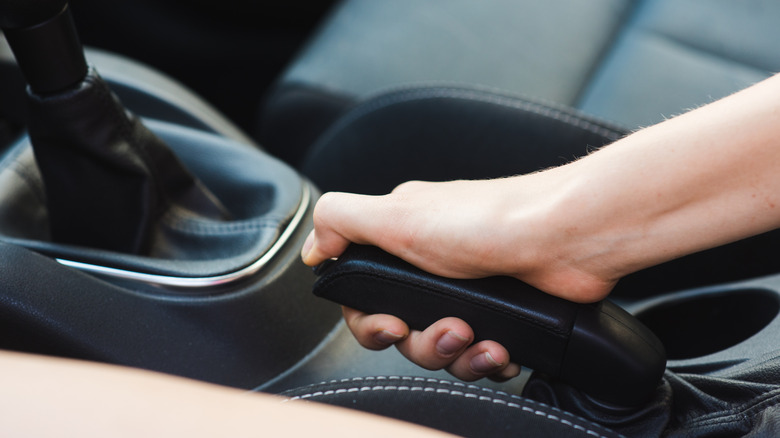
Except for Studebaker's forward-thinking 1936 President, HSA on manual cars didn't go mainstream until decades after the manual transmission itself. If you learned to drive after HSA became standard and want to master the skill yourself, keep in mind that riding the clutch on a hill is one of the worst habits a manual driver can have, and without HSA, that mistake becomes even more punishing. The most common technique for proper manual hill starts is the handbrake trick. It's easiest with an old-school lever, and a bit trickier with a button — people still can't seem to agree on how to best use the parking brake on a hill anyway. Either way, stop on the hill, engage the parking brake, and let the car rest. Once it's time to go, ease the clutch up with a touch of throttle until you notice the engine note shift and the car straining against the brake — that's your cue to release the handbrake/parking brake while rolling onto the throttle.
It takes some practice to get it right: Too much throttle jerks the car forward; too little stalls it. As such, be sure to take your time and try it somewhere safe and with plenty of visibility. If your car has an electronic parking brake, check whether it auto-releases — some do once you're moving off, but plenty still need a manual button press, so know which one you've got before you're on a hill. The other habit worth building is being quick and decisive with the pedal swap — brake to gas, no lingering. The less time you spend hovering and finding the clutch bite point, the less time the car has to start rolling back. It's less a technique than a rhythm, but it's the one that keeps your clutch and handbrake cable happy long-term.