

The 1983 Corvette Is The Rarest Example Of America's Sports Car: Why It Kinda Sucks
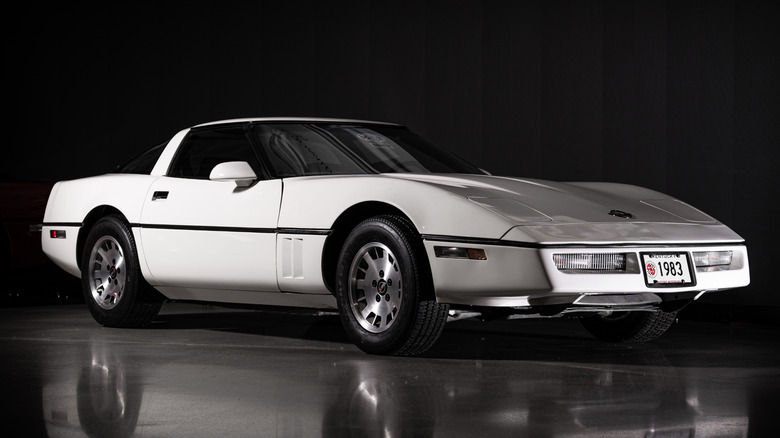
Everyone who knows anything about Corvettes knows Chevrolet skipped the 1983 model year when jumping from the C3 generation, ending in 1982, to the C4 generation kicking off in 1984. Well, sort of. A few dozen 1983 cars were built as prototypes, and one survives today as a permanent fixture of the National Corvette Museum. The C4 Corvette is perhaps my favorite generation of America's iconic sports car, as they're still incredibly cheap to buy and look like nothing else on the road. In my years as an automotive writer and enthusiast, I've had opportunities to drive early C4s and late C3s alike. As the only example of the 1983 model year, and the earliest C4, this one is half-assed and GM should have left it in the oven a little while longer. It kinda sucks.
Like the 1984 model year cars that followed, this 1983 is equipped with the only V8 engine GM ever built that's actually worse than the California-smog-era 305 small block, the terrible Cross-Fire L83 engine, carried over from the 1982 C3-generation cars. With two throttle bodies, unreliable electronic controls, and super-short intake runners to fit under the Corvette's lowslung hood, it made an underwhelming 205 horsepower — when it could stay running. Enthusiasts dubbed the engine "Cease-Fire" as it wasn't exactly a pillar of quality. Add in the terrible four-speed 700R4 transmission and the bland white paint, and you've practically got a recipe for falling asleep at the wheel.
Chevy intended it for release in 1983, but decided to wait a year because of development delays, new emissions standards, and a lack of quality control. Since 1984 Corvettes are already known for a rough ride and creaky, rattly, ill-fitting fiberglass bodywork, I can only imagine how bad a 1983 pre-production prototype car must be to drive.
A piece of history
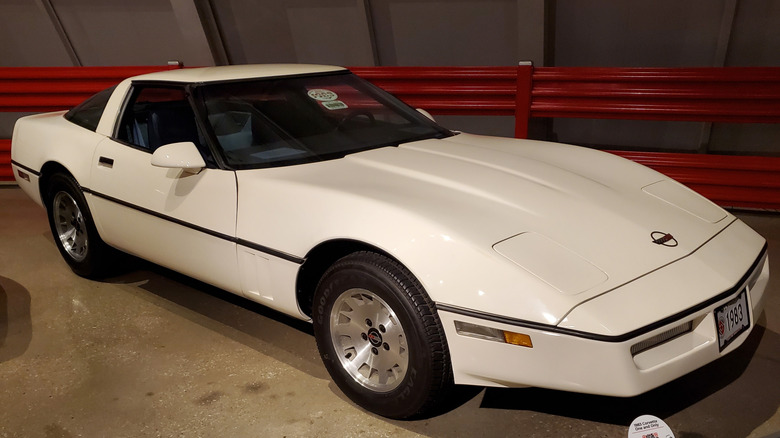
Prototypes are almost always bad to drive, because they're the things engineers use to refine the process. Chevrolet's engineers didn't quite get it right with the 1983 prototype, and the 1984 cars suffered as a result. While they were a dramatic improvement from the aged C3 generation, by today's standards these machines were uncouth and difficult to live with. It's amazing to think about both how far Corvette has come since the early 1980s, and how GM could have easily given up on the project before it actually got good at making a sports car again.
If the drivetrain is wrong, the suspension is too stiff, and the body isn't bolted together tightly enough, it doesn't really matter that the C4 is significantly faster and generated practically unbeatable lateral grip (0.9g on the skid pad) for the time. An unfinished, unreliable car proved the C4 not ready for prime timem, and the engineers rushed to improve on the formula.
As the progenitor of my favorite generation of Corvette, I'm sure glad the lone remaining 1983 car is still around and kicking, but I don't think I would want to drive it. It has been preserved as a piece of history, sitting on a museum floor for the rest of existence. This is something that definitely belongs in a museum. Given the choice, I'd rather drive pretty much any other Corvette.
Don't worry, the C4 got better
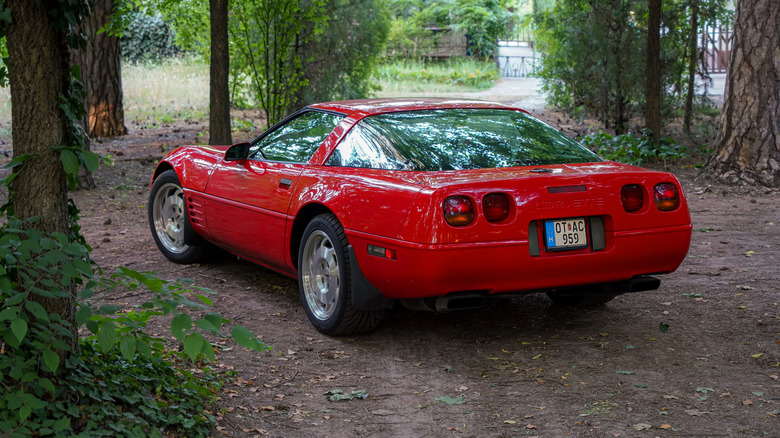
Buyers and test drivers complained, and the engineers took that feedback and kept continually updating the Corvette to make it a better car. After the lackluster 1984 delivery, things started to improve rapidly, with a new engine coming for 1985 and the passable Doug Nash 4+3 manual swapped out for a proper ZF 6-speed in 1989.
The 250-horsepower L98 engine was a big step up from the L83, but the 1992 addition of the 300-horsepower LT1 felt like a quantum leap forward. Corvette had finally fulfilled the prophecy that the 1983 car failed to live up to. By the end of its run, the C4 was a proper world-beating supercar. Factor in the 330-horsepower LT4 to close out its run in 1996, and the ZR-1's iconic 375-horsepower dual-overhead-cam LT5, and it was perhaps the best sports car America had built up to that time. The only thing that could have been better would have been the incredible V12-powered Corvette that Chevy was cooking up to go toe-to-toe with the Dodge Viper.
At the end of the day, the slightly dodgy, mildly crappy 1983 prototype led to one of the most successful American engineering endeavors of all time. I'm willing to forgive its trespasses as the engineering crew behind Bowling Green's best didn't give up on it, and actually worked to help it deliver what was hiding inside all along. Kudos to them — they're the real MVPs here.