

Here's How Much The Average US Household Spends On Gas Yearly (And The Amount They Use)
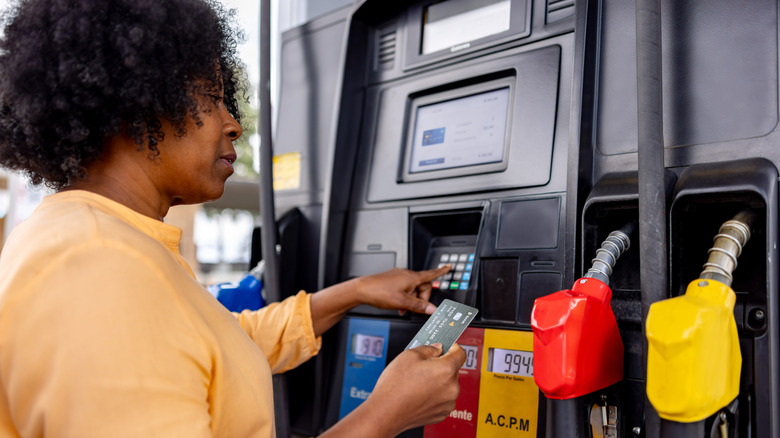
We live in an era of economic uncertainty where gas prices are highly volatile. U.S. gas prices swung from a national average of $3.10 a gallon in 2025, the third straight year that fuel costs had fallen, to $4.09 a gallon as of July 23, 2026, according to AAA, reversing that multi-year trend.
Crude oil is trading near $90 a barrel right now, and AAA connects the increase to the unrest playing out around the Strait of Hormuz. Prices have climbed enough that some drivers are switching to regular gas instead of the premium grade, just to soften the hit at the pump, even though the cars in question are designed to run on premium.
When you look at it through the lens of an average household, those price hikes can become substantial. So, how much does the average U.S. household spend on gas yearly? Per the Bureau of Labor Statistics' Consumer Expenditure Survey, U.S. households averaged $2,411 in gasoline costs across 2024, a $201 monthly line item that worked out to roughly 3.1% of everything a household spent that year.
GasBuddy's 2025 Fuel Price Outlook put the following year's household total at $2,252, though that number was only a projection published in December 2024, months before 2026's geopolitical turmoil actually played out. You also have AAA's 2025 Your Driving Costs study, which assumes a 15,000-mile average travel distance for the study vehicle at 13 cents per mile, or $1,950 annually. Given AAA's standardized 13 cents per mile and $3.15 per gallon (regular gas) figures, the study's assumptions imply the average driver is using about 619 gallons per year.
How gas costs compare to other car expenses
For a household, gas is far from the biggest car expense, but if current projections are anything to go by, prices aren't easing soon. AAA's 2025 Your Driving Costs study tallies what a new vehicle costs a household per year at $11,577, broken into six categories: depreciation, fuel, maintenance, insurance, financing, and registration/taxes.
Depreciation leads by far: a new vehicle sheds $4,334 in value on average for each year of a typical five-year ownership stretch. Insurance ($1,694) and maintenance (about 11 cents per mile, or $1,650) sit just behind fuel (13 cents per mile, or $1,950), rather than far below it. Financing adds $1,131 in interest on top of the loan payment itself, and registration/taxes round out the list at $813.
It is worth noting that the $1,950 fuel figure assumes AAA's $3.15-a-gallon baseline. At July 2026's $4.09 average, the same household is looking at closer to $2,500 a year in gas instead. These costs also hinge heavily on what's actually in the driveway — sticking to the cheapest new cars the market has to offer would naturally keep the picture lower.
Back in 2016, things looked significantly different. AAA's Your Driving Costs study that year found the average owner spent just $8,558, the cheapest ownership had been in six years, thanks largely to cheap gas. A decade later, that total has climbed to $11,577, a 35% increase, with gas now pushing the number up instead of down.
Owning an electric vehicle might be cheaper
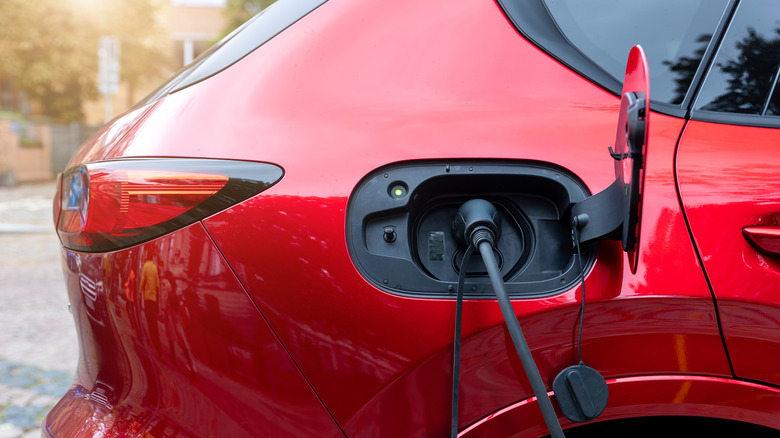
All of this might prompt an American household to consider switching to an electric car to mitigate fuel costs. But does that switch actually offer meaningful savings? Turning back to AAA's 2025 Your Driving Costs study, electric vehicles still cost more overall than comparable gas cars across the classes the study tracked, largely because higher depreciation, insurance, financing, and fees outweigh the fuel savings.
Where the electric vehicle savings are real is on the two costs that actually hit a budget every month: fuel and maintenance. Combine those two line items and an electric medium sedan runs $2,087 a year against $3,455 for the gas version — a gap of roughly $1,368. The pattern holds in every size class: compact SUVs save about $1,272 a year, medium SUVs about $1,473, and pickups about $1,520.
If you are looking to buy used, EVs are now the most affordable used cars, meaning that you can effectively dodge the worst part of owning an EV, which is buying one new. As for the running costs, electricity has moved less than gas prices have. AAA's 2025 16.7-cents-per-kWh baseline has crept up to 18.83 cents as of April 2026, a jump of about 2 cents. On the other hand, gas has climbed nearly a dollar over a similar stretch, from $3.15 to $4.09 a gallon. Both costs went up, but gas rose more than twice as fast in percentage terms.