

5 Things To Know Before Buying A Used Hyundai Genesis Or Equus With A V8
Lately, the spotlight has been thrown firmly onto Genesis' high-performance Magma program, with Genesis' racing efforts and vehicles such as the Magma GT supercar grabbing the headlines. The division is expected to offer the supercar with a mid-mounted twin-turbocharged V8 spitting out more than 600 horsepower, which is quite stupendous.
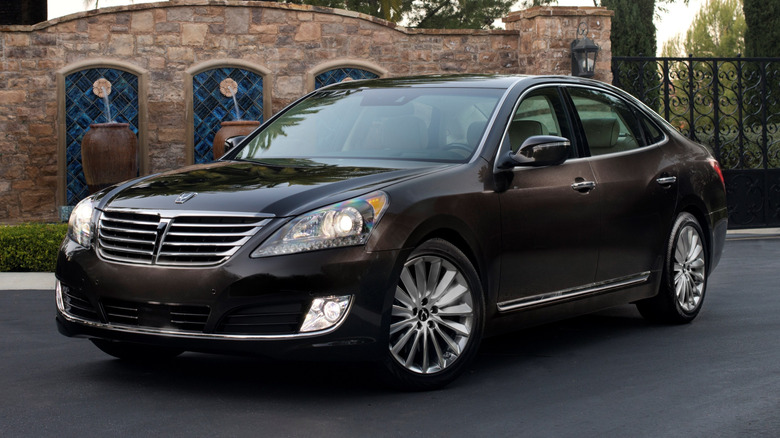
With all the buzz, it's probably also revived your interest in the V8-powered Hyundais from before Genesis spun off into its own standalone luxury car brand in 2015, the Hyundai Equus and its younger sibling, Genesis. Sales of the Hyundai Genesis started during the 2009 model year, with the Equus arriving in U.S. showrooms two years later. Both remained in production through the 2016 model year, before the Hyundai Genesis subsequently became the Genesis G80, with the Equus replaced by the Genesis G90.
If your focus is very much on a powerful and supremely well-appointed full or medium-size luxury sedan that can be had at considerably less money than most rivals, these two doubtless make an awful lot of sense. But there are several things you need to consider before you take the plunge. Both cars were afflicted by potentially serious faults that resulted in recalls, for example. We'll also talk about the reliability, performance figures, and value of the two cars to help paint a clearer picture.
Displacements of 4.6 liters and 5.0 liters were offered
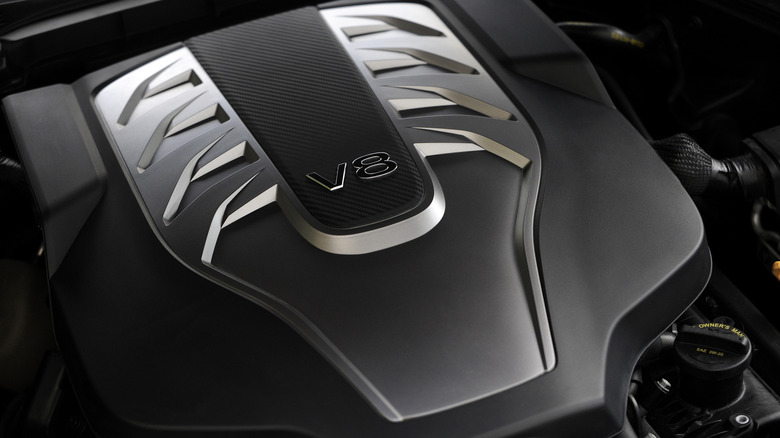
The Hyundai Genesis and Equus used V8 engines from 4.6 liters to 5.0 liters in capacity. At launch, the Hyundai Genesis was available with the 4.6-liter Tau V8, with engine output pegged at 375 horsepower (368 hp with regular gas) and 333 pound-feet of torque. Starting in early 2010, the powertrain was revised, and with that, power output for later 2010 cars and 2011 Genesis 4.6 models was boosted to 385 hp when using premium fuel (378 hp on regular fuel). This raised the 0-to-60 time from a manufacturer-estimated 5.7 seconds in the 375-hp models to 5.3 seconds in variants with the upgraded 385-hp V8.
The same 385-hp, 4.6-liter V8 engine initially powered the Hyundai Equus when it arrived for the 2011 model year, but it was soon replaced by the very slightly larger 429-hp, 5.0-liter direct-injection V8 engine starting in 2012. In the Hyundai Genesis, the previous 4.6-liter V8 wasn't dispensed with immediately and was used as a mid-level engine option, with the new 5.0-liter V8 powering higher-end 2012 Genesis versions like the 5.0 R-Spec. It was dropped for the 2013 model year, however, leaving the larger 5.0 V8 as sole V8 engine choice.
The 2009-to-2011 Hyundai Genesis 4.6 and 2011 Equus models both utilized a ZF six-speed automatic transmission, while 2012-to-2016 versions of the cars were equipped with an eight-speed automatic transmission built in house by Hyundai. Both cars drove their real wheels only. Hyundai's HTRAC all-wheel drive system was available for the Genesis from 2015, but it was only available with the 3.8-liter V6 engine. Also in 2015, the Hyundai Genesis' 5.0-liter V8 was detuned marginally to 420 hp (down from 429 hp).
The Hyundai Equus' reliability is a bit of a mixed bag
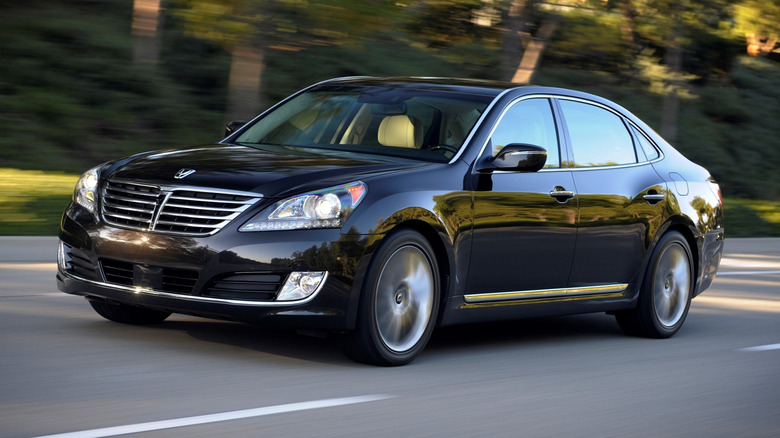
RepairPal has been quite scathing in its assessment of the Equus full-size luxury sedan. Reliability scored poorly, as the Equus could only manage a below-average rating of 2 out of a possible 5. This compares to an average of 2.5 points for the full-size luxury car segment.
RepairPal also found the Equus visits a shop for major unplanned repair work approximately once every year, and there's also a 20% chance that it will require a major repair during that time. Beyond that, owning an Equus is believed to come with a high risk of steep repair bills, with the average model estimated to cost about $976 for maintenance and repairs in one year.
Owners' most common complaints were air suspension struts failure, which typically occurred between 60,000 and 100,000 miles, potentially due to leaking air struts, failed solenoid blocks, and compressor issues. Signs often include a rough ride, loss of suspension pressure and ride height, as well as the vehicle sagging at one or more corners.
Suspension troubles aside, excessive engine oil consumption is another concern that owners have faced. The cause was low-friction piston rings on 2012-to-2013 Equus models, which often led to spark plug fouling and, consequently, misfires.
On the other side of the Equus divide, the luxury sedan appears to be rated well by most owners, and some even say it has never let them down. This claim is backed up by iSeeCars data, which scored the Equus 7.5 out of a possible 10 points for reliability, beating out rivals such as the 2007–to-2013 Mercedes-Benz S-Class and 2010–to-2016 Porsche Panamera (both with 7.4/10).
The Hyundai Genesis recorded good reliability scores across the board
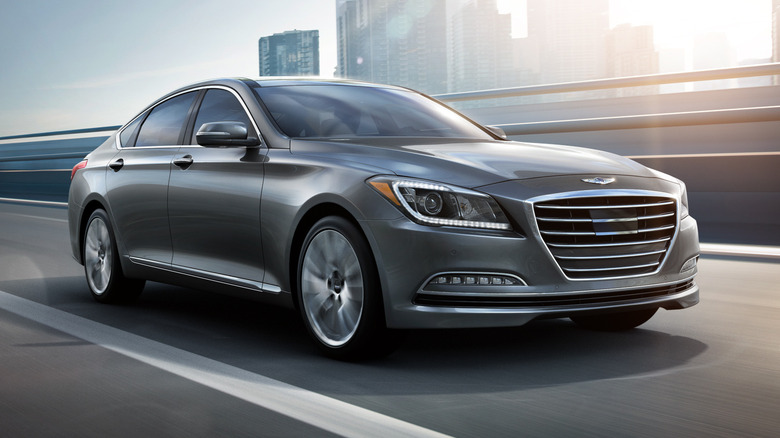
The Hyundai Genesis received a well above average reliability rating from a number of organizations, including RepairPal. It scored 3.5 out of 5.0 stars from the auto repair and maintenance site, finishing an impressive 7th out of 30 cars in its class.
Hyundai Genesis repair is also said to cost $565 on average each year, and there's a 14% probability of a major repair occurring. In iSeeCars' analysis, the 2009-to-2014 Hyundai Genesis earned a strong 8.1 out of 10 for reliability, while the 2011-to-2013 Genesis models scored above average in Consumer Reports' reliability survey (2015-to-2016 Genesis reliability was average). But, like any car, the Hyundai Genesis does have some issues.
The data shows issues are often related to the brakes, transmission, and interior accessories. The Genesis sedan also occasionally suffers from the same abnormally high oil consumption issues that afflicted the Equus. Plus, there have been reports of the car stalling while driving, but they're mostly associated with the 3.8-liter V6, not the V8-powered versions.
The Hyundai Genesis and Equus were subject to multiple recalls
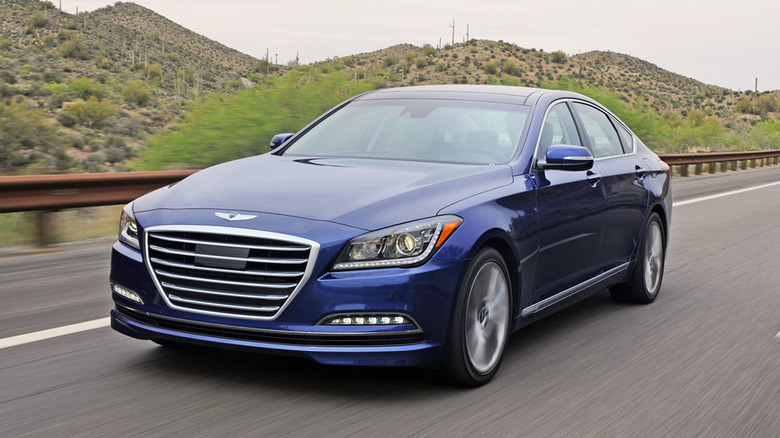
Safety recalls for the Hyundai Genesis were numerous. Six recalls were issued for the 2015 model alone, including one over concerns about the Anti-Lock Brake System (ABS) module and another based on a potential risk of fire in the engine compartment, due to water entering the starter solenoid and causing a short circuit under wet conditions. Another water-related recall notice for the 2015 Genesis states that water may get into the rear combination lamp housing, leading to either the incorrect gear being shown on the instrument panel or delayed engagement when selecting Drive or Reverse. Certain 2009-to-2011 Hyundai Genesis models were also called back three times, due to issues relating to the stop lamp and hydraulic electronic control unit (HECU) corrosion caused by Hyundai's use of brake fluid that lacked corrosion resistance.
As for the Hyundai Equus, some 2011-to-2013 models were recalled due to potential loss of windshield wiper function, with the 2011 model also affected by a stop light-related call back. Recalls were also issued for certain 2014-to-15 Equus models amid fears that their Anti-Lock Brake System (ABS) module could leak brake fluid and cause an electrical short circuit, leading to a fire in the engine compartment while the vehicle is parked or driving.
The Hyundai Genesis and Equus are suffering huge depreciation
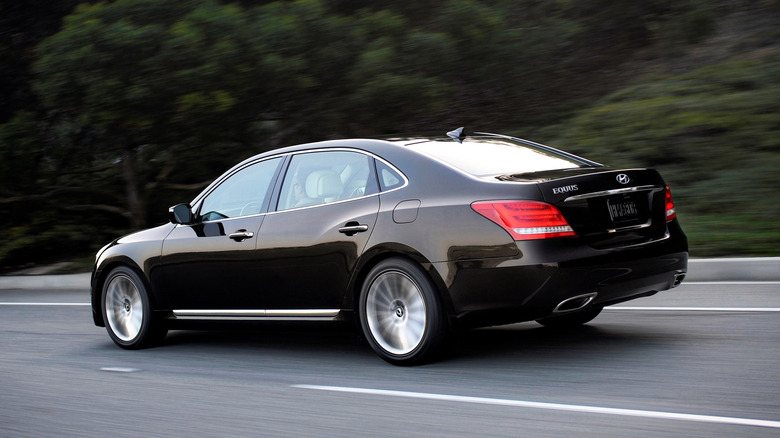
The depreciation curve for cars is such that luxury vehicles are very often the worst hit. The Genesis and Equus appear to be no exception. This means that as a buyer, you stand to benefit from more affordable prices, considering the Hyundai cars have lost a disproportionate amount of their value over the last decade.
Take the 2016 Genesis 5.0. KBB data shows it had an MSRP of $54,800 when it hit the scene as a brand-new luxury sedan. However, the current fair purchase price for a model in typical condition is $15,100, meaning it has depreciated by 72.45%. The 2015 model lost even more of its value, dropping by 76.07%. Meanwhile, opting for a Hyundai Genesis with the 4.6-liter V8 can slash as much as 90% from the original price, with the 2011 Genesis 4.6 experiencing the most significant value drop, from an original MSRP of $43,800 to a current fair purchase price of $4,500, on average.
As for the Equus, the 2016 model dropped between 83.07 and 83.99% of its original value. Signature Equus trims are said to be worth $10,000 (down from $62,450), while the Ultimate trims average $11,800 (from $69,700 new). Versions with the 4.6-liter V8 also took big hits, with the 2011 Equus Signature shedding $53,200 from its original MSRP of $58,900, equating to roughly a 90.33% drop, with its fair purchase price currently sitting at $5,700.