

The Quickest Trucks Are Now EVs, But The Fastest Trucks Are Still Gas (And Old)
The thing about the law of unintended consequences is that those consequences are often pretty bad. For example, when the government rolled out its Corporate Average Fuel Economy (CAFE) regulations in 1975 to push automakers to build more efficient cars, one of the key strategies the companies employed to achieve that was to make the cars lighter — which often made them both slower and less safe at the same time.
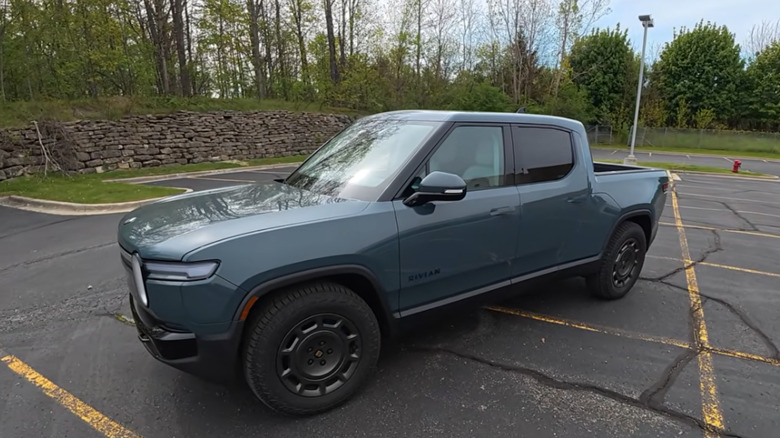
The new interest in EVs, however, gives us at least one unintended consequence that gearheads can get excited about: On the way to their improved efficiency over gas cars, EVs have rewritten the rules for acceleration. That's how we got to the point where the 7,148-lb full-size Rivian R1T electric pickup is quicker to 60 mph than a wide variety of lean, mean supercars. Needless to say, this also means the Rivian — and many of its electric-truck rivals — are quicker than their gas-powered counterparts. But when it comes to top speeds, the differences in how gas and electric powertrains work still give the absolute records to trucks that drink gas.
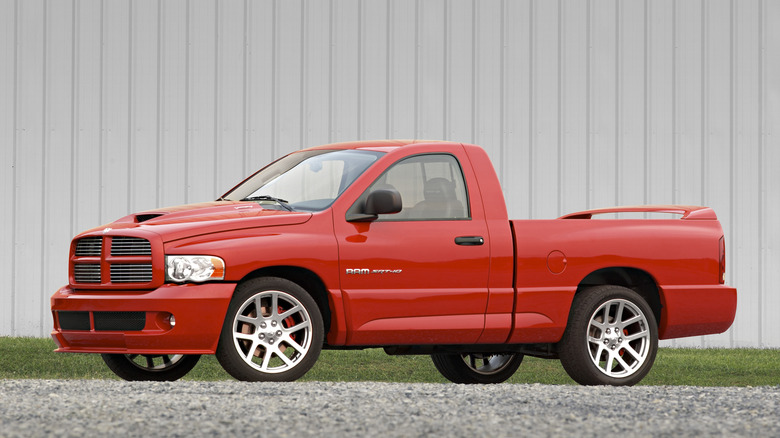
Of course, there is a catch: It's not the current crop of gasoline-fed pickups that includes the fastest examples. In fact, at approximately 130 mph, the quad-motor Rivian R1T and Tesla Cybertruck tie for the highest top speeds among today's trucks. Instead, to find the fastest production trucks in terms of top speeds, you have to go back to the beginning of the 21st century. These include models like the Ford F-150 SVT Lightning with a top speed of 142 mph and the incredible Dodge Ram SRT-10 that can reach 154 mph. Here's why these trucks are so much faster, but not quicker.
Why are EV trucks quicker than gas ones but not faster?
The big differences in how gasoline engines and electric motors work also explain the big differences in their performance profiles. For one thing, it takes more time for a gas engine to develop torque than it does for an electric motor. After pressing the gas pedal, the engine throttle bodies open, fuel is injected, and the combustion process begins. After that, additional fractions of a second pass before the engine speeds up, and that power travels through the crankshaft and transmission before it finally reaches the driving wheels. Even more time passes until the engine actually reaches its peak power band. Those fractions of a second add up. For an electric motor, though, the path between the battery and the wheels is much shorter. The electricity also travels through the system to the motor significantly faster than the time it takes for internal combustion power to get from the engine to the wheels.
Where gasoline engines have an advantage is in maximum velocity. The core difference here is that combustion-engined vehicles usually have multi-speed transmissions, and EVs don't. Without getting too deep into the details, a transmission changes the ratios between how fast the crankshaft spins and how fast the wheels turn, allowing a gas engine to keep a car cruising at highway speeds at relatively low rpm. In a single-gear EV, the only way to reach and maintain highway speeds is by keeping the motor turning at ever higher rpm — leading to notable drawbacks like reduced range and overheating at high speeds. Because of that, and the fact that EV tires differ from regular tires, many EV makers intentionally limit top speeds.
Why don't modern trucks go faster?
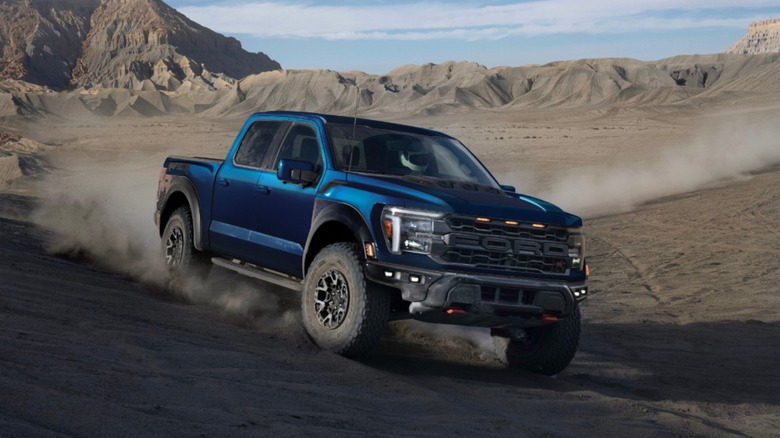
The current record-holder for fastest bona fide production pickup truck, the Dodge Ram SRT-10, is motivated by the same 8.3-liter V10 that featured in the Dodge Viper – meaning the truck also has the record for the largest-displacement engine in a production pickup. It's a powerplant that's good for 500 horsepower and 525 pound-feet of torque, with output handled by a six-speed manual transmission. Those are no doubt some impressive specs, but they don't really compare to a modern Ford F-150 Raptor R. The Blue Oval's boss pickup packs 720 hp and 640 lb-ft of torque from a supercharged 5.2-liter V8. Moreover, when you put the Raptor R on the scales, it checks in with a curb weight of 5,993 pounds, resulting in a power-to-weight ratio of about 1 hp per 8.3 lbs — significantly better than 1 hp per 10.3 lbs for the Dodge.
Yet even with more power pushing less weight, the Raptor R is well behind the dynamic Dodge in terms of top speed, at just 114 mph. What gives? Well, the Raptor R is literally limited to that maximum velocity with a factory-installed speed governor. Buyers of the most powerful pickups at the turn of the century seemed to have been more interested in street/track performance than off-road chops, too. Today, the opposite holds true: Hi-po trucks nowadays are expected to dominate in the dirt with huge off-road tires, lifted ride heights, and heavy-duty suspensions, none of which will help them set records for absolute maximum speed. On the other hand, the chances of a Ram SRT-10 or an SVT Lightning keeping up with the Raptor on the trail are practically nil.