

8 Factory 4-Door Convertibles That Range From Stately To Quirky
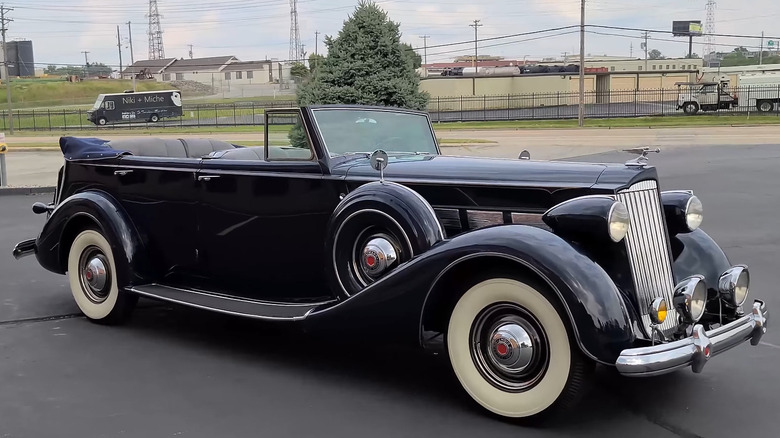
Especially in recent years, the convertible car has been defined by having only two doors — it's a phenomenon so widespread that we can't really think of any modern convertibles with four doors. However, toward the start and middle of the 1900s, a great many cars came stock with four doors and an open-top driving experience. We should mention that since this was an era of coachbuilding, cars with the same model name could look very different in the hands of different companies.
For a car to make our list, it had to be an official four-door open-top model that didn't go through a coachbuilding process, or one where a significant number of buyers opted to coachbuild their vehicle as a convertible. The roof could be made of canvas, or be a removable hard top of any sort, with manual or automatic closing.
Many of the cars on our list also were offered with the same bones (chassis and engine configurations) but different body styles — at the time, it was common for manufacturers to offer several body styles to capture a broader market. Where there are distinctions (such as if an engine was tied to a particular body style for example), we'll be sure to point that out — though it's rare.
Lincoln Continental, fourth generation
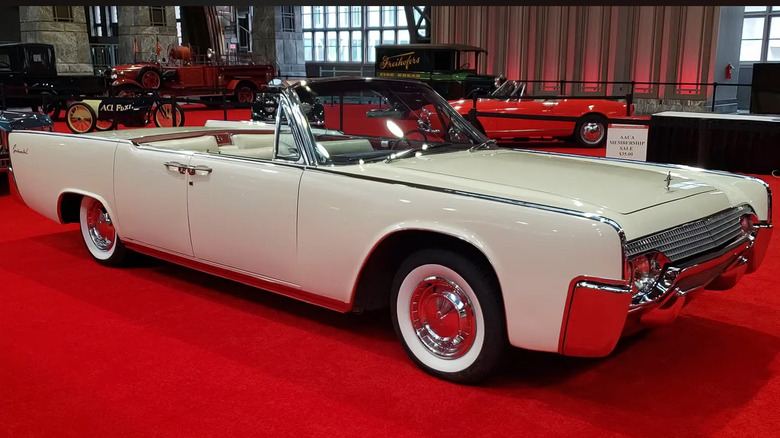
First up, we have the Lincoln Continental, a nameplate associated with opulence and luxury since it was first launched. A standout design choice on this generation of Continentals was the use of "coach doors" — which meant that the rear doors would open from hinges mounted to the back of the vehicle instead of from the traditional front-hinged doors. This much-loved generation of the Continental was in production for almost the entirety of the 1960s, being introduced in 1961, and phased out in 1969, when it was replaced by the more recognizable 1970s generation.
A lesser-known bit of Lincoln Continental history is that the 1961 model started life as a Ford Thunderbird, then was scooped up by Lincoln to turn into a flagship luxury cruiser. Convertibles had an air of class, and that body style is perhaps best remembered for being the vehicle of choice of President John F. Kennedy, though several other celebrities and household names, including Elvis Presley and President Lyndon B. Johnson, owned one, too.
The pre-1966 models got a 430-cubic-inch V8 motor making 300 horsepower (bumped to 320 in '63), as well as Ford's legendary 462 ci V8 that churned out 340 hp, available starting in 1966. When new, a 1961 Lincoln Continental would have set buyers back the handsome sum of $6,069, equivalent to about $68,000 today when adjusted for inflation.
Packard Super Eight and Super Twelve
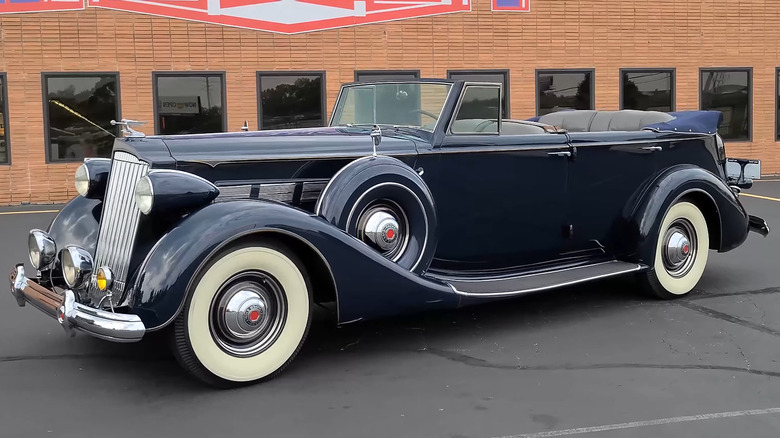
Packard was once famous, but has faded into obscurity. Perhaps that shouldn't surprise anyone, given that the company went out of business seven decades ago, shutting shop in 1956 after a series of poor financial decisions — most prominently buying Studebaker — and competition from the "Big Three" automakers put unmanageable pressure on it. However, Packard made several beautiful models that looked more like art pieces than cars, with the Super Eight and Super Twelve among them.
The Super Twelve was Packard's top-of-the-line offering, with a V12 engine reintroduced after a nine-year hiatus in 1932, and made 175 horsepower to the Super Eight's 150 hp. Packard changed the name to Packard Twelve in 1933 and discontinued the V12 altogether in 1939, replacing the Twelve with the "One-Eighty" trim on the new Packard Super Eight. Since the One-Eighty was replacing a flagship car, it had all the trappings you'd expect of a luxury early 1900s automaker, such as power windows and optional air conditioning.
For those who didn't need quite that much opulence, you had the slightly toned-down Packard Super Eight One-60. The One-60 and One-80 shared the same iconic L-head straight-8 engine that displaced 356 ci, making 160 hp. Along with other body styles, both trims of the Super Eight were available as convertibles.
Cadillac Series 75 and V-16 Convertible Sedan
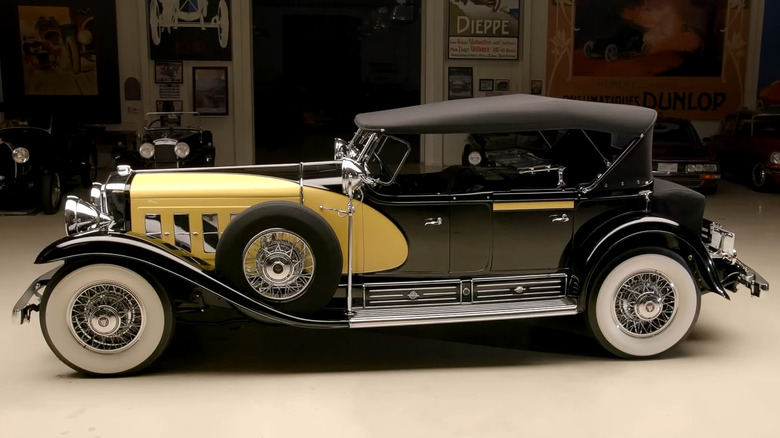
Around the time the Packard Twelve was being sold, Cadillac brought in two amazing models that defined the excess automakers of the time were running with. The Series 75, which ran from 1936 to 1987, was the top-range eight-cylinder model Cadillac offered at the time. However, we call it the flagship eight-cylinder, not the brand's overall flagship, because that honor went to the Cadillac V-16.
As the name gives away, the cream of the Caddy crop in the 1930s was powered by a 452 ci (7.4-liter) V16 engine that's often, though incorrectly, said to have been the largest in the world at the time — though it would dwarf most engines on the market even today. In terms of power output, however, that V16 engine wasn't as high as one might think, putting out about 165 horsepower and 320 pound-feet of torque.
When compared to the 346 ci (5.7-liter) V8 engine making 135 hp in the Series 75, the horsepower-per-liter figures aren't actually all that different, coming in at 22.3 hp/l and 23.7 hp/l for the V16 and Series 75 cars, respectively. Both were available as four-door convertibles, though hard-top versions turn a lot more heads in our opinion.
Duesenberg Model J
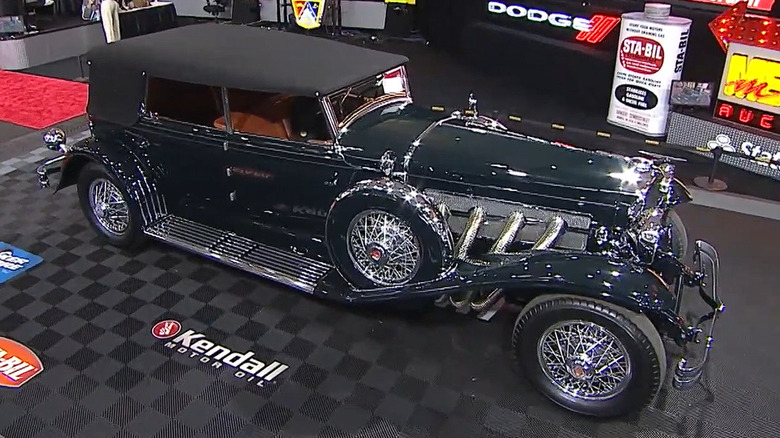
The car enthusiasts are probably most familiar with on our list is the Duesenberg Model J. When the car was introduced, marques like Rolls-Royce, Bentley, and Hispano-Suiza were stealing the show in Europe, and Duesenberg, no doubt, wanted a piece of that action. So brothers Frederick and August Duesenberg introduced their creation at the 1928 New York Salon motor show, and the rest, as they say, is history.
The Model J was naturally aspirated, though forced induction was added later to a variant known as the Duesenberg Model SJ. The naturally aspirated Model J cranked out 250 hp, while the supercharged Model SJ bumped that figure by 75 hp, producing an eye-watering 325 (later 400) hp. They shared the same engine, a 420 ci (6.9-liter) straight-8 featuring innovative technologies for the time, such as dual overhead camshafts, which wouldn't become mainstream until much later.
The Model J, and its adoption by Hollywood stars including Mae West and Clark Gable, breathed new life into the slang term "It's a doozy" — short for Duesenberg. The car was ridiculously expensive, with the chassis and engine combo alone costing $8,500 in 1928 — equivalent to about $166,500 in 2026 money. Perhaps that's why only about 481 Model Js were ever commissioned.
Chrysler Imperial
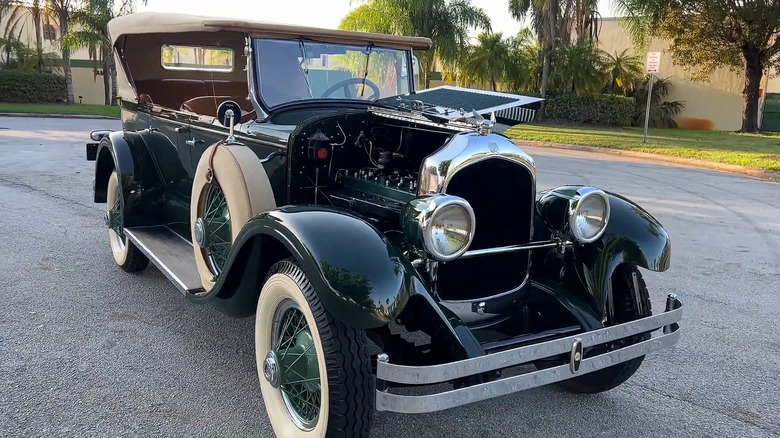
Another mainstay of Americana vehicles is the Chrysler Imperial — and Chrysler is also a brand with a massive fall-off. While Chrysler was responsible for a lot of innovation in the past, today only two family-hauling minivans are on offer. However, once upon a time, Chrysler made the Imperial — and no name would have suited the model better. With a hood that appeared to be half the length of the car, black running boards that flowed into the front fenders as a single unit, and a tall, imposing chrome front grill that matched the equally vertical windshield, this was indeed a car royalty would have no problem being seen in.
Among the body styles on offer was a four-door convertible with a fabric soft-top, which RM Sotheby's says was "the most popular of all open Imperials" — at least in the 1930s. The Imperial ran from 1926 to 1954 under Chrysler's name, sharing styling that was popular with luxury limousines of the time, with a haunched stance and acres of hood in front of the driver.
The early Imperial was a coachbuilt vehicle, since Chrysler only provided the chassis mated to the engine to the wealthy buyer of the time. This would change later, and Chrysler would even turn Imperial into a separate subsidiary brand in 1955.
Buick Roadmaster Convertible Phaeton
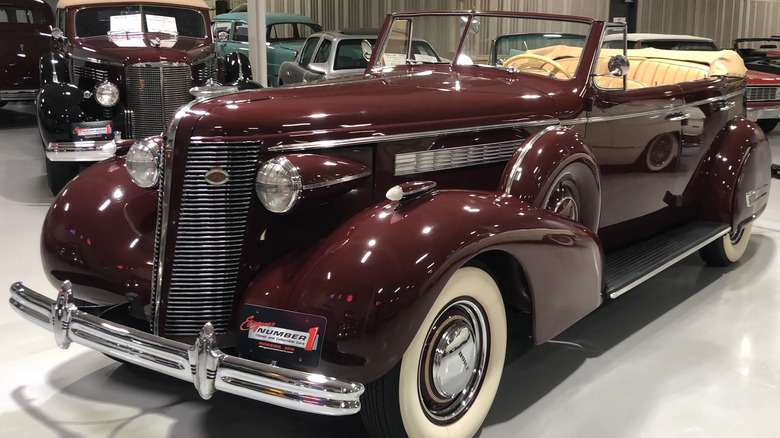
A "phaeton" initially was an open-top, usually horse-drawn carriage. In the automotive context, it was a car that evoked the same shape and design as these open-air carriages of old. So the Buick Roadmaster Convertible Phaeton was a car in the phaeton design, and in the convertible body style. The Roadmaster was introduced in 1936, and remained in production until 1996, when it was discontinued.
Until 1938, the Roadmaster featured a fairly traditional front radiator grille, chromed with horizontal slats — common on cars from this era. 1939, however, brought a number of changes to the model, chief of which aesthetically was the inclusion of what was called the "waterfall" grille, which you see in the photo above. Additionally, as with many GM models today — Buick is one of the brands owned by General Motors — the gear level was irritatingly mounted on the steering column.
From that 1939 model year, the engine of choice in the Roadmaster would have been a 320 ci (5.2-liter) inline-8 that made somewhere around 141 hp. Those 1939 models of the Roadmaster 80 series — that was the official name — retailed for a $1,983 base suggested price, equivalent to about $48,000 in 2026.
Ford De Luxe
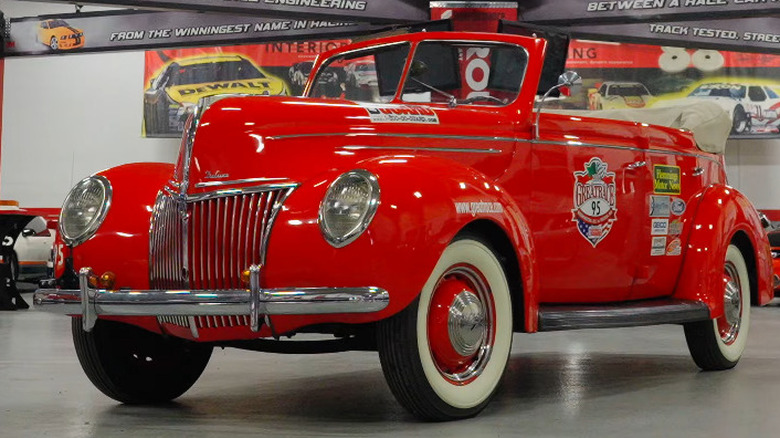
As the name Ford De Luxe might evoke, this was the Blue Oval's take on a luxury car for the buyer who could afford it. Eagle-eyed buyers will also notice that the late 1939-onward models of the De Luxe look similar to the Ford C-model half-ton pickup truck, especially regarding the front fascia. We can't say for sure whether there was any part (or chassis) sharing here, but a quick analysis of the two side by side paints a picture that some cross-population might have happened.
Convertible versions of the Ford De Luxe sedan didn't go on sale immediately with the model's 1932 release; the open-air variants only were sold from about 1935 onward. Just like the Packard models we looked at above, the 1930s De Luxe shipped with an L-head 221 ci (3.6-liter) V8 engine making 85 hp, though by 1948 — when the car was discontinued — a 239 ci (3.9-liter) V8 engine also was on offer. From 1941 to the model line's discontinuation in 1948, the De Luxe was a trim level.
Kaiser-Frazer Frazer Manhattan
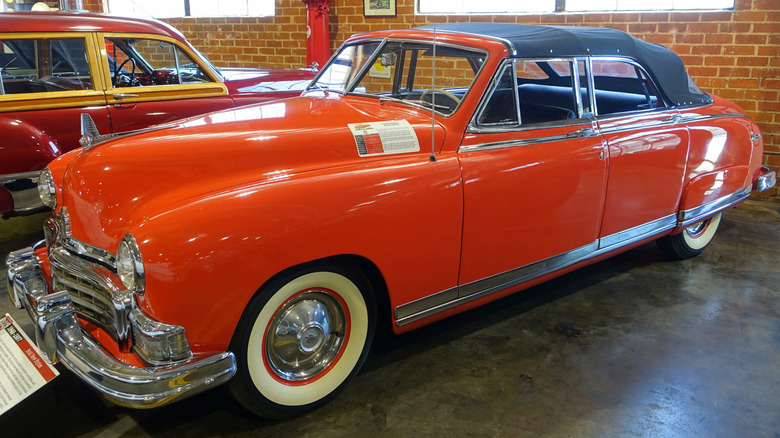
Perhaps the most obscure car on our list is this one, the Frazer Manhattan convertible, likely known only by extremely entrenched petrolheads. That's because it's quite rare, with estimates pegging their production at only about 70.
When in production in the late 1940s and early 1950s, the lucky owners who could afford the magnificent Manhattan had two choices — you either got the car as a four-door convertible, or as a four-door sedan, end of story. Power came from a 226 ci (3.7 liter) flat-6 engine that produced all of 110 hp, meaning the power output trailed the market, even for the 1950s. The engine came paired to a three-speed manual transmission, with or without an optional Borg-Warner overdrive.
Frazer had a sister brand named Kaiser, and the duo could be likened to Ford and Lincoln's relationship — with Kaiser being Ford in that simile. The Frazer Manhattan was discontinued in 1951, though some Kaiser models stayed on the market a bit longer.