

What Are The Differences Between Pre-Eagle And Eagle Hemi Engines?
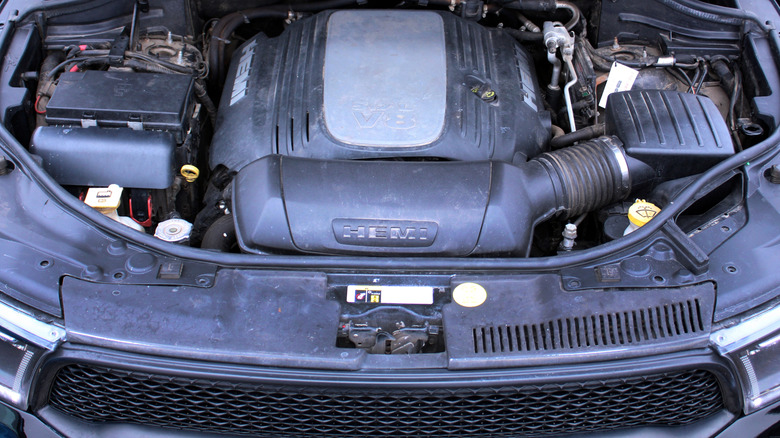
For anyone unfamiliar with Mopar history, there was a period of three decades when the legendary Hemi engine wasn't produced. It sounds crazy, especially considering the canon behind its original home in the history of Chrysler FirePower all the way up until 1971. But between 1971 and 2003, the manufacturer built no production vehicles with this hemispherical combustion chamber design that makes for potent power output.
But luckily, it was brought back into service in the early 2000s. The third-gen 5.7-liter Hemi debuted in early 2003 model year Ram trucks, it sported a wide range of technology to ensure its relevancy in the new millennium. Then, it received some big changes in 2009, leading to what is commonly referred to as the Eagle Hemi.
What are the differences between the pre-Eagle and Eagle Hemi engines? It mostly comes down to the addition of variable valve timing and better-flowing exhaust ports, but let's dig a bit deeper.
Eagle equals progress
The original gen-three 5.7-liter Hemi engine sports no variable valve timing (VVT), its compression ratio is 9.6:1, its cylinder heads' exhaust ports are square-shaped, and they flow around 270 cubic feet per minute (CFM) of air. Horsepower is rated at around 330 to 350 horsepower and 370 to 390 pound-feet of torque, depending on application.
The Eagle has VVT, a 10.5:1 compression ratio, the exhaust ports are D-shaped for smoother flow, and the heads flow around 330 CFM. Additionally, the engine features enhanced valve springs and a sturdier crankshaft. Depending on the application, the engine can produce between 360 and 395 hp and 394 to 410 pound-feet of torque.
Because of the addition of VVT on the Eagle, Chrysler had to make a lot of revisions, including to the block's oil passages, the front camshaft journal, and crank trigger, as well as some differences between the heads. Due to this, there aren't many interchangeable parts between them.
Pre-Eagle and Eagle reliability fixes
It's widely known within the modern Hemi community that pre-Eagles have issues dropping valve seats, which happens due to a difference in thermal expansion between the aluminum heads and the steel valve seats. Enthusiasts report that there are several fixes out there, such as installing updated, tighter seats and installing a lower 180-degree thermostat (stock is 203 degrees).
Eagles can experience lifter (or, tappet) issues known as the "Hemi Tick" among enthusiasts. The tick is caused by a failed roller bearing — as they have a roller tappet cam instead of flat tappet cam — that ends up damaging the lobes and leads to misfires. Common practice for avoiding this is to religiously change the oil every 5,000 miles or six months with high-quality full-synthetic oil, and make sure to screw on a quality OEM filter. Then, installing a Hellcat oil pump raises oil pressure, ensuring the lifters are properly bathed in oil. Finally, if the camshaft and lifters do need to be replaced, stick with OEM Mopar units.
The difference between pre-Eagle and Eagle Hemi engines mainly has to do with improved flow and VVT on the latter, leading to more power. However, each has their own known flaws that are important to be aware of if you're in the market for one.