

The Top Speed Average Tires Can Handle May Not Be As High As You Think
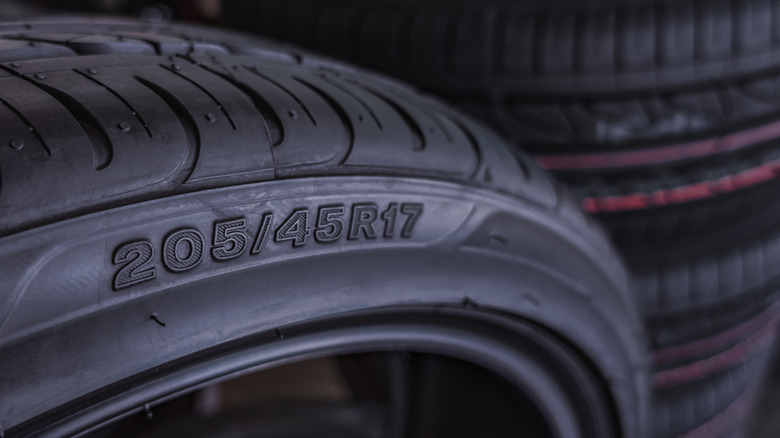
Tires have gone a long way since Michelin patented and relentlessly improved upon the radial tire design. Modern tires come with symmetrical, directional, or asymmetrical tread patterns, and the segment continues expanding with all-weather tires that can better cope with snow and slush than a standard set of all-season tires. Tires also have load indexes and speed ratings. The former is the maximum weight a tire can support under load, while the speed rating is the maximum speed the tire can handle (under load) without deforming, failing, or exploding.
Using the wrong tire with a different size, aspect ratio, load index, and speed rating than prescribed can be detrimental to vehicle handling, acceleration, braking, ride comfort, and overall safety. The general rule is to always stick with the recommended load index and to choose replacement tires that meet or exceed the manufacturer's specifications for tire speed ratings.
With that in mind, aren't you wondering why upgrading to a tire with a higher speed rating is somewhat acceptable while downgrading to a lower speed rating should generally be avoided? It's all in the name of safety, since the top speed an average tire can handle is not as high as you previously thought.
Tires of the same size can have different speed ratings

Vigilance is necessary when buying new tires since they can come in the same size but have different speed ratings. For instance, the Goodyear Assurance Finesse (215/55/R17) all-season tire has an H (130 mph) speed rating. On the other hand, the Goodyear Assurance Maxlife is a similar all-season tire for passenger cars but has a V (149 mph) speed rating for the same 215/55/R17 spec. Take note, both tires are rated at a maximum load of 1477 lbs. (or 94 load rating) despite having different speed ratings.
The point is to double-check before buying new tires to ensure the new rubber matches the manufacturer's recommendations while conforming to the vehicle's performance attributes. The speed rating is not just about outright speed. BFGoodrich said that tires with higher speed ratings can deliver more traction and stronger braking, but the downside is faster wear. Conversely, a lower speed rating could mean less grip, but the benefits are higher comfort and longer wear
Where to find the speed rating of a tire
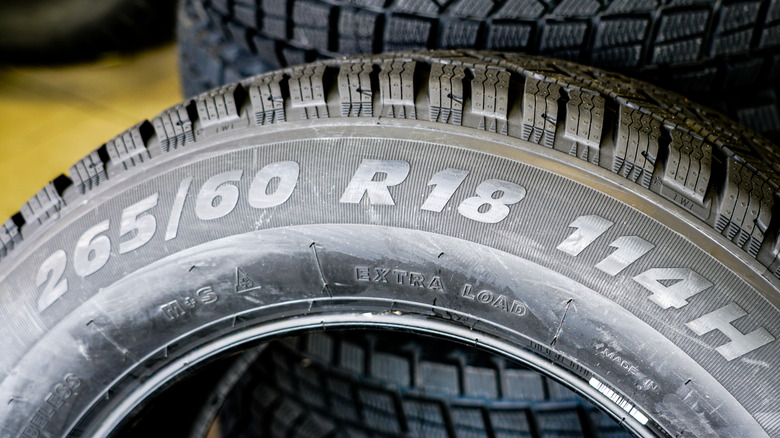
Notice that the load index and speed rating are typically mentioned in the same breath? It's because their ratings are consistently next to each other on the tire's sidewall. You can also find the recommended speed rating in the owner's manual or on a placard on the driver's door jamb.
The speed rating is one of the many numbers on a tire's sidewall. For example, a P215/55/R17 99W tire means it's a passenger car tire with a 215mm width, a 55 aspect ratio (or height of the tire sidewall; in this case, 55% of the tire's width), and it's a radial tire for a 17-inch rim.
The final markers, 99 and W, are the load index and the speed rating, respectively. The equivalent of 99 in the load index chart is 1709 lbs. Multiply that by four, and the maximum weight that the tires can support is 6836 lbs. Then we get to the W speed rating, which is 168 mph (270 kph) in the speed rating chart.
When America adopted the lettering system for tire speed ratings in the early 70's, tires generally came in S (112 mph), T (118 mph), and H (130 mph). Now, high-performance tires can have V (149 mph), Z (149+ mph), W (168 mph), and Y (186 mph) speed ratings. As a side note, tires with a ZR (215/55ZR17 93W, for instance) marking have a maximum speed of over 149 mph. In this case, the maximum speed is W or 168 mph.