

After Nearly 50 Years In The Depths Of Space, Voyager 1 Still Sends Messages That Take 23 Hours To Reach Earth
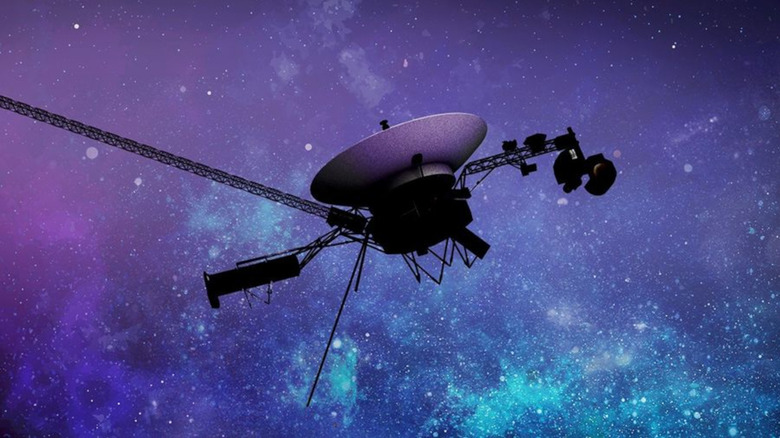
It traverses the ocean of stars that lies beyond our solar system, both the oldest spacecraft still in operation and the farthest object ever made by human hands. Launched before the parents of some of the team who still work on it were born, it continues to gather lessons about our cosmic home long after it was expected to die. Systems failing, nuclear battery draining, it presses forward on its long march through the long dark, the very edge of humanity's grasp. It holds what may very well be our world's first communication with another. But for now, the only species it talks to is our own, still trapped on our pale blue dot.
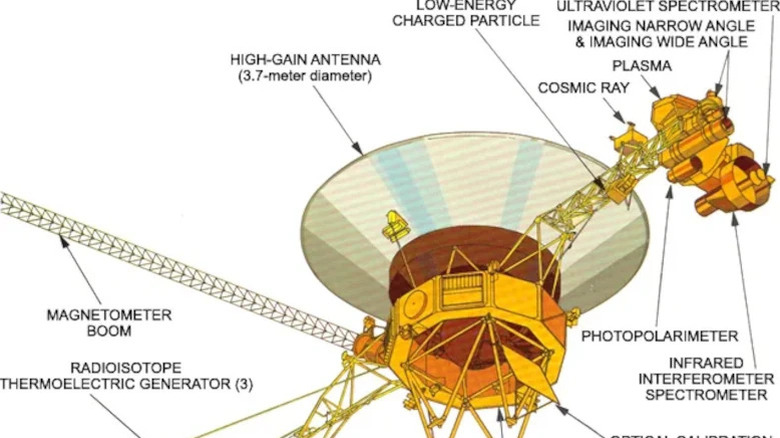
NASA's Voyager 1 probe lifted off from planet Earth in 1977 and never returned. A twin with the Voyager 2 probe that also left that year, its mission was straightforward: fly past Jupiter and Saturn and collect data using a range of scientific instruments. These included an ultraviolet spectrometer, a magnetometer, and an imaging science subsystem, among many others. In 1979, it discovered a new ring and two new moons around Jupiter; in 1980, it discovered a new ring and five new moons around Saturn. And then the mission was accomplished, human knowledge was advanced, and the probe's job was done. There was nothing left for it to do.
But this is NASA. Finding ways to use what it has in space for purposes never intended is its specialty. Voyager 1 still had a future as the greatest explorer in history.
A second chance, for greater things
In 1989, both Voyager probes were granted a new lease on life by NASA's Jet Propulsion Laboratory, which operated them both (and still does today). With the planets of this solar system now behind them, they turned their sensors to what was before them: the edge of the heliosphere, the Sun's cosmic "turf" where its magnetic field and solar particles are the dominant force. Using what instruments remained to it, Voyager 1 studied a "wall of fire" that got as high as 90,000 degrees Fahrenheit. It was the first object ever to get there and send the information back to Earth, because in 1998, it overtook the earlier Pioneer 10 probe. Ever since, it is Voyager 1 that has been our first ambassador to the outer depths. In 2012, it passed through the heliosphere altogether and entered interstellar space, where its mission continues to this day.
However, in its age and mileage, it is also growing ever weaker. It is powered by three radioisotope thermoelectric generators (RTGs), essentially small plutonium pellets that generate heat within a container; the heat differential with the outside causes electricity to flow. At launch, this system produced 470 watts in total. But the decay of the plutonium reduces this output year over year, forcing JPL to shut down one precious scientific instrument after another just to keep the others powered up.
Today, Voyager 1 produces just 230 watts, just enough to power its magnetometer and plasma wave subsystem. But JPL has a bold plan to extend its life even further as it travels ever farther, trying to keep Voyager working past its 50th birthday next year.
Keep warm in the cold, my friend
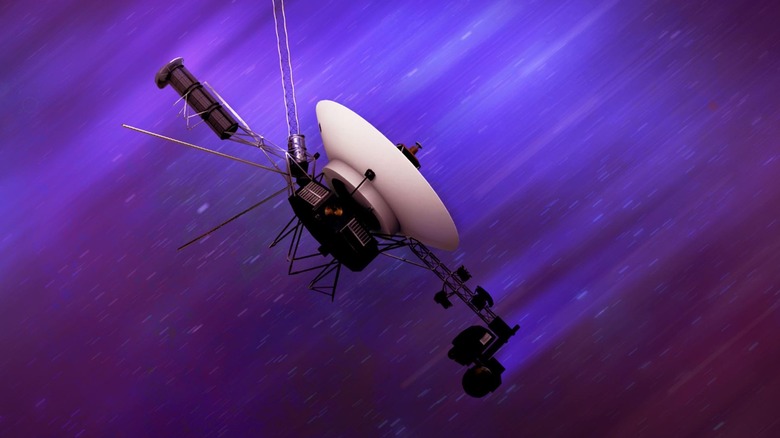
There's more at stake than just the power drain of the scientific instruments. Its thruster lines are both clogged and in danger of freezing; without thrusters, Voyager 1 can't turn its antenna around to face Earth, and we would lose contact with it forever. Certain systems on the spacecraft are kept powered just to heat those lines, but by doing so, that puts even more strain on the dying RTGs.
Always seeking solutions, JPL believes that it may have one. Dubbed the "Big Bang," the Southern California space center will attempt to switch off the devices currently heating the lines and switch on several others, all at once. If it works, the thrusters will stay warm at a savings of 10 watts. That will ensure that the probe and its twin Voyager 2 have enough power to last until the 2030s, which must have seemed like an impossible date back in 1977. And it will enable the spacecrafts to keep sending messages home, even if they take an entire day to get there.
Messages home, and messages beyond
At the time of writing, Voyager 1 is 15.85 billion miles from the pale blue dot it once so famously photographed, advancing out from it at a rate of 88,000 miles per hour. From that distance, a radio communication takes a full 23 hours to reach the team at JPL. These are only trickles of information, delivered at 160 bits per second; that must have seemed fast in 1977, but today would be considered old-school dial-up internet. Of course, the same is true in the other direction. So if JPL wants a status update from Voyager 1, it will have to wait nearly two days to hear the answer.
Nearly, but not exactly. That milestone ought to happen in November, when Voyager 1 will reach precisely one light-day from planet Earth. This is the distance that light travels in a day, and since radio is just light at a different frequency, it's also the point at which talking to home has a one-day lag.
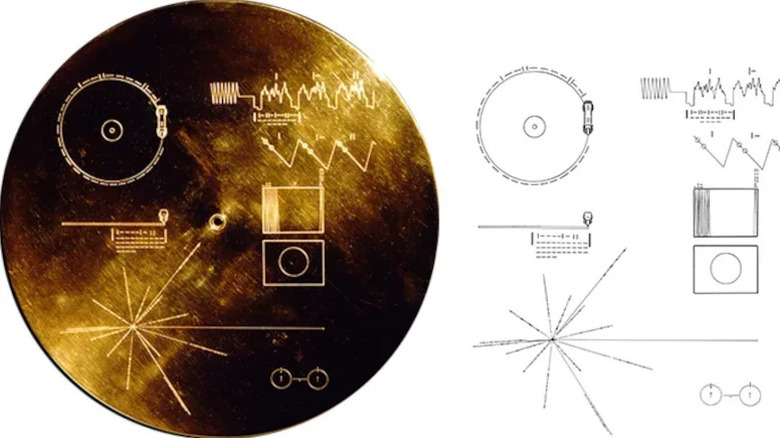
For all JPL's engineering prowess, the day will eventually come when Voyager 1 stops signaling to us at all. It's duty as a messenger, however, will continue on into time and space, as it harbors mankind's greetings to any other cosmic travelers it may encounter. Contained on the famous golden record, we have placed basic information about our species, our civilization, and our planet in pictographic expressions based on math and science. On the record itself are greetings in 55 languages, alongside sounds of nature. There are also direct greetings from U.S. President Jimmy Carter and UN Secretary General Kurt Waldheim.
Once we lose contact with Voyager 1, we may never know if it makes contact on our behalf with someone else. Even crippled, even without power, even without applause from the beings who first made it, Voyager 1 may yet make itself the Earth's finest achievement. Indeed, perhaps it already has.