

Bonneville Speed Week Is Where Some Of The Weirdest And Rarest Records Are Set
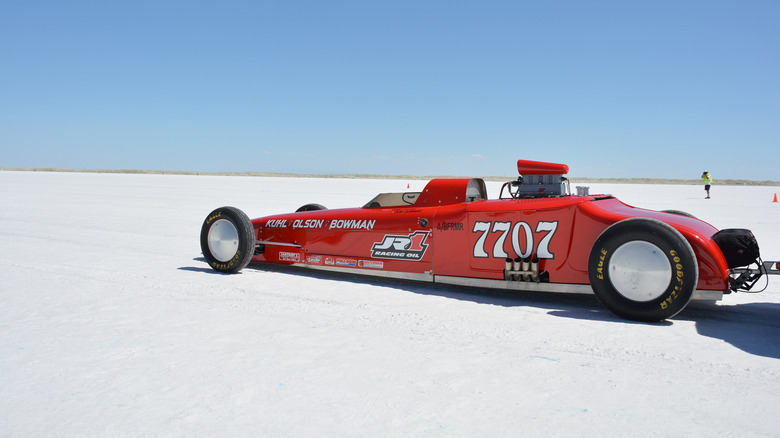
Every August, 30,000 acres of dried salt in Northwestern Utah transforms into the fastest stretch of flat ground on the planet. The Bonneville Salt Flats – remnants of an ancient inland lake — offer a natural surface so hard, flat, and consistent that vehicles have been using it to chase speed records since 1914. Bonneville Speed Week itself has run annually since 1948, and this year's will run from August 1st through the 7th.
The records set here range from the expected – streamliners chasing 400 mph — to the genuinely strange: belly tanks built from WWII aircraft drop tanks, an Indian Challenger that broke a 58-year-old land speed record, and a 20-year-old AA/BFALT record that stood untouched until 2024. Bonneville is where those gaps get filled.
Speed Week is organized by the Bonneville Nationals Inc. and runs across six days of racing, weather permitting. The categories are broader than most people expect — streamliners, roadsters, belly tankers, lakesters, competition coupe/sedan, vintage models, and more compete under the same Utah sun, each chasing records within their specific classes.
Spectators aren't kept at a distance. Rather, the pits are open to foot traffic, and anyone who makes the trip can walk up to the vehicles, talk to drivers, and view machinery that exists nowhere else in the world. The salt flats sit about 88 miles west of Salt Lake City off I-80, near Wendover.
The remarkable records
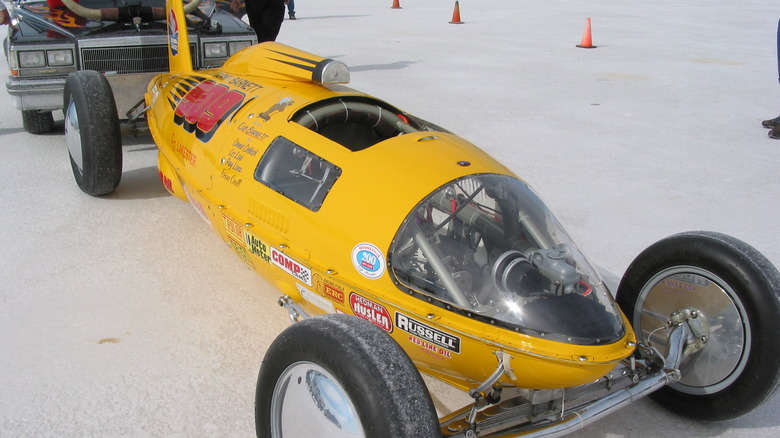
The records set here are some of the most granular in motorsport. There isn't one overall land speed record — records are carved up by vehicle class, engine type, displacement, fuel source, and body style, which is exactly how you end up with something like a standing world record for the fastest AA Fuel Streamliner, or the world's fastest tractor, alongside records for belly tankers and motorcycles.
The belly tank lakester is one of Bonneville's most iconic and historic vehicle types. Named for the auxiliary fuel tanks carried under the wings of WWII aircraft, belly tank lakesters are essentially cigar-shaped shells on four exposed wheels. One of the most famous examples is the So-Cal Speed Shop Lakester, built in the late 1940s from surplus P-38 Lightning drop tanks. It set a handful of records using three different Ford Flathead V8 engines – swapped between runs – including a best speed of 198.340 mph in 1952.
At the other end of the spectrum, Laura Klock set the world's fastest bagger record on a Harley-Davidson Road Glide in 2007. On the electric side, EV West pushed the 2/E class record to 229.363 mph at Speed Week 2020 in its first year on the salt. The team used a Tesla-powered lakester with a removable battery pack swapped out between runs on a custom gantry. At 2024's Speed Week, 108 records were set during the course of the event. Those records include Anita Strasburg setting the fastest lakester speed ever recorded by a woman in a wheel-driven car at 376.239 mph, as well as Jeffrey Ferguson breaking an AA/BFALT record that had stood untouched since 1991.
What to expect this August
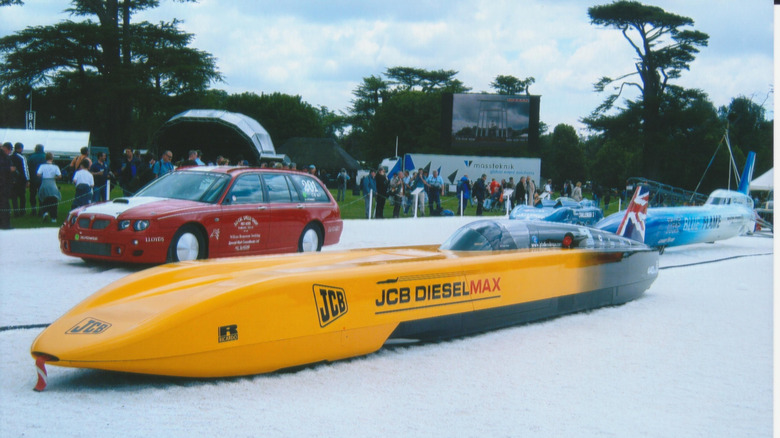
Starting as early a 6:30 a.m. on August 2nd, and going until 8:00 p.m., drivers and their machines will be lined up to push the limits of speed on the salt flats of rural Utah. But this year, spectators will be looking out for a unique top speed attempt.
JCB, the British construction equipment manufacturer that set the diesel land speed record in 2006 at 350 mph, is returning to Bonneville with something new. The 32-foot-long JCB Hydromax carries two production-based hydrogen internal combustion engines delivering a combined 1,600 horsepower, powering all four wheels through a twin-transmission and clutch system. The formerly retired Andy Green — the first person to break the sound barrier on land, at 763 mph in 1997 — will drive the Hydromax, as he drove the Dieselmax nearly two decades ago.
JCB's target is over 350 mph. The current world land speed record for a hydrogen internal combustion set by BMW in 2004 sits at 187.52 mph. That makes the gap between where the record is and where JCB aims to put it one of the more dramatic potential jumps in the event's history.